











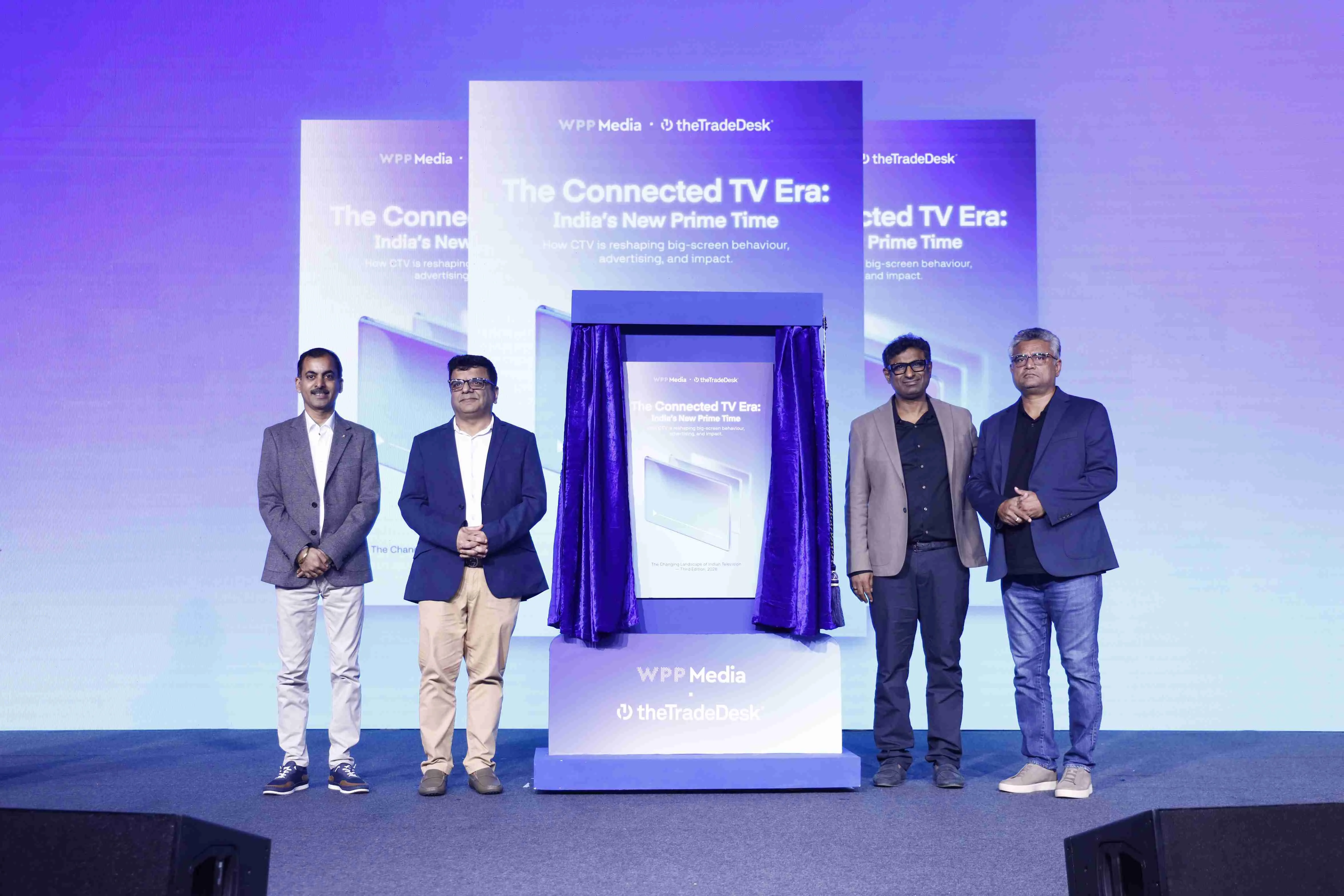
Mumbai: India's Connected TV audience has grown threefold since 2022 to 207 million viewers across 62 to 65 million households, according to a new study on how advertisers need to plan for television going forward. The findings come from The Connected TV Era, a report from WPP Media and The Trade Desk, with research conducted by Ormax Media. The study draws on more than 3,000 verified urban CTV users and over 12,000 CTV and OTT viewers, offering one of the more comprehensive views of big-screen viewing behaviour in India to date.
Growth Beyond the Metros
The report's clearest finding is that CTV growth is no longer concentrated in India's largest cities. Rural CTV viewership grew 110% year-on-year to more than 70 million viewers, with small towns growing 55% and mini-metros 46%, against just 21% growth in metros. Non-metro India now accounts for the majority of the CTV audience, and the report argues the next 100 million CTV viewers are unlikely to come primarily from cities.
Access is increasingly happening through the television itself rather than external devices: 82% of CTV users stream through apps built directly into their smart TVs, with OEMs including Samsung, LG, Xiaomi, Sony and TCL named as key players. The report frames the smart-TV operating system as an increasingly important, ownable advertising surface in its own right.
A Shared, Not Solo, Screen
One CTV impression now reaches an average of 2.5 people, with more than 80% of viewing happening alongside family or friends and only 19% of viewers typically watching alone. The report says this shared-viewing pattern changes how advertisers should be assessing reach, frequency and household-level impact, since impression-based calculations built for personal screens can understate what CTV actually delivers. Average household size across CTV homes is 3.3 people.
Attention That Converts
Across all CTV viewers surveyed, 83% said they seek more information after seeing an ad, rising to 89% among premium viewers, a signal the report reads as CTV converting attention into action rather than passive viewing. That premium audience, defined as the top 15% of urban CTV viewers by spending propensity, numbers around 21 million and over-indexes on financial products, travel, home furnishings, paid memberships, lounge access, fitness and credit card ownership, making it a particularly valuable segment for advertisers.
Gen Z Hasn't Left the Big Screen
The report pushes back on the assumption that younger audiences have moved away from television. Gen Z viewers, typically consuming content across two screens, spend close to 3.1 hours a day on CTV, watching everything from web series to sports and films. The report describes CTV as a lean-back environment where viewers stay deeply engaged, positioning it as a potential foundation for an omnichannel strategy, building attention on the largest screen first before reinforcing messaging elsewhere in the consumer journey.
"India's television market has reached an inflection point. The audience is not leaving the big screen, but the way it watches is changing. CTV is bringing together younger viewers, shared household attention and audiences moving beyond linear television. Media plans now need to reflect that reality."
Rajiv Rajagopal, Senior Vice President, Head – Advanced TV, Media Solutions, WPP Media
Tejinder Gill, Vice President, Business Development, India and South East Asia at The Trade Desk, said the next phase of CTV will not simply be won by shifting television budgets from one screen to another, but by using data to reach the right households, manage frequency and understand whether attention on the big screen actually led to a business outcome. He described that shift as the planning reset advertisers now need to make.
What Advertisers Are Being Told to Do
The report's planning recommendation centres on using addressable CTV to identify households that linear television misses, managing exposure across connected devices, and linking big-screen advertising to measurable outcomes such as brand lift, online engagement, store visits and retail sales. More than half of CTV homes, 54%, are either cord-cutters or light-linear viewers, groups the report calls increasingly important for incremental reach precisely because they are difficult or impossible to reach through linear TV alone.
Taken together, the report's core argument is that CTV should be planned as a distinct medium in its own right, not as an extension of linear television or online video, with the next phase expected to move toward AI-led formats, interactivity, shoppable CTV, household identity graphs and unified cross-screen measurement.


