











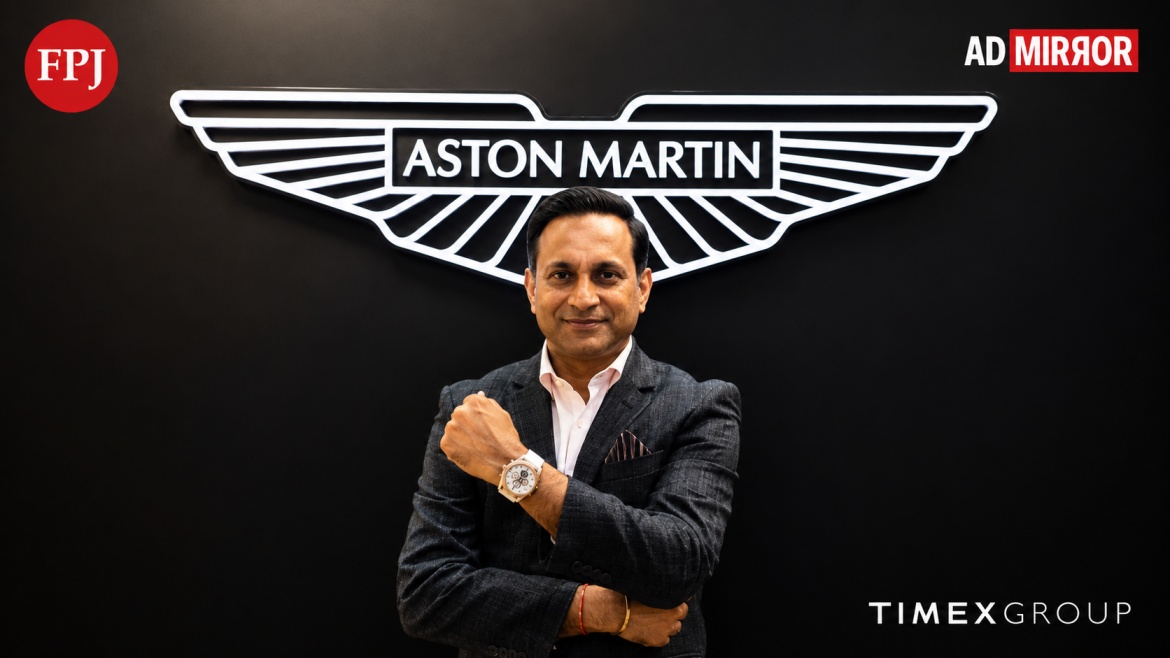
Mumbai: Over the past decade, Deepak Chhabra has built a reputation for reviving and scaling consumer brands. After growing Crocs India from a $20 million business to nearly $80 million and steering Tupperware India through a challenging phase, he took over as Managing Director of Timex Group India in 2022 with a clear mandate: reinvent one of the world's oldest watch brands for a new generation of consumers.
It has worked. Timex Group India has grown from ₹266 crore to over ₹800 crore in revenue, expanded its portfolio across owned and licensed brands, strengthened its manufacturing footprint, accelerated premiumisation and emerged as one of India's fastest-growing watch companies.
In this conversation with AdMirror, Ashad Hussain speaks with Deepak Chhabra, Managing Director, Timex Group India, about the company's transformation journey, the rise of premium watches, Gen Z consumers, manufacturing ambitions, quick commerce, competition with Titan, and why calculated risk-taking has become central to Timex's next phase of growth.
Edited Excerpts
Timex Group India crossed ₹800 crore in revenue in FY26, nearly 3X growth in four years. What fundamentally changed?
Three things. We expanded our brand portfolio, moving from talking about Timex the brand to Timex the group, which today manages about 15 brands. We overhauled our channel mix. Today we are across quick commerce, dot-coms, marketplaces, departmental stores, exclusive retail, and traditional trade. And we changed our communication strategy entirely to target where youth actually consumes.
But the bigger shift was on positioning. We tried to sell cheaper than Titan. We are a global brand with better products. So we stretched the brand upward, raised prices above inflation every year, and invested in premiumisation. The market absorbed it. Revenue grew at 35% CAGR over four years. Costs grew at 7%. That gap explains most of what happened.
In the combined Timex-Titan market, you have gone from 7% share four years ago to 23% today. How?
We are at about 90% of Titan's distribution, 6,000 points of sale versus their 7,000. We have a larger brand portfolio than them. Their licensed portfolio is limited to two brands. We have six major licensed brands and fifteen overall. Our online strength is significantly higher than theirs.
What we lacked was exclusive retail. They have 1,300 stores, we had 55, and we are fixing that by targeting 150 to 200 exclusive franchise stores in the next two years. Titan's Tata Trust is a genuine advantage, especially in jewellery, and one we cannot easily replicate. But in watches, the gap is closing fast.
Titan and Fastrack have built formidable positions in India's watch market. In a category where product, pricing and distribution often overlap, what differentiates Timex?
Nobody knows watchmaking like us. We are the biggest watchmakers in the world in terms of number of units, with about 2 billion sold. The technology, craftsmanship, design, and innovation we understand, nobody else does. We are also a global brand operating across 150 countries, which means we understand trends way faster than any single-country brand. And because of our global sourcing might, we are more efficient on supply chain. None of these three advantages are with the competition.
What the competition has is the Tata Trust, which is really big, especially in jewellery. But in watches, distribution, brand portfolio, and online strength are our edge. And the numbers prove it. If you take the combined business between both companies as 100, we were at 7% share four years back. Now we are at 23%. We are gaining share fast, and for all these reasons.
EBITDA margins went from 9.2% to 14.5% in one year. Q4 was 17.4%. What drove that?
Four factors. One: my headcount today is similar to what it was four years ago. Fixed costs as a proportion of a much larger revenue base go down. Two: manufacturing is running at near 100% utilisation, which generates supply chain efficiencies. Three: we worked on channel mix, shifting toward channels that deliver better margins. Four: pricing. We raised prices above inflation every year and improved gross margins consistently.
But if you want one number, it is this. Revenue grew at 35% CAGR, costs at 7%. That is the entire story. We believe 15 to 16% EBITDA is sustainable. We are not chasing the bottom line. Our market share is still 23 versus 77. We want the top line first.
Timex manufactures watches for Louis Philippe, Van Heusen, Peter England, Woodland, and Levi's. That business is barely reported. How large is it, and why doesn't the company talk about it?
It contributes about 14% of revenue, roughly ₹120 crore on an ₹800 crore base. We manufacture more than a million watches a year for these brands. We do not talk about it because strategically it is not the business we are building. Tomorrow one of them decides to stop making watches, and that revenue disappears. I cannot control that.
But it is operationally critical. It keeps our supply chain running at optimal utilisation. It absorbs fixed costs without requiring marketing investment or additional headcount. It goes directly to the bottom line and makes our margins work. We just do not lead with it.
The Aston Martin collection launched in November and sold out by January. What does that tell you about the Indian luxury watch buyer?
It tells you the Indian consumer is ready. They just need the right product and the right story. Aston Martin gave us both. More than 100 years of heritage in car making, plus Formula One, which now has 70 million paying followers in India. We aligned the product assortment to both: a Formula One line priced from ₹12,000 to ₹20,000, and a Lagonda heritage line from ₹20,000 to ₹60,000.
We made it democratic without making it cheap. That balance, exclusivity at an accessible price, is what the Indian premium buyer responds to. The sell-out validated it.
"When you take risk, you will fail. But you have to fail fast. Move on, try something else. Just fail fast."
Deepak Chhabra, Managing Director, Timex Group India
Licensed brands went from 4% to 25-28% of revenue in four years. Guess grew 51% last year. What changed?
We built separate teams. Previously, the same salesperson was selling a ₹5,000 Timex and a ₹1,00,000 Versace. You cannot do justice to both. We separated the licensed portfolio into fashion and luxury verticals, built dedicated product, sales, and go-to-market functions for each. We also started influencing our global product teams to develop India-specific variants, what we call SMUs or specially manufactured units, because preferences here like rose gold and gold plating do not mirror global trends.
And we got into premium retail chains. Helios, our competitor, also sells our brands. If you are in every relevant watch retail point in the country, the licensed portfolio builds itself.
Guess grew 51% last year and is now the second-leading non-luxury fashion watch brand in India. Can it eventually become as significant as Timex itself?
The answer is no. Timex will always be way bigger, and the reason is demographic. Guess sells at an average price point of about ₹13,000 to ₹14,000. As you cross ₹10,000, the consumer funnel becomes very small. There are about 400 million people in India who can afford less than ₹10,000. Once you cross ₹10,000, that drops to about 120 to 125 million. Once you cross a lakh, it is only 5 million.
Any watch brand priced above ₹10,000 will always have less absolute growth potential than one priced below it. Growth as a percentage could be higher in Guess, but the absolute business will always be way bigger for a sub-₹10,000 brand. That is not a Guess problem. That is just the demographic reality of the Indian market.
Timex is 175 years old. How do you make it relevant to a consumer who thinks it belongs to their grandfather?
That is candidly the one perception we are actively working to change. The Gen Z consumer looks at Timex and thinks, this is a great brand, but probably not for me. My dad has it, my granddad has it. So all our initiatives in the last four, five years have been towards youngifying the brand, while not losing the existing consumer base.
On the product side, we invested in Helix, a youth brand designed to be more affordable than Timex with everything Gen Z needs. We use Helix as the entry point and graduate buyers to Timex over time. We also have TMX for the absolute first-time purchaser who has never owned a watch. On the channel side, we are where Gen Z shops: quick commerce, dot-coms, marketplaces, not just traditional multi-brand retail. And on content, we are getting into collabs this generation connects with, Superman, Peanuts, Harry Potter.
You are targeting 150 to 200 exclusive franchise stores in two years, up from 55 today. What is the expansion strategy and which regions are the priority?
North is our biggest market, followed by West, South, and East. East is generally smaller for everyone, and so it is for us. But the gap between regions is shrinking. We are going franchise, FOFO or Franchisee Owned Franchisee Operated, because we are a brand, not a retailer. 200 company-owned stores would mean 1,200 to 1,500 employees working on operations rather than on product and brand building. The franchise route gets us to scale without that distraction.
We call the rollout strategy carpet bombing. We pick 10 cities, open a high density of stores in each, and then move to the next 10. Rather than two stores across 50 cities, which splits your marketing budget thin and builds no visibility, we concentrate. We will restrict exclusive store expansion to the top 50 cities. Not beyond.
Timex is expanding manufacturing capacity from 6 million to 10 million units, with infrastructure ready for 15 million. How serious is the India export ambition?
We are already exporting about 200,000 watches. Eight months ago, when US tariffs on China were first announced, we began resourcing production in India as a China-plus-one strategy. We stopped when clarity on India's own tariff treatment became uncertain. But the plan is in place. The moment tariff structures settle, India becomes a meaningful export base for Timex globally.
The physical infrastructure for 15 million units is built. Assembly lines are only commissioned for 10 million. That headroom is deliberate. If exports move, we can scale quickly. The honest limitation is efficiency. India today can be about 90% as efficient as China. China has entire towns built around a single category, down to the packaging. India is getting there, but it is not there yet. It is China and India, not China or India.
"We want to make what we sell in India, in India. And we want to export from India."
Deepak Chhabra, Managing Director, Timex Group India
Quick commerce currently contributes 4% of your business. You expect that to double to 8% in 12 months. Why?
Because quick commerce is not cannibalising slow commerce. It is opening an entirely new use case, last-minute gifting. Watches were never part of that occasion. Nobody called a courier the night before a birthday for a watch. Now they do. We were the first watch brand on Swiggy Instamart, about one and a half years ago. Today we are across all six major quick commerce platforms.
Father's Day and Raksha Bandhan were amazing peaks on quick commerce. These are panic purchases. If the watch was not available there, they would have bought something else. That is incremental business. At 4% today and dark stores opening every week, 8% in 12 months is a conservative estimate.
E-commerce grew 90% during the year. How is digital reshaping the way watches are discovered and bought?
Omnichannel for us does not mean you order somewhere and pick up somewhere else. It means you discover us somewhere, you engage with us somewhere else, and you transact somewhere else entirely. Online covers our distribution gaps too. In a country with 5,000 towns, you cannot be physically present everywhere. Any consumer anywhere in the country should be able to find us. That alone drives a significant share of online business, particularly for licensed brands like Guess, which cannot be in every tier-2, tier-3 town offline.
But the more interesting insight is price sensitivity by channel. Online business in watches goes down as price goes up. Versace contributes 5% of its sales online. Timex contributes 35% online. At higher price points, people want to touch, try, and feel on their wrist before buying. That is why exclusive retail still matters, and why online and offline are not competitors. They serve different consumers at different price points.
You joined Timex after leading transformations at Crocs and Tupperware. What leadership lessons from those journeys have shaped the way you are building Timex today?
Both those brands had very different challenges, but both were de-growing when I came in. At Crocs, the brand was amazing but they did not know how to distribute. It was known more for kids and men, women adoption was very low. So we made it relevant for the whole family and set up distribution. We took it from a $20 million business to $80 million in three years.
Tupperware was becoming extinct. Plastics was a no-no, and the direct selling model was completely outdated. Coming to Timex, the challenge was similar in one respect: almost 100% of the business was dependent on third party distribution. We diversified the channels. And then on positioning, for the longest time we tried to sell cheaper than the competition. Where we are a global brand with better products. So we stretched the brand upward, built new franchises, and started participating in the premiumisation journey India is on. These two shifts, more than anything else, are what drove the turnaround.
This interview appears in print in partnership with Free Press Journal. To read the print copy, click here for Epaper


