











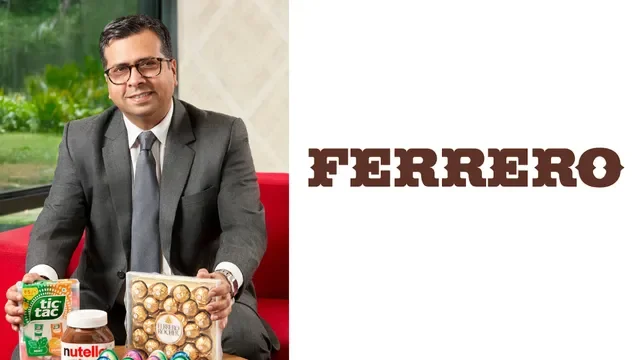
Mumbai: Ferrero India is entering its next phase of growth with an ambition to move into double-digit market share over the next three to five years, driven by premiumisation, portfolio expansion and deeper consumer engagement. For Zoher Kapuswala, Marketing Head, Ferrero India Subcontinent, the opportunity is not simply about taking share from established chocolate players, but about expanding the premium end of a still under-penetrated category.
In this conversation with AdMirror.com Kapuswala outlines Ferrero Rocher’s evolution beyond traditional gifting to the growing role of Nutella and Kinder, and how Ferrero is looking to build more frequent consumption, expand its reach beyond metros and use quick commerce as a powerful conversion channel. He also discusses why India is emerging as a global manufacturing hub for Ferrero, the company’s double-digit market-share ambition and why Bangladesh currently stands out as the most promising growth market in South Asia.
You have spent many years building premium brands in India. What is the one thing about the Indian consumer behavior that still surprises you?
What surprises me most about Indian consumers? They don’t always do what they say. The gap between stated intent and actual behaviour is where real insight often lies.
Recently, we conducted an “Empathy Day” where the entire marketing team went out and spent time with consumers, speaking to them for an hour to an hour and a half. We then gave them a shopping mission and, based on what they had told us, we also went out and shopped. What we found was a clear delta between what consumers said and what they bought.
It reinforced a fundamental lesson for us: research can tell you a lot, but you can't take it entirely at face value. You need to complement quantitative data with continuous consumer immersion to observe behaviour, understand context and decode the insight behind the numbers.
At Ferrero, that is something we consciously build into the way we work. Because the Indian consumer will keep surprising you and often, the most valuable insight lies in the gap between what they say and what they do.
Ferrero is comparatively a smaller player in the Indian market though you have been here from 2004. What is your market share ambition over the next 3 to 5 years and where will that growth come from?
Ferrero as a company has been in India since 2004, while Ferrero Rocher was launched in 2010. Our ambition is to move into double-digit market share in India over the next three to five years. That is a clear milestone for us, rather than simply an aspiration to grow ahead of the market.
We see the opportunity coming from two clear engines. The first is continued growth of our existing portfolio, and the second is innovation. But innovation will not come at the expense of the core. We want to grow the core while using innovation to bring incremental consumers, occasions and consumption into the category.
So, the strategy is straightforward: strengthen the brands we already have, expand their relevance and reach, and use innovation to create additional growth. Ultimately, we want to build a broader, stronger Ferrero portfolio in India one that can materially change our position in the market over the next three to five years.
Are you primarily urban based and what are your plans to touch tier 2, tier 3, 4 markets?
We are not an urban-only business. Our portfolio spans ₹5 to ₹239 and beyond, giving us the ability to reach consumers across Tier 1, Tier 2, Tier 3 and smaller urban markets. We have ₹5 and ₹20 Tic Tac, ₹25 Kinder Creamy, ₹50 Kinder Joy and Kinder Choco-Bons, while Nutella starts at ₹239. That breadth gives us a strong platform to expand our footprint beyond the metros.
Ferrero Rocher, however, is a different proposition. As a premium brand, our focus will be on metros, Tier 1 and Tier 2 markets, with selective expansion into Tier 3. At the same time, e-commerce and quick commerce are allowing us to overcome some of the traditional barriers to physical distribution. We are present on platforms such as Amazon, Flipkart and the leading quick-commerce platforms, giving consumers across urban India access to the brand.
Physical availability remains important, particularly for products that require temperature-controlled storage. We are therefore investing progressively in coolers and building that infrastructure across the market. This is relevant not just for Ferrero Rocher but also for Raffaello and other products in our portfolio.
So, our approach is not about taking every brand everywhere. It is about matching the right brand, price point and distribution model to the right consumer and market.
What is the market you are targeting for this product, which is a bar introduced for the first time today because it is priced at a premium?
Our consumer is the “global Indian” curious, upwardly mobile and experience-seeking. While our demographic focus is NCCS A, particularly Millennials and Gen Z, what really defines this consumer is their mindset: they are willing to experiment, discover new things and pay for experiences that feel distinctive.
This generation is moving beyond simply buying brands to seeking brands that offer a story, a feeling and an experience. Whether it is travel, discovering new geographies or trying new products, they are increasingly looking for experiences that feel more personal, elevated and worth sharing.
That reflects a broader evolution in consumption from commodities to branded commodities, then to brands with emotional storytelling, and now to brands that deliver an experience in their own right.
That is where Ferrero Rocher Bars fit in. The proposition is not simply about selling chocolate at a higher price; it is about giving consumers more value for that price. The gold, craftsmanship, multiple layers and textures, and the heritage of Ferrero Rocher come together to create a more elevated, multi-sensory experience.
For us, premiumisation means consumers should feel they are getting something meaningfully different, not simply paying more. The premium must be earned through superior product experience, distinctive cues and a proposition that gives consumers a reason to trade up.
How many coolers are you targeting across India and what has been the measurable impact in terms of sales and the brand visibility? Is it being installed at Malls/ airports?
We started the cooler programme three to four years ago and have been scaling it consistently. We are currently adding around 5,000–7,000 coolers every year. I wouldn't want to put a cumulative number on it, but the programme is expanding meaningfully year on year.
The coolers are not primarily meant for malls or airports. They are designed for traditional trade where air conditioning is not available and where maintaining product integrity is critical. If a store is already air-conditioned, there is no need for us to install a cooler.
We are also seeing traditional trade evolve. Many stores are becoming self-service outlets, and some are adding air-conditioning. But there are other high-potential environments where a cooler can make a real difference. Mithai stores, for instance, are particularly relevant because consumers are already entering with a gifting or celebration mindset and Ferrero Rocher fits naturally into that occasion.
So, the cooler is not simply a piece of equipment for us. It allows us to unlock distribution in outlets where the product otherwise may not be viable, while ensuring that the quality and integrity of the product are maintained.
How are you approaching quick commerce? Does the platform change the kind of consumers you are reaching out to?
We look at the consumer as an omnichannel consumer. There isn't a separate “e-commerce consumer” who behaves completely differently from someone shopping in traditional or modern trade. The same consumer moves across channels depending on the occasion, need and convenience.
We are investing in and committing to e-commerce and quick commerce, but we see their role primarily as demand capture and conversion. A Blinkit or Zepto banner, a search result or product listing is essentially the digital equivalent of a media or visibility opportunity in modern trade.
But visibility on the platform alone isn't enough particularly for a premium product. If a consumer sees a ₹499 product and doesn't understand what it is, why it is different or why it deserves that price, the platform cannot do the entire job.
That is why we believe demand creation has to happen off platform through digital, YouTube, OTT, television, outdoor and social media. These channels build awareness, consideration and relevance; quick commerce then helps convert that demand into purchase.
So, I see quick commerce as the place where the consumer acts, not necessarily where the brand is built. Our job is to create awareness and desire elsewhere and then make sure that when the consumer is ready to buy, Ferrero is right there.
Ferrero Rocher is strongly associated with gifting and occasions. How are you making the brand relevant to everyday consumption and reducing dependence on seasonal demand?
You are right that Ferrero Rocher is strongly associated with gifting and occasions, and seasonality will continue to be an important part of the business. There is still significant headroom to build the brand around festivals and gifting, so that will remain a strong focus.
But the opportunity is to take the brand beyond those large occasions and build more frequent, smaller moments of indulgence and sharing, whether it is treating yourself, sharing a chocolate with family or friends, or simply enjoying a premium product without waiting for a festival or a special occasion.
That does not mean making Ferrero Rocher an everyday, mass-priced chocolate. We will remain firmly at the premium end of the category, which means consumption will naturally be more selective. The ambition is to increase the number of occasions on which consumers consider the brand, rather than change what the brand stands for.
And as Indian consumers become more willing to trade up, we believe premium chocolate itself will become a more frequent part of consumption. So, the opportunity for Ferrero Rocher is to move from being bought only for a special occasion to being chosen more often for a special moment.
With known chocolate brands dominating the market on scale and distribution, and Indian players competing aggressively on price and local relevance, what is Ferrero’s real competitive advantage in India?
India is a particularly attractive opportunity because the chocolate category is still under-penetrated, while the premium end is expanding. Chocolate consumption per capita remains significantly below mature markets, leaving considerable headroom to bring more consumers into the category. At the same time, rising incomes and changing attitudes towards indulgence and gifting are creating greater willingness to trade up.
For Ferrero, that creates a distinctive opportunity. We can grow not just by taking share, but by helping expand the premium end of the category itself. As consumers become more global in their tastes, they are increasingly open to premium, experiential forms of indulgence and gifting.
Our strength is in making that premium tangible through strong brands, product craftsmanship and experiences that consumers are willing to pay more for.
So, the India opportunity is not simply about winning a bigger slice of the existing chocolate market. It is about helping grow the market and capturing a disproportionate share of the premium growth as that happens.
On exports you mentioned 43% of your production is exported. Yes. What does it mean for the brand India's story and the product made in India are being consumed globally and does that change how you think about the quality and the innovation for the Indian market?
You are right. With 43% of our production being exported, India is not just a market for Ferrero; it is an important part of our global manufacturing network. And that means one thing very clearly the product we make here has to meet the same global standards as it does anywhere else.
Globally, our philosophy is very simple: the product should be consistent, wherever it is made or consumed. Unlike some players who change the recipe to suit local tastes or price points, we don't compromise on the core recipe or ingredients.
Take Tic Tac, for example. The Tic Tac we make in India goes to markets across Africa, the Middle East, Australia and the Far East. The core recipe remains the same. Of course, markets can choose flavours that suit local preferences, we may make mango or pineapple for a particular market but the core mint and orange remain the same.
And that is important for India because our quality benchmark is not “good enough for India”; it is the Ferrero global benchmark. If a product made in Baramati is being consumed in Australia or the Middle East, it must meet the same standards.
The other point is the complexity of our products. These are sophisticated products to manufacture, and that requires a complex
engineering and manufacturing setup. That is why a facility like Baramati becomes a hub not just for one product, but across multiple brands and markets.
So, for me, the export story is not just about volumes. It is about demonstrating that India can manufacture Ferrero products to global standards and serve consumers not just here, but around the world.
You mentioned that you have grown by 7X in the past few years. What is your market share and where do you think you are going in the next three years? And talking about the growth, which brand or category is expected to drive the most significant growth in next three years or five years?
We have seen Ferrero Rocher gain market share consistently year after year, across both online and offline channels. That includes traditional trade, modern trade and e-commerce, which tells us the brand is becoming stronger wherever consumers choose to shop.
Looking ahead, premium chocolate, Nutella and Kinder will be our biggest growth engines over the next three to five years. We have clear ambitions for each of them, but we also recognise that brands are built over time.
Take this launch. We have launched it at the right time, around the festive season, but we are not measuring success by one Diwali. We built Ferrero Rocher into a household gifting brand over 16 years, and that happened through consistent investment and consumer adoption.
We will take the same approach here. This is a long-term play, not a seasonal bet. We will keep investing in the brand, expanding distribution, building awareness and creating relevance over time. That is how we believe enduring brands are built.
With your major media mix and the mandate is Nepal and Bangladesh and Sri Lanka. Which of those markets is showing most
exciting growth, potential and what does the South Asia expansion strategy look like for Ferrero?
Bangladesh is clearly the most promising market for us in South Asia now. It is a sizeable market, it is growing well, and we are actively investing behind the brands and communication to build that growth further.
Nepal and Maldives are also showing encouraging growth and remain important markets for us. Sri Lanka is a little more challenging now, largely because of taxation and duties, but we are working towards addressing those challenges.
Our approach to South Asia is therefore not about treating the region as one homogeneous market. We are looking at each market based on its size, growth potential and the conditions required to build a sustainable business.
The larger opportunity is to build South Asia as a meaningful growth corridor for Ferrero not by applying one playbook across markets, but by investing disproportionately where consumer demand, market potential and the operating environment come together. Bangladesh is leading that opportunity today.


