











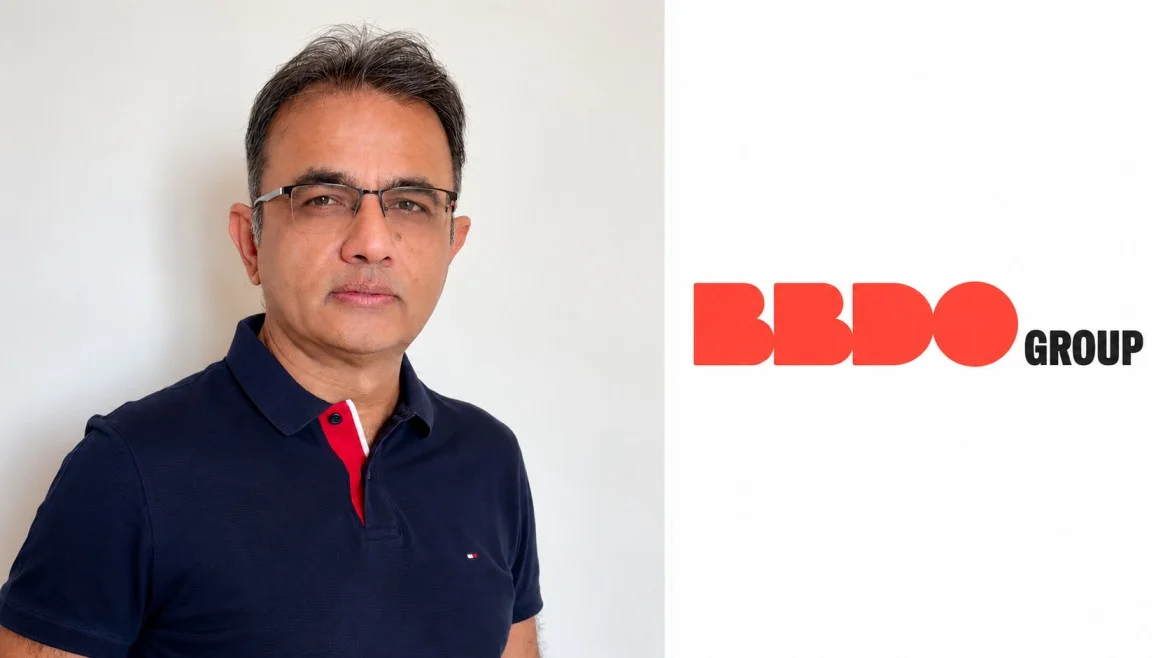
Mumbai: At a time when artificial intelligence, data, performance marketing and efficiency are reshaping the advertising industry, the question of what makes creativity truly valuable has never been more relevant.
In this conversation with Admirror, Jitender Dabas, CEO of BBDO Group India, discusses the changing role of creativity in driving business growth, his leadership journey across McCann, Cheil and BBDO, and the challenge of protecting creative ambition in an increasingly outcome-driven marketing ecosystem.
Dabas also shares his perspective on how BBDO India must evolve as the traditional agency model faces disruption from AI, consultancies, in-house teams and creator-led ecosystems. He reflects on what clients expect from agencies today, how leadership itself is changing, and what it takes to build an agency that remains creatively distinctive and commercially relevant.
From "The Work. The Work. The Work." to AI-powered advertising, this is a conversation about where the agency business is headed and why creativity may matter more, not less, in the years ahead.
Jeetu, you've often spoken about the importance of creativity driving business growth in an era where AI, data, and performance marketing dominate boardroom conversations. Do you think the industry is in danger of undervaluing creativity just when brands need it the most?
It's a good question, and it's interesting that you're asking it at a time when we talk about living in a creative economy.
So, on one hand, we define these as the times of the creative economy. On the other, you're asking whether creativity is being undervalued. And I don't think the question is incorrect, because if you define creativity in the way we have traditionally defined it and put a price on it in the way we have traditionally charged for it, then yes, creativity is under pressure.
But I think what is really under stress is the business model around creativity, how we define it, how we deploy it and ultimately how we value it. And that is an issue for both clients and agencies.
I've always believed that the more technology comes in, the more everything eventually becomes equal. Manufacturing went through this a long time ago. There was a point when quality itself was rare and therefore a differentiator. Today, with automation and technology, everyone can produce a certain level of quality.
So, when quality becomes equal, differentiation becomes even more important. But we need to stop equating creativity with advertising. It's much bigger than that. To me, it's about how you solve a problem or identify an opportunity differently.
I'm an engineer, and I believe engineers are some of the most creative people because they are constantly asking, why can't this be done differently? Why can't this problem be solved another way?
Take something like Uber. Somebody looked at cars standing idle and asked why they couldn't be deployed to connect people who needed to get from A to B. That is a creative business idea. And that's why startups and new business models are increasingly shaping the way we live and work.
Coming back to brands and advertising, if brands are going to remain one of the few real sources of competitive advantage, then this ability to think differently becomes critical.
The true test is when people stop being rational about a brand. When someone says, "I must buy this brand, and if it's not available, I'll wait for it." That's when you've created something beyond functional value, and that's where I think we sometimes misunderstand AI. The opportunity with AI isn't simply automation or efficiency. It's the ability to multiply the impact of a strong idea.
Imagine you have one powerful campaign idea. Traditionally, you might develop a few films, print executions, social assets and adaptations around it. AI can potentially allow you to take that same core idea and create hundreds of highly relevant variations, different visualisations, languages, contexts, formats or even versions tailored to specific audiences without diluting the central thought.
That's a very different proposition from simply asking AI to generate 100 ideas. The value isn't in producing more stuff. It's taking one great idea and giving it a much bigger life. The ability to visualise an idea, prototype it quickly, test how it could work in different contexts and then scale it across platforms is far more dramatic than I would have imagined even a short while ago.
So yes, there is an efficiency opportunity with AI. But I think the efficiency debate will come under pressure. In our excitement about what AI can do, we've perhaps forgotten that there is also a cost to all this, the cost of infrastructure and computation. That reality will come back into the conversation.
Eventually, I hope the industry settles into the right understanding of what AI can really do. Its true power isn't in generating more options or simply making things cheaper. It's in taking a great idea and multiplying its impact at scale, with relevance, and ultimately with greater excellence.
Tell me Jeetu, is there a creative vacuum today?
No, I don't think there's a creative vacuum. I mean, look at us, we say there's a creative vacuum, and then we spend ten hours watching Instagram Reels! So clearly, there's somebody's creativity keeping us there. I think what has really changed is the benchmark.
Earlier, as an agency, you competed with television, newspapers, maybe a few soaps. Today, you're competing with millions of creators. Somebody sitting in Bhubaneswar, somebody in Jalgaon, somebody somewhere else in the world could be making incredibly good content, and you're competing with that for attention.
So, there's no shortage of creativity. There's a huge shortage of attention. And the bar has gone up. But I think there's another trap for agencies. We start believing our job is just to help brands catch that attention. I think our role has to be much bigger than that.
Who's going to hold the brand together? Who's going to create the next brand? Who's going to use creativity to solve the business problem?
Because AI will eventually give you nine choices. Fine. But who's going to tell you which one is right for your brand, your consumer, your business? That's where the agency partnership becomes valuable, and that's also where I think our pricing model has a problem. We charge for what we produce. We don't necessarily charge for the value of the thinking that helped solve the business problem. I think the same thing applies to brand custodianship.
We all grew up when the agency was the brand custodian. We were the creators and the custodians. Today, the creators are everywhere, there are influencers, creators, communities and that's fine. But somebody still must hold the brand together.
You don't have to say the same thing everywhere. But there must be a certain idea, a certain foundation, that everything is building towards. Otherwise, you're not building a brand. You're just producing content. Influencers bring something very valuable: authenticity. But there's a difference between an influencer coming into your brand world and your brand appearing in the influencer's world.
I keep asking that question, because if the influencer's personality completely takes over, then where is your brand? I think the agency's role as brand custodian becomes more important, not less.
The irony is that we've never really charged for it. We've charged for the creative product; we've charged for production. We never really said, "This is what you're paying us to protect and build your brand over time."
Now, if production is moving out to influencers and creators, but we're still expected to hold the brand together, then we must start asking: How do we put value on custodianship? Because it has value. We just haven't historically priced it that way.
Your career journey has taken you from McCann to Cheil and now to BBDO. What were the key lessons from each chapter and what convinced you that BBDO was the right platform for you in the next phase of leadership?
You know, every part of your life adds up to what you eventually become, especially in advertising. Every place I've worked has left something with me, and looking back, those experiences have shaped the way I lead today.
I started at Ulka, then Grey, and spent a significant period at what was then JWT, before McCann, Cheil and now BBDO.
At JWT, I learnt the power of big systems and processes and, importantly, what it means to work on a scale. Those were the heydays of JWT and HTA, and you saw what a large, well-run organisation could accomplish.
McCann was very different. It was about culture, storytelling, narratives and, of course, the power of big ideas and big platforms. McCann has built some incredible global brands, Mastercard, Coca-Cola and that taught me what a strong idea can do for a business.
And then there was Josy Paul. Somebody joked recently that I've moved from Joshi to Josy, because my journey has taken me from Prasoon Joshi at McCann to Josy Paul at BBDO. It's a nice coincidence, but for me, Josy is much more than that. He's an icon, not just in India but globally, and he's also somebody you learn from simply by being around him.
My time as a CSO was another important chapter. That's where I really saw what strategy and effectiveness can do. You understand that a good strategy isn't just a document; it can change the quality and impact of the business.
Then came Cheil. The tenure was short, but the learning curve was huge because of the way Cheil brings technology and creativity together. You see servicing, technology and creativity working as one ecosystem rather than sitting in separate boxes.
I joke that my operating system got upgraded in ten months. And then came BBDO. I've always admired BBDO globally because it's one of those agencies that manages to be exceptional at the work while also being very strong on strategy. If you look at Cannes, they've consistently been at the top. That combination of outstanding creative work and strategic strength is incredibly formidable.
In India, what makes this particularly interesting is the opportunity within the BBDO group. You have institutions like Ulka and Mudra, each with their own heritage, people and culture, alongside the global power of BBDO and the creative legacy that Josy has built.
So, for me, it almost feels like everything you've learnt in different places comes together in one place. And then the question becomes: Okay, what can we create from all of this?
That's what attracted me to BBDO. It wasn't about coming to another agency and doing more of the same. It was about taking everything I've learnt, from scale and systems, to culture and storytelling, to strategy, technology and creativity and asking how we make it relevant to the business problems our clients are facing today.
And at this stage of my career, I'm less interested in simply building an agency that produces more advertising. I'm interested in building an organisation, building the place, the culture, the business and the operating system around it.
We also have a wonderfully diverse portfolio to build around, with longstanding relationships like Amul, Tata Motors, ICICI and ITC, global brands like WhatsApp, McDonald's, Mercedes and Red Bull, and a whole set of emerging businesses.
That is a very interesting mix. But after spending so many years in this industry, you also start asking yourself, what do I give back?
For me, one way of doing that is to create the kind of organisation you always wish to exist in a place where great people, great culture, great work and great business can come together. And that's what makes BBDO the right platform for me at this stage.
BBDO globally has built its reputation around the philosophy that "The Work. The Work. The Work." In the Indian market, where clients are increasingly focused on short-term outcomes and efficiency, how do you protect and champion long-term creative ambitions?
One is the fact that people confuse doing big things with big campaigns.
Doing big things honestly starts with the intent and not the scale of output. Does it require a big campaign? It could be one small act, it could be one big campaign, but the idea is, are you solving big problems? And we take pride in saying that big does not necessarily mean we are not talking about big problems. It is about big problems for disproportionate impact.
In fact, when people are looking at short-term outcomes and efficiencies, it is even more important that we try and attempt things that will create a bigger impact. Doing too many things does not mean you are doing something big. I would much rather say, do things that will create big impact rather than doing one hundred things.
Sometimes we get too worried about filling every funnel and doing more things. I'd much rather have CEOs calling us and saying, 'This is a problem I can't solve. This is where I need your creativity.' That, for me, is a much more valuable conversation.
Many agency leaders today are balancing transformation with business realities. What is your vision for BBDO India over the next three to five years? And where do you see the biggest opportunities for differentiation?
When I look at BBDO today, we're sitting at a very interesting intersection. We've got scale, we've got three very different organisations with very strong cultures and heritage, and we've got a huge depth of talent.
But for me, transformation isn't about becoming a bigger organisation. It's about becoming more valuable.
The question is: What business are we in? What are we talking to the client?
If I can sit across the table from a CEO and say, "You've got this business problem. Here's how we can apply our thinking to create an outcome for you," that's a very different proposition from saying, "Tell me what campaign you need."
I think we're moving from the volume of production to the quality of thinking, advice and ideas, and we have a very interesting advantage because the three brands within the group have very different strengths.
Mudra has always been very good at partnering businesses as they grow, and look at India today, there are hundreds of ambitious entrepreneurs and emerging businesses that are looking to build scale. That's a very relevant proposition.
Ulka has helped build some of India's biggest businesses. With Indian companies increasingly looking to go global, there's a strong proposition there as well, then you have BBDO the global scale, the ambition and the creative strength.
I don't see this as taking bits of Ulka and bits of Mudra and putting them together. There is Ulka. There is Mudra. There is BBDO. Each has strong equity.
The opportunity is to make each one sharper in what it stands for, while giving all three the strength of the larger group. Because capabilities can be replicated. A sharp value proposition is much harder to replicate, and ultimately, I don't want to say, "This is exactly what BBDO will look like three years from now." The world is changing too fast. But I do know what I want us to become.
I want clients to come to us when they have a problem that's important, difficult and doesn't have an obvious answer and for us to say, "Tell us the problem. Let's see if we can solve it." If we can get there, then I think we've built an agency that is not just creatively strong, but genuinely valuable to the business.
The traditional agency model is being challenged by consultancies, in-house teams, creator ecosystems and AI-led solutions. How should creative agencies evolve to remain indispensable to clients?
Look, I think it comes down to one thing: what value are you bringing to the table? I know brands that have said, "We don't need an agency. We'll do it ourselves." And then, two years later, they went back and appointed an agency.
I remember a CMO telling me, "I don't think I need an agency. Tell me three or four iconic brands that have been created in the last ten years," and that's a fair question. But I think sometimes we're in-housing for the wrong reason. We're doing it because we need speed. There is so much content and so much output that needs to be created, and an in-house team can do that very efficiently.
But the question is: Are you building a brand around a sharp idea? Because brands aren't built by producing more content. Brands are built when somebody says, "I want this brand. And if it's not available, I'll wait for it."
That's brand equity. I think agencies have to stop defining themselves by the output they produce.
We've also been guilty of putting labels on us as, traditional agency, digital agency, creative agency, consultancy. Labels make things easy to understand, but they can also become limiting.
The real question is: What business are you in? What value do you create?
If I'm competing with you on the number of pieces of content I can produce or telling you I can help you get more attention than an Instagram Reel, I'm in a difficult business.
But if I say, "I can help you create disproportionate value by building a brand that matters to people and to your business," that's a very different proposition, that value may not always be directly connected to the piece of work I produce. I think that's how creative agencies remain indispensable. Don't define yourself by the product. Define yourself by the value you're creating.
It's like entertainment. We're still in the business of entertaining people, but we don't watch everything on radio or in a cinema anymore. The format keeps changing, television, streaming, mobile, whatever comes next. But the underlying value hasn't changed.
So, as an agency, I must keep changing how I deliver what I do. But I shouldn't lose sight of what business I'm actually in, and for us, that's about using creativity to create value to build brands, solve business problems and create an impact that is disproportionate to the output.
If we can define ourselves that way, then whether the work is created by an agency, an in-house team, a creator or AI becomes a secondary question. The value we create is what makes us indispensable.
Having worked across some of the industry's most influential networks, what do you believe clients are asking for today that they weren't asking for five years ago?
I think if you go back five years, clients will be largely asking for campaigns. Then it became platforms, content, integration and so on.
Today, I think the biggest change is this: there are many more questions and far fewer clear answers.
AI is a big part of it. Consumer behaviour is changing, platforms are changing, content is changing and clients are asking themselves, "What should I actually be doing?"
The CEO is asking, "How much AI are we using? Should we be putting more money into influencers? Should we be doing what that other company is doing?"
The conversation is changing from "Can you execute this?" to "Can you help me navigate this?" and that's a much more interesting role for an agency.
Of course, we will still create campaigns, content and all of that. But the bigger value is helping clients figure out which questions are worth answering in the first place. Because when change happens this fast, nobody has all the answers.
I think the best agency-client relationships today are less about bringing a ready-made answer and more about saying, "Let's figure this out together."
And perhaps that's the biggest shift: clients don't necessarily need agencies to have all the answers. They need partners who can help them find the right ones.
Are brands losing out by hiring too many influencers to take the brand message across, how would you as an agency advise clients on this?
I think when you don't have the knowledge or the answers, you tend to punt on somebody else's decision. And that's where some of this influencer rush comes from.
You see everyone putting money into influencers, so the question becomes, "Why aren't we doing it?" It's a bit like Bollywood, one movie becomes a hit, nobody quite knows why, but suddenly everyone wants to follow that formula.
Of course, the data tells you where people spend time. If people are spending a lot of time with influencers, you say, "Okay, let's put money there." But the real question is: what exactly are you buying?
Are you buying followers? Are you buying views? Are you buying brand fit? Or are you buying the ability to influence someone's behaviour?
Because I think we've got to be careful about confusing reach with influence. Not every creator is an influencer. Somebody can make a video, get three million views and still not have the ability to influence you.
I often use myself as an example I might be a performer, but that doesn't automatically make me an influencer. The ability to get views and the ability to influence people are two very different things. So, if I'm just buying followers and views, in some ways I'm buying an audience. That's not necessarily a bad thing, but let's be clear about what we're buying.
There are also genuine creators who have built trust with a particular community and can influence what people think, choose or do. That's a very different proposition, and I think the agency's role is to help the client make that distinction.
Because when you're under pressure from management and everyone else is spending money, the easy question is, "Why aren't we?"
The harder and more important question is: "Is this actually right for my brand, and what do I expect this influencer to do for me?" That's the conversation we should be having.
If you were advising a young planner or creative entering the industry today, what skills or mindset would you tell them to develop to stay relevant in a business being reshaped by technology and changing consumer behaviour?
I think there are a few things that are not going anywhere. The first is your ability to influence. We're in the business of influencing people getting people to think differently, feel something or ultimately make a decision, and to do that well, you must understand people. If you understand people, you're going to be better at influencing them. That doesn't change, even when the tools change.
The second is storytelling. The format may have changed, it could be a film, a meme, a reel or a song, but people are always going to be hungry for stories. Just look at the reels we watch. Why do some hold your attention and others don't? Often, it's simply because the story is better told, and the most powerful stories are often rooted in real insight or someone's lived experience.
So, if you're a young creative or planner, learn the new tools. Absolutely. Use AI, understand technology, understand the new formats but use them to make your thinking better, not to replace your thinking, the one thing I would never compromise on is observation. There is no substitute for observing people, understanding what they're doing, what they're feeling and why they're behaving the way they do.
I'd add one more thing understand culture. What motivated me when I started may not be what motivates a young person today. Money might get someone through the door, but it doesn't necessarily make them stay.
People stay because they like where they work. Am I happy here? Do I want to come back tomorrow? Am I comfortable? Am I learning? Am I overstressed? Does this place allow me to do my best work? Those questions haven't really changed across generations.
At one of our BBDO-DDB leadership meets, somebody described the organisation beautifully: "We are talented and nice people." I thought that's a pretty powerful ambition. Because you want to work with talented people, obviously. But you also want to work with nice people you trust, people you enjoy being around, people who make you better. My advice to young people would be: learn the tools, but don't forget the fundamentals, understand people, observe relentlessly, tell great stories and be someone others want to work with.
As CEO, how do you define success beyond awards and revenue growth? What are the cultural, talent or business indicators that tell you BBDO is moving in the right direction?
Awards and revenue are important, of course, but they don't tell you the whole story. For me, the first test is people. Are great people choosing to join us? Are they staying? Are they learning, taking risks and doing their best work?
The second is our clients. Are they coming to us only when they need a campaign, or are they calling and saying, "I've got a business problem. Can you help me solve it?"
Then there's the work. Is it just winning awards, or is it changing behaviour, building brands and creating business impact?
Finally, culture. Do people trust each other? Do they feel they can challenge, experiment and have fun doing the work? If we have great people, stronger client relationships, ambitious work and a culture people believe in, I know we're moving in the right direction.
The awards and the revenue are important. But they're the outcomes. The real indicators are the people, the work and the value we create.


