











Women are increasingly visible in boardrooms, leadership teams and entrepreneurial ventures. Yet representation does not automatically translate into influence, decision-making authority or access to the most commercially critical roles. The question, therefore, is no longer simply about getting more women into leadership positions, but whether the systems that define leadership are equipped to recognise and accommodate the realities of women's careers.
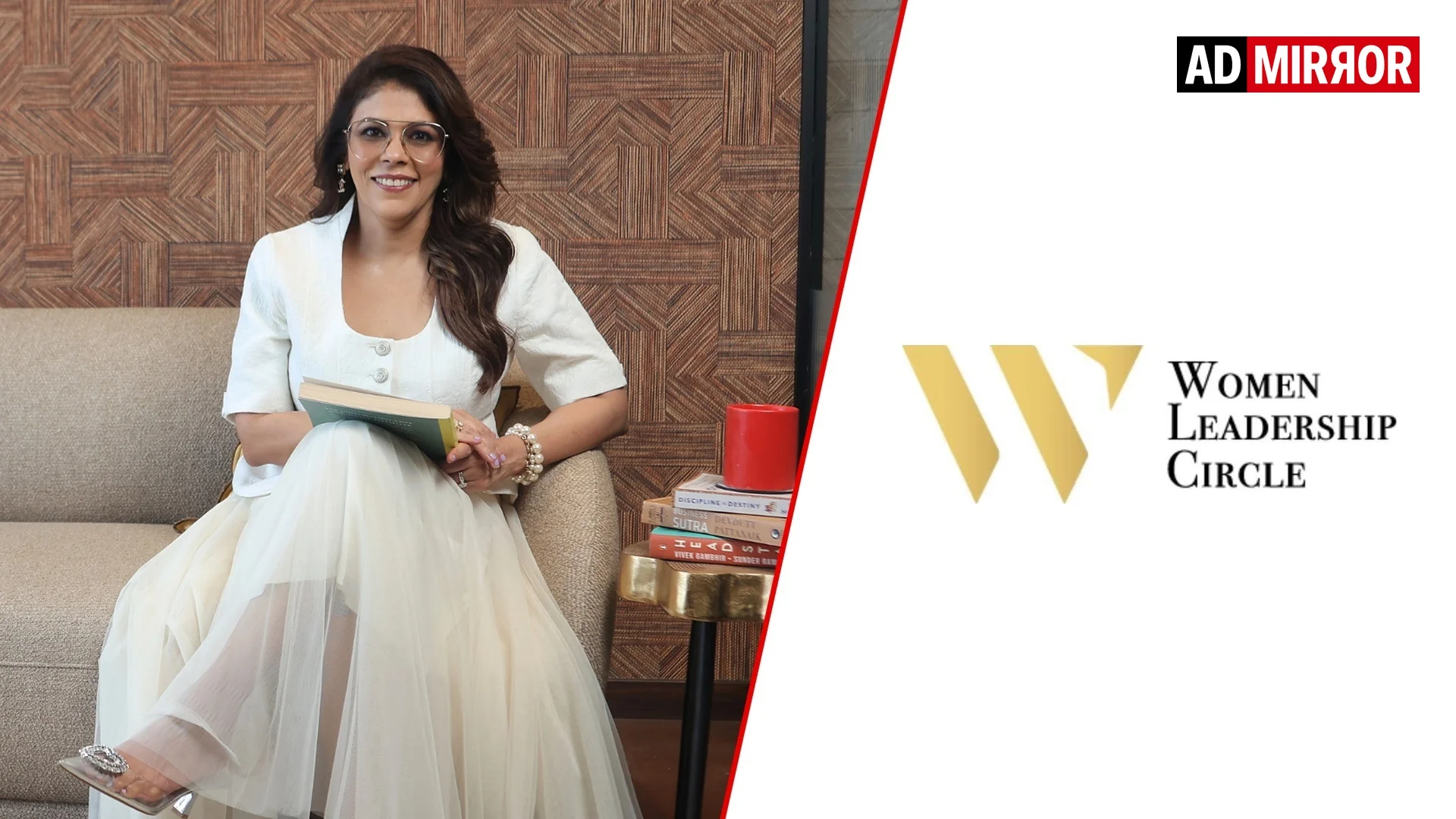
In an in-person conversation with AdMirror, Jaya Mehrotra, Founder of Women Leadership Circle (WLC), makes a case for rethinking the very architecture of leadership. Drawing on over two decades of experience in financial services and her work as a leadership and executive coach, Mehrotra argues that organisations continue to operate around a linear career model that does not account for the multiple transitions women navigate through their professional and personal lives.
From motherhood and career breaks to changing ambitions, portfolio careers and the persistent under-representation of women in P&L and C-suite positions, she believes the problem cannot be addressed by asking women to become more confident or assertive. The responsibility also lies with organisations to rethink talent management, build meaningful sponsorship structures and evaluate women's potential over decades rather than short-term performance cycles.
Mehrotra also challenges the conventional emphasis on mentorship, arguing that women need an ecosystem of mentors, coaches and sponsors who can help them build agency and access opportunities. As artificial intelligence reshapes the workplace, she believes self-awareness, creativity, emotional intelligence and the ability to navigate complexity will become increasingly important leadership capabilities.
Through WLC, Mehrotra is attempting to take this conversation beyond networking and community-building towards a more influential ecosystem — one that can develop future mentors, support women entrepreneurs, create board opportunities and expand women's participation in capital allocation and business decision-making.
In this conversation, she speaks about the structural biases embedded in corporate career paths, the economics of career breaks, the sponsorship deficit and why the next phase of women's leadership must be about changing who holds power.
We have more women entering leadership roles today, but the gap between representation and real influence remains a stumbling block. From what you see in your work with women leaders, where is the leadership system still failing women? What needs to change beyond simply increasing representation?
Somewhere, we have to accept that women go through multiple life cycles, and these transitions fundamentally change their priorities, perspectives and sometimes their ambitions. Motherhood, children growing up, teenagers leaving for college and menopause are all significant phases in a woman's life. Yet organisations continue to be built around a linear career path.
The career ladder, in many ways, is designed around a traditional male career trajectory. Women don't necessarily move in a straight line. Their careers have curves, ups and downs, ebbs and flows. They may want to build portfolio careers, move between functions or explore entirely different professional directions at different stages of life.
For instance, a woman returning from maternity leave may discover that her interests have changed. She may have been in sales before motherhood but now want to explore brand management or a more creative role. Organisations need to recognise these transitions rather than expect women to return and immediately resume the same trajectory.
I remember how, after pregnancy, my best friend and I were focused on making money quickly. Our priorities had shifted, and our professional ambitions were temporarily different. Had we had the right coaching, role models and reassurance that this was a phase rather than the end of our ambition, perhaps our journeys would have been different.
You cannot wish away these life stages. Organisations need to build talent management systems that recognise women's evolving capabilities and assess their potential over two decades, rather than judging them through two-month targets or two-year performance cycles.
At WLC, one of the first things we are doing is talent mapping for every member. We want women to take ownership of their talent and careers over multiple decades.
Women are often told to be more confident, visible and assertive to progress. Are we putting too much responsibility on women to fix
themselves when the bigger issue is how organisations define, recognise and reward leadership?
There is also the question of how women are perceived when they become assertive. If a woman speaks firmly, she can quickly be labelled aggressive. The same behaviour may be interpreted differently when it comes from a man.
However, I also wear the hat of a leadership coach, and I believe screaming, shouting and unrestrained aggression are not effective leadership behaviours, irrespective of gender. If a man is allowed to behave that way and is celebrated for it, the organisation has a serious problem with its leadership culture.
Assertiveness is a tool. You need to know when to use it, when to be firm and when to moderate your approach. It is gender-agnostic. There is a difference between being assertive and being aggressive.
In an increasingly AI-driven world, we need people with greater human intelligence, self-awareness and the ability to navigate emotions. Uncontrolled aggression is not a leadership strength.
Workplace harassment and subtle power play remain realities. While many organisations have POSH committees, women often hesitate to report incidents because they fear being labelled complainers. How do you advise women to navigate situations where they may not feel supported by the organisation?
I think one of the biggest mistakes women make is allowing themselves to become isolated at work. Many organisations have POSH committees, but women may not approach them because they fear being labelled.
My advice is to build an ecosystem within the organisation. Have role models, sponsors and allies you can turn to. Develop relationships based on credibility and trust so that when you need help, you have people you can reach out to.
Sometimes women believe their work alone will speak for them. But you cannot navigate every professional challenge in isolation. You need people who will support you and stand by you when you speak up.
I believe this is changing, but we still have a long way to go. The more women we have in senior leadership positions, the stronger the
support systems and the less intimidating it becomes to raise difficult issues.
Mentorship is widely discussed, but sponsorship often determines who gets the next big role, P&L responsibility or board opportunity. Are women getting enough sponsors at the highest levels? What can organisations do to move from well-intentioned mentoring to actual career sponsorship?
Some organisations are doing meaningful work in this area. I have coached companies that are identifying women as high-potential talent and investing in mentoring and sponsorship. But this is far from widespread.
The problem is particularly acute in mid-sized organisations that may not have dedicated learning and development teams, talent-mapping systems or structured leadership programmes. Sponsorship and mentoring cannot happen by accident. They require a deliberate organisational approach.
I always tell women to find a sponsor within their organisation and two mentors — one within the industry and one inside the organisation.
At WLC, we want to build this ecosystem ourselves. We want to bring together mentors, coaches and sponsors so that women are not entirely dependent on their employers to create opportunities for them.
Ultimately, women need agency over their careers. You cannot keep waiting for an organisation to provide the right environment or keep changing jobs in search of it.
AI is reshaping jobs, organisational structures and the very definition of leadership. What capabilities will become more valuable in an AI-led workplace? Are women leaders adequately prepared for this next shift in power and opportunity?
I think women are well positioned, but I wouldn't say self-awareness or emotional intelligence are inherently female qualities. They are choices that individuals make. I have met men who are exceptionally self-aware.
What has changed is that personal growth is no longer optional. We are moving towards a world of AI and superintelligence, and our own human intelligence has to evolve alongside it.
Creativity, out-of-the-box thinking, agility, innovation and rooted self-awareness will become critical. You need to understand who you are, what your purpose is, what you are passionate about and where your strengths lie.
Even the way we use AI requires this intelligence. You cannot simply accept the first answer a tool gives you. You have to question it, challenge it and refine your prompts until you get the outcome you need. That requires clarity of thought.
We need to invest much more in developing human intelligence. It should become an integral part of how we educate and prepare future generations.
Women are increasingly visible in senior positions, but their representation in revenue-owning, business and P&L roles remains a challenge. Why does this gap persist, and what needs to change in how organisations identify women for commercially critical leadership positions?
There is a circular problem here. By the time women reach the C-suite, the numbers have already reduced significantly. If we don't have enough women in the leadership pipeline, how will we have enough women in P&L roles?
We need more visible role models — women who are leading businesses, managing investments, allocating capital and making decisions at the highest levels.
When younger women see others occupying these positions, they begin to see those opportunities as achievable. We need to build a stronger pipeline and prevent the leakage of women from leadership positions.
At WLC, we are also looking at building the next generation of mentors. We have many coaches, but mentoring is a distinct skill. It is not simply a conversation. It requires preparation, structure and the ability to guide someone through their professional journey.
We want to train some of our senior founding members to become mentors and create a sustainable pipeline of women who can guide the next generation.
WLC is built around community, peer learning, mentorship and leadership development. What does success look like five years from now? Is the ambition to create a stronger network of women leaders, or to actually change the distribution of leadership and decision-making power?
Our larger ambition is to build a more equitable future. Five years from now, we would like to see women from WLC occupying leadership positions, building businesses, joining boards, creating advisory networks and participating in capital allocation.
We have a Pitch Room, and our larger ambition is to build cap tables, create advisory boards and facilitate opportunities for women to join boards and influence business decisions.
Our target is to build a community of 5,000 women. But the impact cannot stop with those 5,000. The idea is that these women influence 50,000, who influence five lakh, and eventually create a much larger multiplier effect.
If we can get the first 5,000 right, the impact can extend far beyond the community itself. That is the kind of circle of influence we want to create.
If you could change just one unwritten rule about how leadership works today — one that could fundamentally alter the trajectory of women's careers — what would it be?
I would change the way organisations penalise women financially when they take career breaks.
A woman may take a maternity break or a longer sabbatical, and organisations may say their doors are open for her to return. But when she comes back, she often does not return to the same room. She may be offered a role at a fraction of her previous salary.
Why should a woman who has taken a career break automatically be paid less? She may have spent those years managing a household, raising children and handling multiple responsibilities. That does not mean she has lost her talent or capabilities.
Of course, an organisation can assess her skills and identify where upskilling may be required. But that is very different from discounting her professional worth.
If a woman was earning Rs 30 lakh before a break and returns to an offer of Rs 10 lakh, the financial and psychological disincentive can be enormous. It also makes returning to work far less attractive.
We need to address this constant discounting of women. It is one of the biggest barriers to bringing experienced women back into the workforce.
I also believe women need to become better at negotiating their worth. There is a saying: you don't get paid what you deserve; you get paid what you negotiate. Many women still hesitate to ask for what they are worth, although this is beginning to change.


