











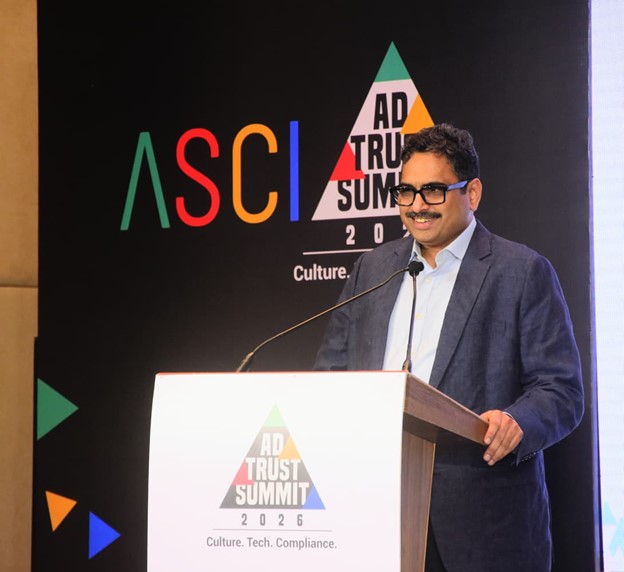
Mumbai: At a time when India’s advertising ecosystem is expanding rapidly across digital platforms, artificial intelligence, and creator-led channels, the need for trust and accountability has come sharply into focus. Addressing the inaugural AdTrust Summit 2026 in Mumbai, Union Information and Broadcasting Secretary Sanjay Jaju underscored that advertising must go beyond scale and reach to build credibility, transparency, and consumer trust.
Positioning advertising as a powerful force that shapes markets, culture, and aspirations, Jaju highlighted both the opportunities unlocked by digital innovation and the growing risks of misleading promotions, deep fakes, and fraudulent advertising targeting vulnerable audiences. Against this backdrop, he outlined five core principles for responsible advertising, truthfulness, transparency, content responsibility, protection of vulnerable groups, and innovation with accountability while also launching the Ad Law Compendium with ASCI and Khaitan & Co as a step toward strengthening compliance and industry standards.
Today, attention has shifted from traditional broadcast to platforms and creators has policy kept pace with where real influence now lies, or is regulation still chasing a moving target?”
The shift from traditional broadcast to digital platforms and creator-led ecosystems is no longer emerging its decisive. Digital is firmly established as the primary growth engine of advertising, projected to account for nearly 60% of ad revenues by 2025. Within this, influencer marketing continues to scale at pace, expected to grow at an 18% CAGR to ₹3,375 crore by 2026, while AI is fundamentally reshaping how advertising is created, targeted, and measured.
Policy, to its credit, is beginning to respond to this structural shift. The Ministry of Information and Broadcasting’s move to bring online advertising within its formal mandate signals clear intent to stay aligned with the evolving ecosystem. The approach is calibrated enabling industry growth while building necessary guardrails around consumer protection, legal compliance, and accountability. Its responsiveness on issues like self-declaration norms, following Supreme Court directives, also reflects a more consultative and adaptive stance.
However, the gap between innovation and regulation remains a live challenge. Critical areas such as targetability, traceability, and platform responsibility particularly in the context of cross-border advertising and high-risk categories still require more robust and clearly defined frameworks.
The direction is right, but the pace of disruption means regulation is still playing catch-up with a rapidly evolving, platform-first advertising landscape.
What ethical concerns arise from influencer marketing in India?
Influencer marketing in India is scaling rapidly, but its ethical foundations are still evolving. One of the most pressing concerns is the lack of clear disclosure when paid partnerships are not transparently labelled, consumers are often misled into believing they are viewing independent opinions rather than sponsored content.
This is compounded by high non-compliance rates with disclosure norms, as highlighted by industry watchdogs, pointing to a systemic gap between guidelines and ground reality. The issue goes beyond compliance into questions of authenticity and accountability hidden sponsorships and exaggerated claims risk eroding consumer trust in both creators and brands.
A more critical concern is the vulnerability of younger audiences. Children and Gen Z consumers often struggle to distinguish between content and advertising, making them more susceptible to subtle or manipulative brand messaging.
As influencer marketing becomes mainstream, the need for transparency, responsible endorsements, and stricter adherence to disclosure norms is no longer optional it’s essential to sustaining trust in the ecosystem.
In an era where content travels faster than regulation, who is accountable the platform, the creator, or the government?
In today’s platform-first ecosystem, accountability can no longer sit with a single stakeholder it has to be shared, structured, and enforceable.
Platforms are increasingly expected to embed compliance into their architecture through stronger ad policies, algorithmic checks, and clearer governance of branded content. Creators, on the other hand, must recognise that influence comes with responsibility. Credibility is their currency, and practices like hidden sponsorships or promoting questionable products can quickly erode that trust.
The government’s role is to define the guardrails ensuring consumer protection, legal compliance, and accountability, while still enabling innovation and growth. Recent steps to bring online advertising within the regulatory ambit signal intent, but enforcement at scale remains a challenge.
The reality is that while roles are being defined, the lines of accountability are still evolving making collaboration between platforms, creators, and regulators critical to building a credible ecosystem.
Does India have the policy boldness to become a global content powerhouse?
India has the scale, talent, and cultural depth to emerge as a global content powerhouse but policy needs to move from being protective to being enabling.
There is clear progress. The government has acknowledged the importance of digital media, OTT, and online advertising, and is gradually expanding its regulatory and policy framework to reflect this shift.
However, global leadership in content will require more than regulation it will demand investment in infrastructure, incentives for content exports, ease of doing business for creators, and a forward-looking approach to emerging areas like AI and AVGC.
At the same time, policy must avoid becoming overly cautious. In a global market where countries are actively competing for content dominance, agility and bold decision-making will be key differentiators.
India’s intent is clear but to truly compete on the global stage, policy will need to evolve from managing growth to actively accelerating it.


