











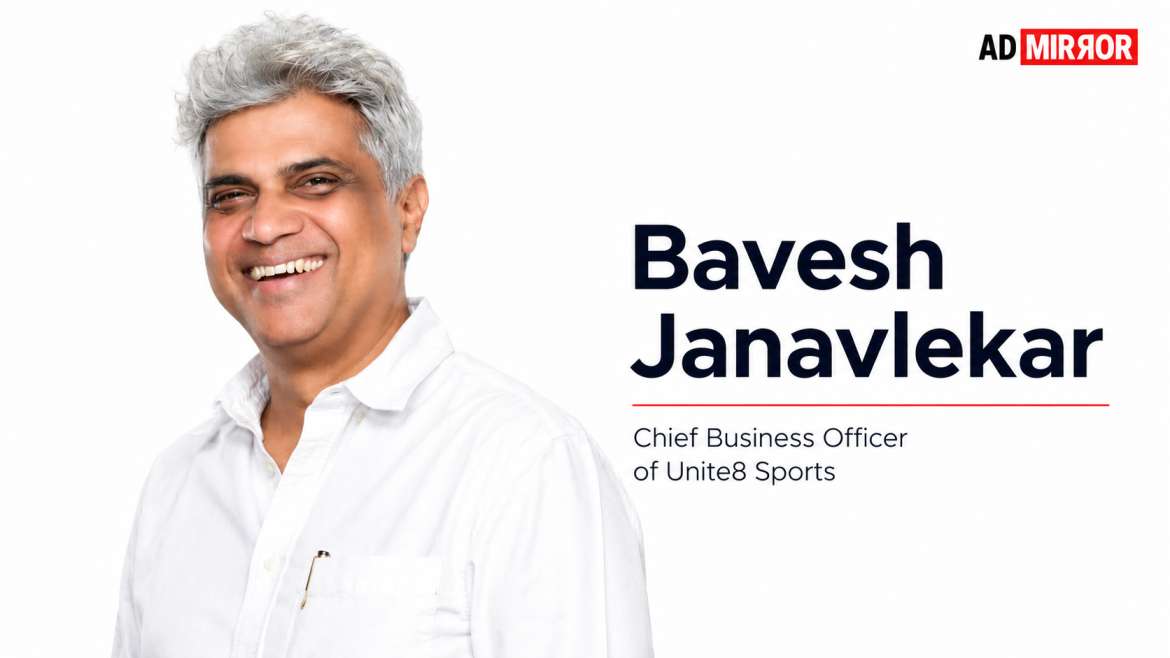
Mumbai: India's sports broadcasting landscape is witnessing a major shift. With Zee Entertainment securing exclusive rights to FIFA events through 2034, including the FIFA World Cup 2026 and several marquee global tournaments, the conversation around football's growth potential in India has never been more relevant. At the centre of this play is Bavesh Janavlekar, Chief Business Officer of Unite8 Sports, the sports business arm spearheading Zee's long-term vision in the category.
In this conversation with Kalpana Ravi, Editor in Chief, AdMirror, Janavlekar shares insights into the FIFA deal, the business case for football in a cricket-dominated market, advertiser interest, regional-language strategies, audience growth plans, and how Unite8 Sports intends to turn a global sporting property into a long-term growth engine for Indian sports media.
India remains a cricket-first nation. What gave Zee and Unite8 Sports the confidence to make such a significant investment in FIFA rights, and what opportunity are others perhaps overlooking in Indian football fandom?
For us, the FIFA World Cup is more than just a marquee event, it is a strategic entry into a rapidly expanding fan ecosystem. Our confidence comes from a visible shift, especially among younger, digital-first viewers who are actively following global sports. Football already has deeply rooted fan bases in West Bengal, Kerala, Goa, and the Northeast, and we are seeing that interest grow steadily across urban markets as well. What is often overlooked is not the presence of football fans, but the intensity of their engagement and their need for more consistent, high-quality access to the sport. For ZEE5 and Unite8 Sports, the FIFA World Cup is a strong starting point to tap into this demand at scale and build a sustained football ecosystem through multilingual experiences for fans across the country.
You have described FIFA as an anchor property. Is the vision merely to broadcast a global event, or to use FIFA as the foundation for a long-term football ecosystem and proprietary sports IPs under Unite8 Sports?
Our vision extends well beyond broadcasting a single global event. Through this eight-year partnership, we have secured rights to a broad portfolio of FIFA competitions, including the FIFA World Cup 2026 and 2030, the FIFA Women's World Cup 2027, Men's and Women's U17 and U20 World Cups, the Futsal World Cups, and the FIFA Intercontinental Cup. That breadth of rights gives us the opportunity to engage football fans consistently over the long term rather than around a single tournament cycle. The FIFA World Cup 2026 is the starting point of that journey. Beyond the tournament itself, our focus is on creating year-round engagement through the wider FIFA portfolio, strengthening fan communities, and gradually building a broader sports ecosystem under the Unite8 Sports umbrella.
What has been the advertiser response since the FIFA announcement? Are brands approaching football as a premium, affluent audience play or as a scalable mass-reach proposition over the next decade?
India continues to be a cricket-loving nation, and cricket operates at unmatched scale here. At the same time, audience behaviour is clearly evolving, with growing interest in a wider mix of global sports. We have seen this reflected in the response to football properties such as the Calcutta Football League and Bengal Super League, which highlight the demand for accessible and locally relevant football content. The FIFA World Cup builds on this momentum as one of the few truly global sporting events that combines scale, emotional connect, and sustained engagement. For ZEE5 and Unite8 Sports, the focus is on building a long-term football ecosystem through multilingual coverage, digital-first experiences, and year-round engagement rather than treating it as a short-duration event property.
The 2026 World Cup is being played across North America, meaning many matches will air at unconventional hours for Indian viewers. How are you planning programming, highlights, and advertiser integrations to overcome the time-zone challenge?
Football fans in India have historically shown they are willing to stay up for key matches because of the scale and emotional connect the tournament brings. Our approach is to ensure viewers can engage beyond live matches, through highlights, replays, and curated content that allows fans to catch up at convenient times, alongside surrounding content that keeps the conversation going through the day. From an advertiser perspective, this opens up opportunities across both live and non-live formats, including highlights, digital integrations, and platform-wide engagement. The idea is to make the World Cup accessible in multiple ways so audiences can participate regardless of when they choose to watch.
How extensive will the language-feed strategy be for FIFA, and can localisation become the catalyst that takes football beyond its traditional strongholds into mainstream India?
Regional language will play an important role in how we present FIFA to audiences in India. The approach is to offer dedicated feeds in English, Hindi, Bangla, and Malayalam across ZEE5 and Unite8 Sports, while ensuring availability across our broader broadcast and digital ecosystem. For many people who are aware of football but do not engage with it consistently, language can help make that first level of connection simpler. Growth will come from a mix of factors: consistent visibility, access, and how the sport is experienced over time. Regional feeds can open the door to newer audiences while strengthening engagement in markets where the sport already has a strong base.
The FIFA partnership covers 39 FIFA events through 2034. Success won't be measured only by World Cup ratings. What KPIs will tell you that Unite8 Sports has genuinely expanded football's footprint in India?
The larger objective is to build deeper football engagement in India over time. We would look at how the overall sports consumer base is growing on the platform, how many new audiences are coming in through football, and how consistently they engage across multiple FIFA properties, not just a single tournament. Another important indicator will be the depth of engagement, whether fans are watching beyond live matches, engaging with surrounding content, and returning across tournament cycles. Increased advertiser interest and stronger participation across formats will also be a key signal. If we are able to build a more consistent, always-on football culture on the platform and bring more audiences into the fold over time, that would be a meaningful measure of success.


