











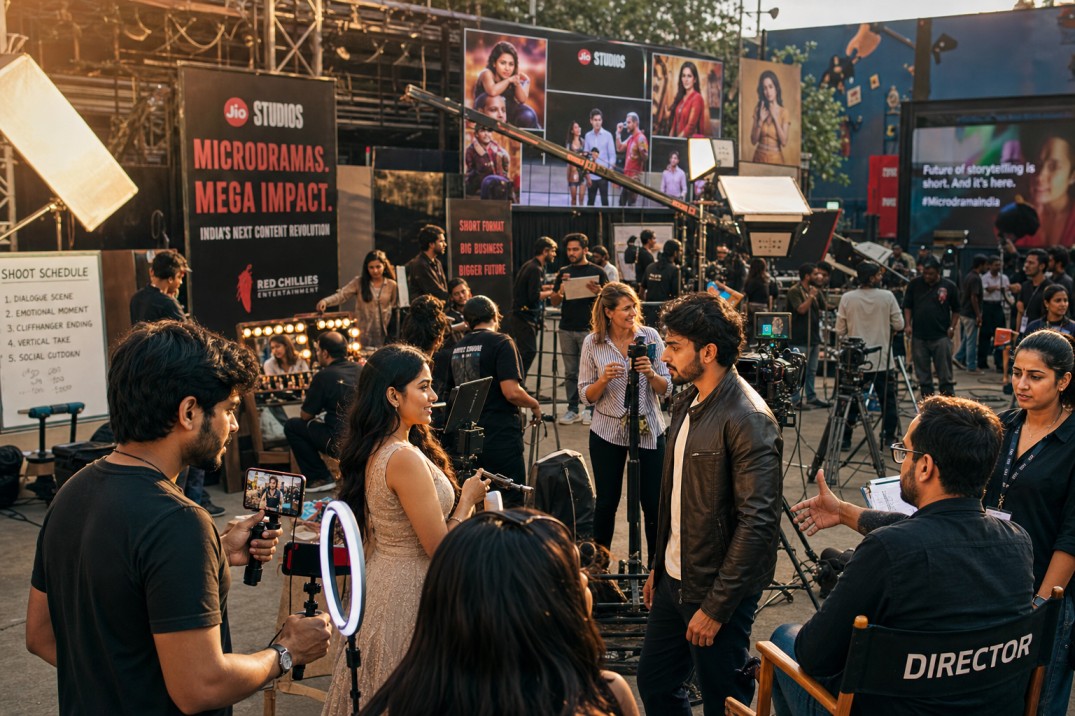
Mumbai: The microdrama moment in India has moved past curiosity. It is now at an inflection point. What began as low-cost, high-volume, creator-led storytelling on platforms like YouTube Shorts and Instagram Reels is rapidly formalising into a serious content business.
The entry of Reliance Industries and Red Chillies Entertainment signals a decisive shift from algorithm-chasing content to structured, studio-backed IP creation. This is where distribution scale meets storytelling craft, and where microdramas begin to resemble the early days of OTT: fragmented, experimental, but full of commercial promise.
India's content economy has always evolved in waves, from satellite television to multiplex cinema, from early OTT to today's algorithm-driven feeds. Microdramas are the latest wave, but unlike previous shifts, they are not defined by technology alone. They are defined by behaviour. Built for a generation raised on infinite scroll, microdramas compress storytelling into hyper-engaging, emotionally loaded bursts of 30 seconds to three minutes. They are designed not for passive viewing but for addictive consumption, where every episode ends with a hook, every narrative leans into high emotional stakes, and every frame is optimised for vertical screens.
Platforms like YouTube Shorts and Instagram Reels laid the groundwork by conditioning audiences to consume short-form video at scale. What microdramas have done is layer fictional storytelling onto that behaviour, creating what can best be described as daily soaps for the swipe generation.
At the heart of the microdrama surge lies a convergence of structural shifts. India is a mobile-first market at scale. The next wave of internet users is not transitioning from desktop to mobile: they are born into mobile ecosystems, consuming content in bursts during commutes, between tasks, and in fragmented moments of downtime. The attention economy has tightened, and microdramas succeed because they deliver instant emotional payoff, reducing the friction between discovery and engagement. The format also aligns with India's long-standing love for melodrama and episodic storytelling: the same emotional arcs of family conflict, romance, and betrayal that built massive television audiences, delivered now in minutes rather than hours. Finally, there is a cost advantage. Compared to large-scale OTT productions, microdramas can be produced quickly and economically, enabling high-volume experimentation.
Microdramas are not about making shorter content. They are about rethinking storytelling itself.
The entry of Reliance and Red Chillies fundamentally alters the trajectory of the format. Reliance brings what microdramas lacked: distribution muscle, data infrastructure, and monetisation scale. Its ecosystem spanning telecom, digital platforms, and consumer reach has the potential to turn microdramas into a mass-distributed content layer, particularly in regional markets. Red Chillies brings storytelling credibility and production expertise. Its involvement signals a move toward higher-quality writing, better talent, and structured content development. Together, they represent a shift from fragmented creator ecosystems to organised studio systems, from volume-driven production to IP-driven storytelling, and from ad-hoc monetisation to scalable revenue models. This transition mirrors the early days of OTT in India, when platforms moved from licensed content to original programming and fundamentally reshaped the industry.
For brands, this evolution unlocks a powerful new lever. Microdramas collapse the funnel, blending narrative, frequency, and commerce into a single, mobile-first experience. Instead of interrupting audiences, brands can integrate into story worlds, build recurring IP, and drive both engagement and transactions. Traditionally, brands have had to choose between high-impact storytelling and performance-driven formats. Microdramas collapse this divide. By integrating into narrative arcs, brands can become part of the story world rather than interruptions around it. A product is no longer a placement: it becomes a plot device. A service is not advertised: it is experienced by characters. This creates higher engagement through repeated episodic exposure, stronger recall through emotional association, and direct commerce opportunities through embedded calls to action. More importantly, microdramas enable brands to build owned IP, creating recurring characters and story arcs that audiences return to, turning content into a long-term asset. The caveat is significant: brands must think like producers, not advertisers. The moment storytelling is compromised for messaging, the format loses its effectiveness.
The sustainability of microdramas ultimately hinges on monetisation. Globally, particularly in China, microdramas have already demonstrated viable revenue models through freemium access with paid episode unlocks, integrated brand partnerships, platform-driven revenue sharing, and commerce integration within content. In India, these models are still evolving, but the presence of Reliance accelerates the process. With access to user data and payment ecosystems, microdramas can become highly targeted and transaction-driven, bridging the gap between content consumption and commerce. This is where microdramas could outpace traditional short-form platforms: while YouTube Shorts and Instagram Reels excel at discovery, microdrama ecosystems can excel at conversion.
Every emerging format goes through three phases: explosion, where high volume and low barriers flood the market; saturation, where content fatigue sets in and differentiation declines; and consolidation, where fewer players survive with higher quality and stable economics. Microdramas in India are currently between phases one and two. The market is flooded with repetitive narratives, over-the-top performances, and low production quality. This assembly-line content model is not sustainable. As audiences mature, their expectations will rise. The involvement of larger players will accelerate the shakeout, setting new benchmarks that force smaller players to either evolve or exit.
The hype will fade. The format will stay. In that transition lies the real opportunity for platforms, creators, and brands willing to invest not just in content, but in stories that matter, even in 60 seconds.
Despite the inevitable shakeout, several elements of microdramas are here to stay. Format-native storytelling, designed specifically for short durations with strong hooks and rapid progression, will continue to resonate. IP-led ecosystems built around recurring characters and expanding story universes will drive loyalty and long-term engagement. Data-driven content creation will improve hit rates over time.
Commerce integration will make microdramas a powerful business tool. What will not survive is volume without value, ad-disguised content that audiences reject as inauthentic, and copycat storytelling that leads to rapid fatigue. Microdramas will move from a quantity game to a quality game.
For OTT platforms, microdramas introduce a new content layer that can serve as both a feeder and a competitor, acting as testing grounds for ideas that later scale into long-form content. For creators, they open new career pathways: influencers can evolve into actors, writers can build micro-IP, and production houses can diversify their portfolios. For advertisers, they represent a shift toward content-led marketing, where storytelling becomes central to brand strategy.
The AdMirror view is clear. Microdramas are not a passing trend, but they are not immune to correction. The market will undergo professionalisation, consolidation, and polarisation between top-tier content and commoditised output. The entry of Reliance Industries and Red Chillies Entertainment marks the beginning of the next phase. What lies ahead is not a decline but an evolution: more structured, higher quality, more deeply integrated with commerce, and more competitive. The winners will be those who understand that microdramas are not about making shorter content but about rethinking storytelling itself.


