











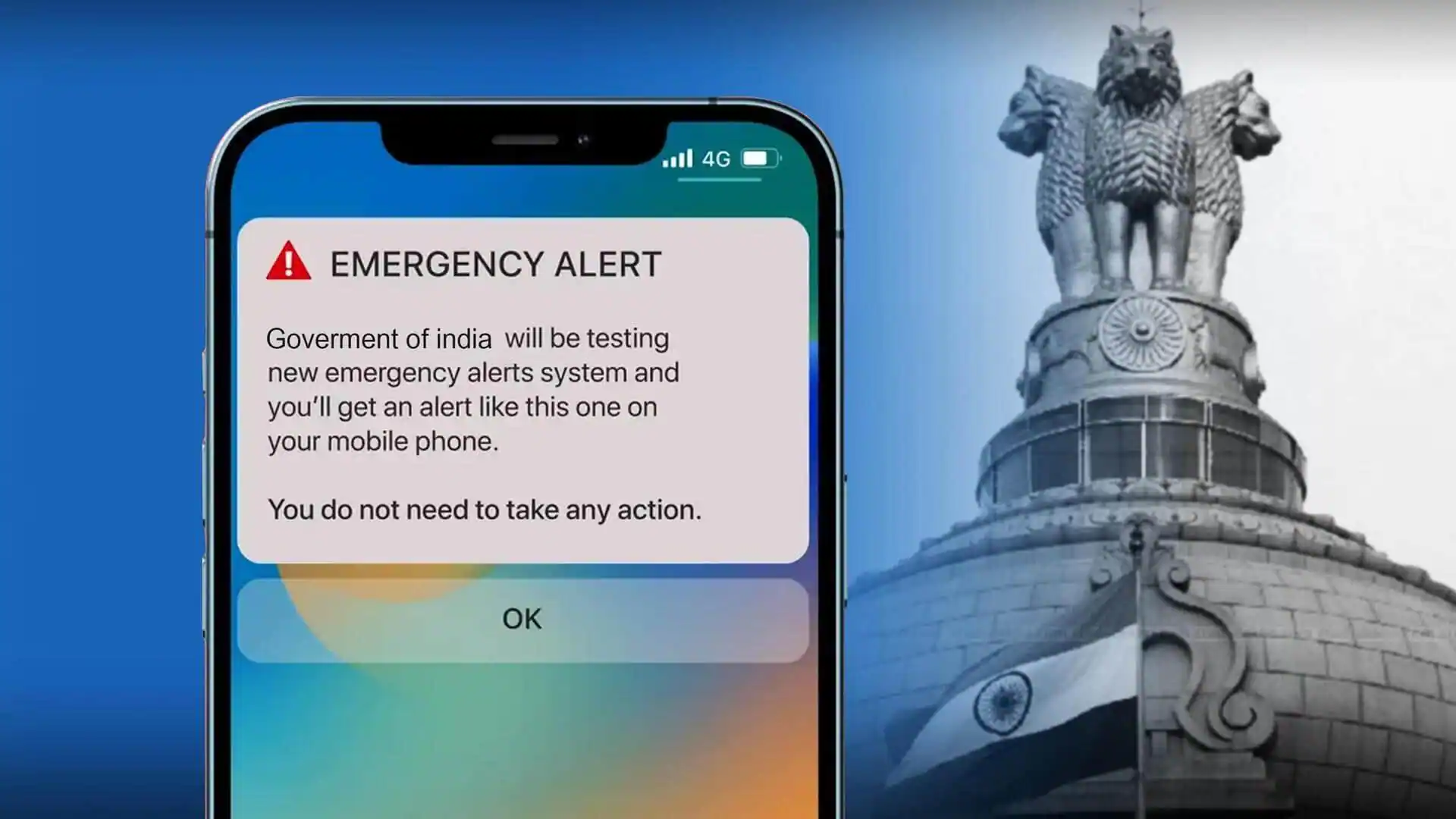
Mumbai: At around 11.40 AM on Saturday, millions of smartphones across India emitted a sharp beep, vibrated, and displayed a pop-up marked "extremely severe alert." Widely shared on social media as an NDMA alert (National Disaster Management Authority), it left most users confused about what they had received and whether they needed to act. For the governments of Japan, the United States, South Korea, Singapore, and more than 25 other countries, what India just tested has been standard emergency infrastructure for years. The rollout date remains unannounced.
If your phone received that alert, here is what happened and why it matters.
The alert was a nationwide test of Cell Broadcast technology, operated through the SACHET platform developed by the Centre for Development of Telematics under the Department of Telecommunications, in collaboration with the National Disaster Management Authority.
At its core, cell broadcast is a one-to-many communication method: a single message is transmitted from a mobile network tower to every compatible device connected to that tower simultaneously, without needing a phone number, an app, or a subscription. Unlike conventional SMS, which sends individual messages one at a time and can be delayed or filtered, cell broadcast overrides network congestion entirely. The message arrives within seconds, triggers a distinct alert tone and vibration pattern, and stays on screen until the user presses OK. Visitors and international travellers in the affected area receive it too, in their own language if the system supports multilingual delivery. India's SACHET system does.
Union Minister Jyotiraditya Scindia described the initiative as an atmanirbhar effort, highlighting that the system was built indigenously by C-DOT and is capable of delivering warnings across 21 languages. He said: "In collaboration with the National Disaster Management Agency (NDMA), Ministry of Telecommunications has started a cell broadcasting solution through Centre for Development of Telematics (C-DOT). In case of any natural disaster in the country, to save the lives of our people, a confluence of human resources and technology has been done today."
Scindia added: "C-DOT conducted Indian government's most special R&D, and through cell broadcasting solution, an atmanirbhar solution was sent to all Indians in 21 different languages."
The technology itself is not new. Cell broadcast was developed in the early 1990s by the European Telecommunications Standards Institute and first demonstrated in 1997 in Paris. Japan adopted it in 2007 as part of its J-Alert system, which sends instant warnings about earthquakes, tsunamis, volcanic eruptions, and ballistic missiles. The system was first trialled in Kobe, the city devastated by a 1995 earthquake that killed nearly 6,500 people. The US launched its Wireless Emergency Alerts system in 2012. South Korea, Singapore, Canada, New Zealand, and Chile have since deployed systems of their own. The European Union mandated member states to implement cell broadcast-based warning systems by 2022. More than 30 countries now use the technology as standard emergency infrastructure.
India, by contrast, has been running on an SMS-based alert system, which has sent over 134 billion messages across 36 states and Union Territories in 19 languages. That system works. But it requires a phone number, it can be delayed under network load, and it can be missed entirely if the phone is on silent.
Japan adopted cell broadcast in 2007. The US in 2012. The EU mandated it by 2022. India ran its first major nationwide test in 2026. The gap is real. What matters now is how fast it closes.
AdMirror, May 2026
This was the first time India has run cell broadcast at this scale. Limited trials had been conducted before, but this was a pan-India exercise, and the response was visible: social media filled up with confused posts from users who did not know what they had received, some alarmed, some curious, and many who had never been told the test was coming.
The Department of Telecommunications posted a clarification: "This is part of the testing of the Emergency Alert System, so that accurate information can be received on time during disasters. During testing, this message may appear repeatedly. Ignore it; you do not need to do anything."
Since multiple mobile towers and telecom networks are being evaluated simultaneously, some users may receive the alert more than once during the testing phase. This is expected behaviour. The alerts are only received on devices where cell broadcast test notifications are enabled, which can be managed through a phone's safety and emergency alert settings.
The context for why this matters is straightforward. India has seen an increasing frequency of climate-related disasters including flash floods, extreme heat events, and cyclones. The ITU, which implements the UN's Early Warnings for All initiative, describes cell broadcast as a critical element for delivering early-warning alerts to populations at risk, and has called on countries to mandate its use for public warnings. The technology requires no personal data, works across all compatible devices regardless of whether they belong to Indian residents or international visitors, and delivers alerts in multiple languages simultaneously. The SACHET platform has been built indigenously by C-DOT, aligning with the government's broader push to develop domestic telecom infrastructure.
What the test did not answer is the most important question: when does the full rollout happen. The government has not announced a timeline. The SMS system remains the primary emergency communication channel. The gap between a successful nationwide test and a live, operational system is where the policy work now sits.
For telecom operators, platform developers, and the media and communications industry more broadly, the infrastructure is evidently ready. The decision on when to activate it formally is what India is still waiting on.


