











Mumbai: Artificial intelligence is rapidly transforming the digital advertising landscape, but alongside new opportunities come new risks. As AI-generated content floods platforms, advertisers are grappling with challenges around misinformation, deepfakes, brand suitability, and consumer trust. At the same time, markets like India are becoming increasingly fragmented, with audiences consuming content across languages, cultures, and platforms at an unprecedented scale.
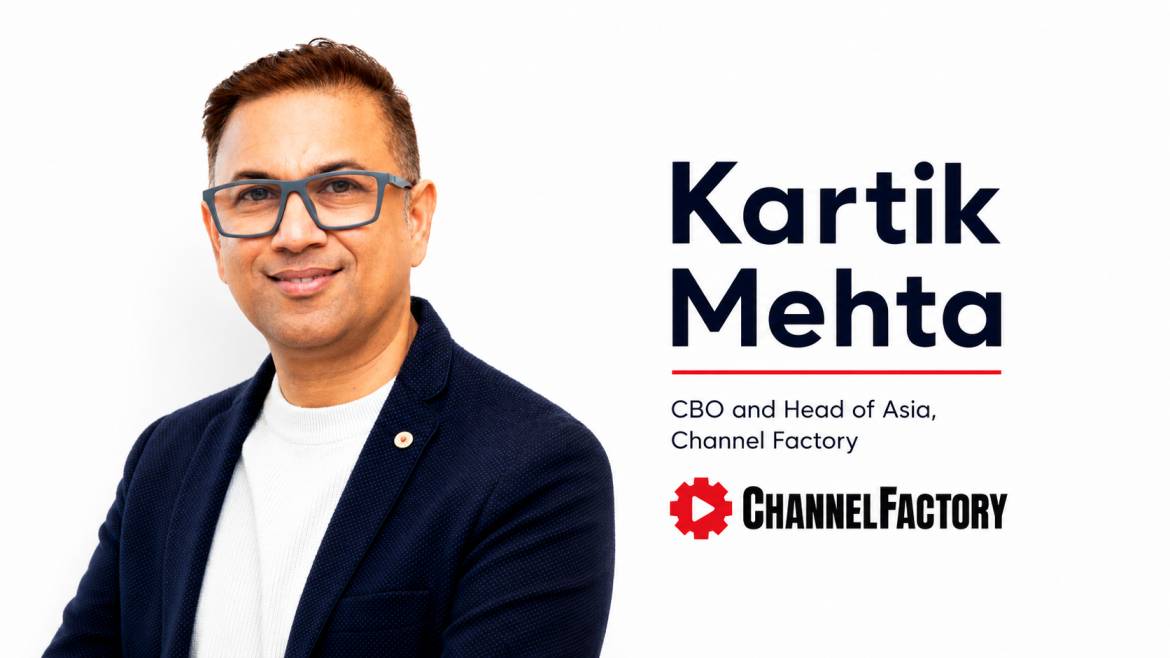
In this conversation with AdMirror, Kartik Mehta, CBO and Head of Asia, Channel Factory, shares his perspective on the future of contextual advertising, the evolution of brand safety into brand suitability, and why conscious advertising is becoming a strategic imperative for marketers.
Edited Excerpts
What made you join Channel Factory, and what drew you to it after your experience at VServe?
What attracted me to Channel Factory was the opportunity to build something from the ground up again. I have always enjoyed the challenge of creation more than optimisation. Taking a business from zero to one, and then from one to ten, is far more exciting to me than inheriting a successful operation and scaling it further. There is a different level of problem-solving, resilience and innovation required when you are building from scratch, and that is where I find the most energy.
The second motivation was equally interesting. Throughout my career, whether at VServe or other organisations, I have largely worked with Indian founders and helped Indian businesses expand regionally and globally. I understand that ecosystem instinctively because it is the world I have grown up in professionally.
With Channel Factory, the challenge was the reverse. Here was a globally established company, and the question I asked myself was: Can I help a global business truly understand Asia? Can I localise its thinking, adapt its approach to regional realities, and build relevance in markets that are culturally diverse and fundamentally different from the West? That combination of building something new and helping a global company navigate Asia's complexity was what made the opportunity impossible to ignore.
Having scaled international businesses before, what similarities and differences do you see in building a global ad-tech company today compared to five years ago?
There are definitely some similarities. Five years ago, as today, success in ad-tech still comes down to solving a real business problem for advertisers. Technology alone is never enough. Whether you are entering a new market or scaling globally, trust, measurable outcomes, and strong partnerships remain the foundations of growth.
What has changed dramatically is the complexity of the ecosystem. Five years ago, conversations were largely centred around scale, audience targeting, and programmatic efficiency. Today, advertisers are navigating a much broader set of challenges, from privacy regulations and signal loss to brand suitability, misinformation, AI-generated content, and increasing demands for transparency.
The role of AI has also fundamentally changed. Earlier, AI was often viewed as a supporting capability that improved optimisation. Today, it sits at the core of product innovation, decision-making, and media strategy. Advertisers expect technology partners not only to drive performance but also to provide intelligence, accountability, and safeguards in increasingly fragmented digital environments.
Another major difference is the maturity of buyers. Brands and agencies are asking tougher questions than ever before. They are no longer impressed by technology claims alone. They want proof of outcomes, independent validation, and solutions that align with both business objectives and brand values. For companies building globally, that means innovation can no longer be measured only by efficiency. It must also be measured by relevance, transparency, and the positive impact it creates within the digital ecosystem.
Brand safety has evolved into brand suitability and now conscious advertising. How do you define the next phase of this evolution, especially in the AI-driven media ecosystem?
Brand safety is no longer the conversation. The real conversation is brand consciousness.
Six or seven years ago, brand safety was a genuine concern. Today, thanks to advances in moderation technology, AI-driven detection and platform-level controls, most major brands
consider basic brand safety a hygiene factor. It is expected, not differentiated.
That does not mean the problem has disappeared. Fraud, spoofing and manipulation continue to evolve. In fact, as ad-tech becomes more sophisticated, so do the bad actors trying to game the system.
The industry's first evolution was from brand safety to brand suitability, moving beyond a one-size-fits-all approach to understanding that suitability differs by category. What may be perfectly acceptable for an alcohol brand could be entirely inappropriate for a BFSI brand. Suitability introduced context into the conversation.
The next evolution is what I call brand consciousness. This is no longer a media or advertising question. It is a leadership question. Every organisation must decide what it stands for. Is it concerned about youth mental health? Cyberbullying? Suicide prevention? Body shaming? Diversity and inclusion? Digital wellbeing? Real consciousness requires leadership commitment and operational action.
The challenge becomes significantly harder in an AI-driven media ecosystem. Every minute, enormous volumes of AI-generated content are being created and distributed across platforms. While AI has democratised content creation, it has also dramatically increased the volume of low-quality, synthetic and often meaningless content competing for attention.
The question for brands is no longer whether their ads are safe. The question is: What kind of content ecosystem do they want to fund? Just because a piece of content is technically safe does not mean it adds value to consumers, culture or society. Brands must decide whether they want to align themselves with meaningful content or simply chase scale within an increasingly cluttered digital environment.
There is also an irony emerging within the industry. In the pursuit of safety, brands often over-engineer communication. Influencers are handed rigid scripts and tightly controlled messaging frameworks. While intended to reduce risk, these measures frequently strip away authenticity, the very quality that audiences connect with. The result is a paradox: brands are becoming safer, but not necessarily more relevant.
"The question for brands is no longer whether their ads are safe. The question is: What kind of content ecosystem do they want to fund?"
Kartik Mehta, CBO & Head of Asia, Channel Factory
Social platforms are under increasing scrutiny for their impact on youth mental health. Where do you believe advertisers should draw the line between performance marketing and ethical responsibility?
The industry keeps talking about performance, but very few are talking about consequences.
The impact of social media on youth mental health should already be a boardroom conversation. Yet, despite growing concerns around body shaming, cyberbullying, anxiety, sleep disruption and digital addiction, very few brands have taken a clear public position on these issues.
Ethical advertising cannot be outsourced to regulators or platforms alone. It requires leadership from CEOs, CMOs and brand custodians who are willing to define what responsibility means for their organisation. The challenge is that ethical or conscious advertising means different things to different companies. For some, it may be youth mental health. For others, it could be cyberbullying, diversity, body positivity or digital wellbeing. The important thing is making a deliberate choice rather than treating responsibility as a CSR checkbox.
What concerns me is that many of these issues remain largely unaddressed despite their
growing impact. We know social validation mechanisms affect self-esteem. We know online commentary influences body image. We know cyberbullying can have severe emotional consequences. Yet these conversations rarely feature in media planning discussions.
The uncomfortable truth is that many leaders only recognise the seriousness of these issues when they affect someone close to them. As advertisers, we have to ask a harder question: Are we merely optimising impressions and engagement, or are we also taking responsibility for the environments we help fund? Because every media investment is ultimately a vote for the kind of digital ecosystem we want to create.
A lot of advertisers still depend heavily on keyword blocking, which often leads to over-censorship and missed opportunities. How is Channel Factory changing the mindset through contextual intelligence?
Keyword blocking was built for a simpler internet. Today's content ecosystem demands a far more intelligent approach. The problem with keyword blocking is that it assumes words have fixed meanings. They do not.
Take a simple example. The word "shot" appears on many global exclusion lists. But is it referring to a gunshot, a basketball shot, a camera shot or a medical shot? The word alone tells you nothing. The context tells you everything.
This is where traditional brand safety approaches often fail. They do not understand meaning; they identify triggers. The result is over-censorship, reduced reach and missed opportunities for brands to appear alongside highly relevant content simply because a particular word exists within it.
At Channel Factory, we approach the problem differently through what we call multimodal analysis. Instead of looking at a single keyword, we analyse the complete content environment. We examine text, audio, visuals, sentiment and contextual signals together to understand what is actually being discussed. A word is never evaluated in isolation; it is evaluated within the broader narrative.
This becomes even more important in markets like India. India is not just multilingual; it is culturally layered. The same phrase can carry different meanings depending on language, geography, context and audience. Simply translating regional content into English and applying global moderation frameworks often results in inaccurate interpretations.
The bigger shift, however, is philosophical. The question should no longer be: "Which words should we block?" The question should be: "Which content environments align with our brand values?" That is why we move brands towards suitability scoring rather than binary decisions. Content is not black and white. And neither should brand safety be.
YouTube, Meta, TikTok and CTV all operate differently. What are the biggest misconceptions brands have about contextual targeting across these ecosystems?
The biggest misconception is that contextual targeting comes at the expense of reach. Many brands assume that if they become more selective about content environments, they will lose scale. The reality is that contextual targeting does not reduce reach; it improves the quality of that reach.
There is a difference between reaching people and reaching people in the right environment. A consumer watching content they genuinely care about is more receptive, more attentive and more likely to form a positive association with a brand.
The industry's obsession with scale has also created a blind spot. Many marketers can tell you exactly how many impressions they bought but struggle to explain where those impressions actually appeared.
Take a simple example. A five-year-old watching children's content on a family device may still be served advertising intended for the adult account holder. On paper, the targeting works because the demographic box is ticked. In reality, the ad appears in a completely inappropriate context. The problem is not targeting. The problem is context.
The question marketers should be asking is not just, "Did I reach my audience?" It should also be, "Where did I reach them?" Because context does not just influence performance. It
influences perception.
Beyond the philosophy, what measurable business impact are brands actually seeing from aligning with positive and expert-validated content?
The biggest misconception is that conscious advertising is purely an ethical conversation. Increasingly, it is becoming a business conversation. Brands are realising that where an ad
appears can be just as important as who sees it.
Alcohol brands, for example, are among the strongest advocates of contextual intelligence. Their objective is not just compliance; it is ensuring their messaging does not appear alongside content consumed by underage audiences. The risk is not simply regulatory. It is reputational.
And reputation has become a measurable business metric. In an era of screenshots, social media outrage and instant public scrutiny, one misplaced ad can generate more negative attention than an entire campaign generates positive impact.
The measurable outcomes typically show up in three areas. First, stronger brand perception: appearing alongside trusted, high-quality content creates stronger brand affinity. Second, reduced reputational risk: avoiding negative publicity and regulatory scrutiny directly impacts long-term brand equity. Third, improved media effectiveness: contextually aligned environments drive stronger engagement, higher attention and better brand recall compared to campaigns optimised purely for scale.
Programmatic advertising has made media buying highly efficient. It has not necessarily made it highly intentional. That is where contextual intelligence becomes critical. The future of conscious advertising will not be defined by morality alone. It will be defined by whether brands can prove that better environments create better business outcomes.
India is one of the fastest-growing digital video markets globally, but also one of the most culturally fragmented. How are AI and contextual technologies adapting to multilingual and hyperlocal content environments here?
India presents one of the most exciting opportunities for contextual advertising because it is not a single digital market. It is hundreds of micro-markets coexisting across languages, cultures, interests, and consumption behaviours. Traditional targeting approaches often struggle to understand these nuances, especially as users increasingly consume content in regional languages and hyperlocal contexts.
What makes India particularly unique is the diversity of content ecosystems, from Hindi and English to Tamil, Telugu, Bengali, Marathi, and several other regional languages. Our technology is continuously evolving to analyse content at scale across these environments, helping brands identify positive, culturally relevant, and brand-safe content opportunities that may otherwise be overlooked.
As AI becomes more sophisticated, the future of advertising in markets like India will be less about targeting individuals and more about understanding the context, culture, and intent surrounding content consumption. That is where we believe the next phase of digital advertising growth will come from.
As AI-generated content explodes across platforms, do you think the industry is prepared for the next wave of misinformation, deepfakes, and suitability challenges? How should brands prepare?
The reality is that AI-generated content is growing far faster than the industry's ability to govern it. While platforms, advertisers, and technology providers have made significant progress in brand safety and content moderation, I do not believe we are fully prepared for the scale and sophistication of the next wave of challenges.
Deepfakes, synthetic media, manipulated narratives, and AI-generated misinformation are becoming increasingly difficult to detect because the technology is improving at an extraordinary pace. The challenge is no longer just about identifying harmful content; it is about understanding context, intent, credibility, and how content may evolve and spread across digital ecosystems.
For brands, this fundamentally changes the conversation from traditional brand safety to brand suitability and contextual intelligence. A piece of content may not violate platform policies, but that does not automatically make it the right environment for every brand.
At Channel Factory, we believe the industry needs to move beyond reactive approaches. Brands should be proactively defining what content environments align with their values, audiences, and objectives rather than focusing only on exclusion lists. AI can be incredibly effective in helping identify positive, credible, and contextually relevant content at scale, but it must be supported by human oversight, expert validation, and transparent measurement
frameworks.
The good news is that AI is also part of the solution. The same technologies enabling content creation can help analyse, classify, and evaluate content more intelligently than ever before. The challenge for the industry is ensuring that innovation in detection and suitability keeps pace with innovation in content generation.
Ultimately, the brands that will be best positioned are those that treat suitability as a strategic business imperative rather than a compliance exercise. In an era of synthetic media, trust will become one of the most valuable brand assets, and where your advertising appears will matter as much as the message itself.


