











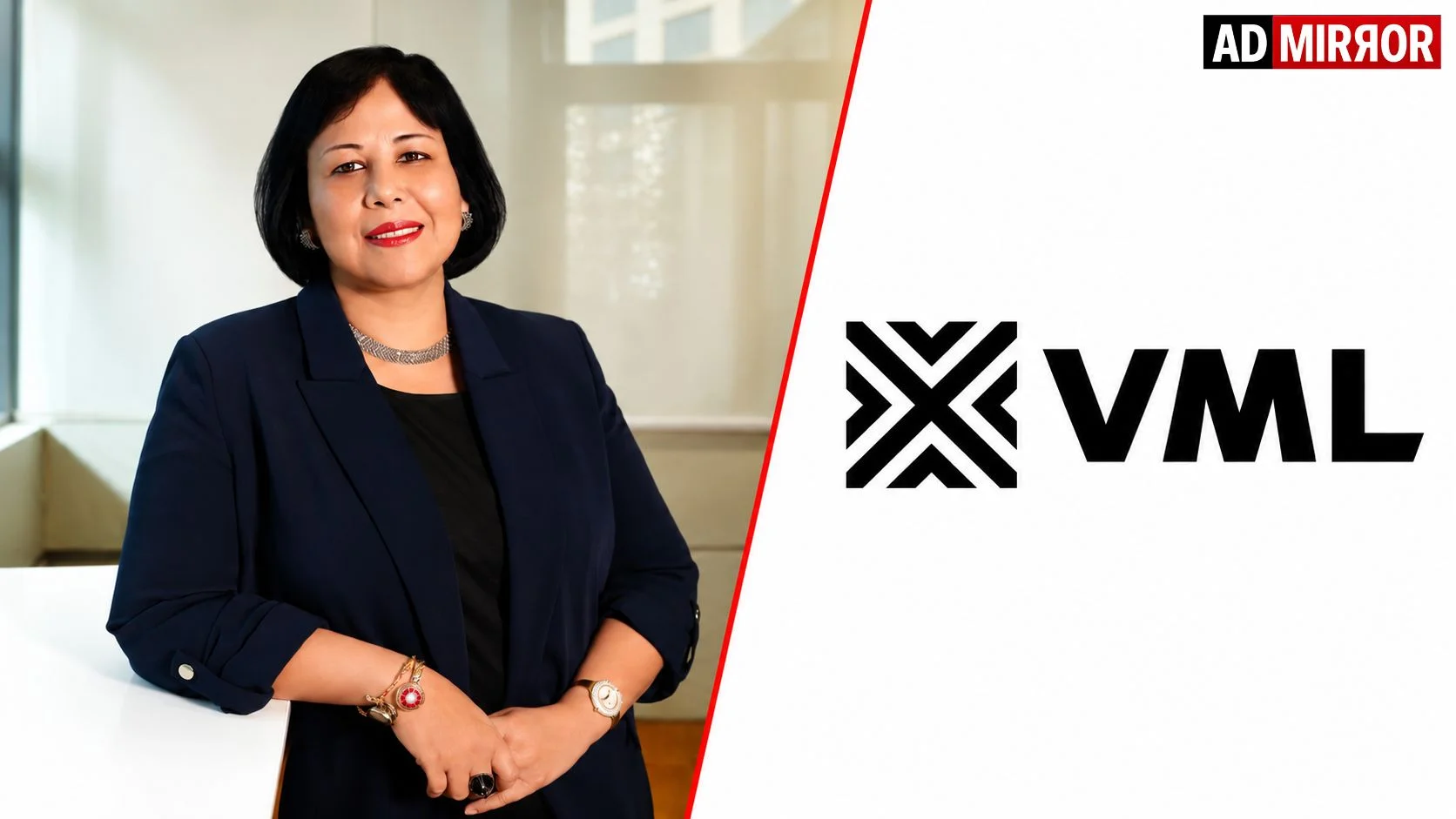
What does it take to lead when the old agency playbook is no longer enough? For Babita Baruah, CEO, VML, the answer is not simply being a woman in a traditionally male-dominated leadership ecosystem. It is about having the ability to rewrite the playbook itself.
In this candid interaction with Admirror, Baruah opens up about the realities of leading one of India's largest agency businesses at a time when the industry is being pulled in multiple directions AI, talent churn, changing client expectations, pressure on margins and the growing demand for agencies to prove their business value.
The gender question inevitably enters the conversation. Baruah is among the relatively few women CEOs at the helm of a major agency business. But rather than making leadership about men versus women, she makes a more compelling argument: the industry needs a different brand of leadership. That becomes particularly relevant when you are integrating six agency businesses, each with its own legacy, talent, clients and market equity.
Baruah talks about the tension between ideas and revenue, why good ideas ultimately drive good business, how VML is thinking about talent retention, and why agility requires more than producing an ad in two hours. On AI, her position is equally clear: technology can accelerate execution and reshape workforce models, but the idea, judgement and cultural understanding remain fundamentally human.
You are one of the few women heading a major agency. What is still holding women back from the boardroom, and what needs to change?
Yes, there is a lacuna. If you look at the statistics and simply count the numbers, there are fewer women in leadership.
But I would look at it through two lenses. First, the journey that leads to leadership. You don't become a leader overnight, although it may appear that way from the outside. There is a journey made up of milestones, opportunities, mentorship and the support of organisations and external mentors. The question is, are we doing enough to shape that journey today?
The second is to ask ourselves, who is the leader of tomorrow? And I want to answer that specifically in the context of our industry. We need to look at what organisations, including ours, are doing to shape future leaders. Are we creating enough opportunities and experiences to prepare them for leadership? We know we need to do more; the question is what more we can do, particularly when the industry itself is dealing with multiple headwinds.
Mentorship is an important area. At WPP Stella, for instance, I am one of the Super Mentors. The programme was shaped by input from participants, and we have tracked their journeys over the last four or five years. It is not just about the formal one-year mentorship. Networking is equally important. The Stella team gives participants access to CEOs, creative heads, planning heads and other senior leaders, and those networks continue even after the programme ends.
We also have what I call safe-room conversations, where women can openly discuss some of the impediments they may not feel comfortable raising in a boardroom or conference room. Why don't you feel comfortable expressing yourself? What do you want to achieve next? Creating those spaces where women can speak honestly is important.
The other area is hiring. When you cast the net, particularly at middle and senior levels, statistics mean you may get more men than women. The question is whether organisations have the patience to look beyond the first few candidates. Industry is impatient. Clients are impatient. Roles need to be filled. But do we have the patience to wait and ensure that deserving women also get an opportunity to be considered?
And I want to be clear, this is not about quotas. I would never advocate hiring someone simply because she is a woman. It is about giving deserving women the opportunity to see the role, network and compete on merit. Because there are fewer women in the pool, it can sometimes take a little longer.
The second big change is the leadership playbook itself. I believe the leadership playbook is changing, and that will naturally create more opportunities for women. Legacy leadership models were perhaps not written with women in mind or, more importantly, with contemporary leadership in mind. Today, leadership is a combination of business understanding, revenue growth, empathy, people management, creativity and the ability to think differently.
Women often drop out at the middle-management stage after having children. How is VML helping them return and return meaningfully?
We do have that problem. At the mid-level, women do drop out, but I see this primarily as a societal issue rather than just an industry issue. It exists across industries.
At VML, we actively encourage what I would call a homecoming, ghar wapsi. I have personally encouraged it, and the system has encouraged it as well. Where it gets more complicated is the question of whether someone can return to the same role or level. That is difficult to commit to because our industry is constantly evolving. Someone may take a year, a year and a half or even two years away to raise a child. When they return, the role itself may have changed.
So, when someone comes back, we look at them afresh. What we already know about the person remains valuable, but we also ask: what would this person be best suited for in the current environment? If there isn't an immediate opportunity, we keep them in mind. Across the larger WPP network too, we recommend people to one another.
I would also use this opportunity to tell women at this stage that it is okay to take a break and consider different options. But it is equally important to recognise that a very long break can mean losing out on opportunities, even when that break is a personal choice. Our industry is evolving every day. New platforms, technologies, skills and ways of working are emerging constantly. If you completely step away from the discipline of learning and keeping yourself updated, returning can become harder.
Women have made it to the top of agencies, but has the glass ceiling really been broken or has the industry simply created a few more exceptions?
I think it would be foolish to say there is no glass ceiling. But I do believe it has largely been broken, at least in parts of the industry. If you look at WPP and, specifically, the number of women CEOs across the organisation, there are quite a few. So, with confidence, I can say that within our organisation, we have either broken the glass ceiling or perhaps there was no glass ceiling to begin with.
But if I look at the broader industry, and include brands and marketing, I do believe there is still work to be done, particularly at the C-suite level where you are talking about P&L ownership. That proverbial ceiling has been broken, but it has not been broken enough. And I think the women who are breaking through are often the ones bringing new thinking, while the organisations enabling them are also willing to embrace that new thinking.
"You cannot build tomorrow's organisation by simply fixing yesterday's organisation. If your leadership playbook is based on what worked for legacy agencies, you risk protecting the past rather than preparing for the future."
Babita Baruah, CEO, VML
As VML's CEO, you carry the P&L. When revenue is under pressure, does the business ultimately choose the numbers over the idea?
It would be too simplistic to say it is either one or the other. But if you ask me what comes first, it must be business. If there is no business, there is no company, no organisation and, ultimately, no people. Revenue generation therefore determines the structure of an organisation, the roles you create and the investments you make. But in our industry, good business happens with good ideas. And that is where the chicken-and-egg situation comes in.
The real question is how much we are willing to invest — not just in having the right mix of teams, but in finding people who are strong thinkers and bring real value through their ideas; people who are strong on execution; people who know how to collaborate. Today, you cannot do everything yourself. You must collaborate with partners, with the external ecosystem and across the organisation.
So, yes, it is both. It is very much a head-and-heart equation. The head tells you that revenue generation is the most important thing. But having been in this industry for so long, I genuinely believe that if you have good ideas, revenue eventually follows. The challenge is that sometimes you need a little patience. And numbers don't work on patience — and I know that myself.
VML has had a strong run with work such as Kolhapuri, Coca-Cola Holi and the KitKat vending machine. What is driving this creative momentum and can an agency build a culture where big ideas become a habit rather than an occasional breakthrough?
I would give a lot of credit to the creative culture we are trying to build at VML. We have good momentum, and the work you mentioned from Kolhapuri to the vending machine and Coca-Cola Holi is a reflection of that. We owe a lot to Kalpesh Patankar, who was our Group CCO who led much of this work with the teams. But no individual can create this alone.
You need to create a culture of creativity across the agency. For us, that means looking for ideas that are rooted in culture and, at the same time, create some kind of shift for the brand. Not everything can or should be reduced to a number. But we should be able to ask: Is the idea making the brand think differently? Is it creating attention, engagement or a new conversation? And that conversation happens with the client partner.
We have made a good beginning. But are we doing enough? My answer is no. We need much more of this. We cannot be dependent on a few moments or a few creative winds, particularly when VML wants to be known as an agency that consistently produces strong ideas.
How important is the client's appetite for risk in making that happen? Are brands genuinely giving agencies the space to experiment?
Some are. I wouldn't say all are, and those are often the clients where you see some of the most industry-recognised work — ideas that not only win awards but also move the needle for the business. A lot of the credit goes to the marketing teams. Many of them are led by very strong marketers who treat the agency as a genuine partner.
But there are also businesses where the nature of the business itself demands agility and a constant flow of business-as-usual ideas. These may not win awards on the biggest stages, but they are doing the everyday job of keeping consumers engaged, and we must respect that work equally. I have consciously encouraged our teams and leaders to take the same sense of pride and delight in good BAU work as they do in a big creative idea. Because that is what keeps the kitchen fires going.
Consultancies, AI and in-house teams are all challenging the traditional agency model. What is the uncomfortable truth agencies need to confront about themselves?
I think we must admit that the pace of change needs to be faster than what we are currently comfortable with. We need to be more agile, and agility does not simply mean turning around an artwork in two hours instead of two days. That is only one part of it, and technology can take care of much of that.
The bigger issue is mindset. We must get comfortable with the idea that sometimes an idea can be perfected as you go along. You must get it out there, learn and improve it. Technology companies often work that way. There is a mindset of building, learning and evolving rather than waiting for everything to be perfect before you move.
The same applies to how we structure teams. We need to become more comfortable with flexible teams rather than always relying on a fixed core structure. There can be people who come in for a particular project, contribute their expertise and move on. These are new models, and organisations are not always comfortable embracing them quickly.
VML brought together six agencies under one roof. Has the integration delivered the business value you expected or is the harder work of aligning talent, clients and cultures still underway?
I think integration has progressed well because we started with a clear roadmap: bring the businesses together, retain the right talent and build a right-sized organisation with the capabilities VML needs. But integration is not just about what happens internally. Our clients are going through change too. Many of them have strong relationships with teams and people, and naturally, they don't want that to change. That is one of the biggest challenges.
When six or seven operating companies come together, each has its own market equity, its own talent and its own client relationships. You can't bring everything across. You must make choices. For us, the question was: what is the right team, what are the capabilities we need, and how do we build an organisation that delivers better for clients while also making commercial sense?
Integration doesn't have a finish line. You can't say, "Okay, we're done." People change, clients change, business changes, and therefore the organisation must keep changing too. So, two-and-a-half years in, I think we've made good progress. But the work continues. I wouldn't take credit for it personally. It's been an organisational effort, and we've had strong support from the wider organisation throughout.
Six agencies, different cultures and one new organisation. Does a woman at the helm bring a different leadership advantage to an integration like this or is it ultimately about the leader, not the gender?
I wouldn't say women necessarily do it better than men. I would say a transformation like this needs a different brand of leadership and perhaps I happen to be a woman doing it.
For me, the biggest shift is this — you cannot build tomorrow's organisation by simply fixing yesterday's organisation. If your leadership playbook is based on what worked for legacy agencies, you risk protecting the past rather than preparing for the future. In an integration, that can mean compromising good people simply because they belong to a particular legacy or operating company.
The more important questions are: What does this organisation need to become? What capabilities will matter tomorrow? Who are the people who can build that future? And then comes the human part of transformation. Have you had the right conversations with your clients, your partners, your ecosystem and, most importantly, your people?
Because when you are bringing organisations together, people need more than a new structure. They need clarity, confidence and a sense of where they fit into the future. So, for me, leadership in a transformation is not about protecting what made you successful yesterday. It is about having the courage to decide what you may need to leave behind to become successful tomorrow. That, to me, is the real leadership advantage. And it has less to do with whether you are a man or a woman, and much more to do with how willing you are to rewrite the playbook.
AI can now create an ad in minutes. What remains uniquely human and where should agencies draw the line?
Human thinking remains irreplaceable.
There is a lot of excitement today about people creating their own ads with AI, and I think that's healthy. It means people are experimenting with technology. It is like a child playing with Lego or clay — you never know where that experimentation can lead. But experimentation should not become the assumption that AI replaces human thinking.
The real question is, who has the idea? What problem are we solving? And where does AI add value? We use AI extensively, and it can certainly help us work with a leaner, more efficient workforce. But the idea, the judgement and the understanding of the consumer and the culture must remain human. I don't see this as humans versus machines. It is about human beings deciding how and where machines should be used.
At senior levels, is there still a different standard for women especially when they negotiate, assert themselves or ask for what they are worth? Have you had to fight that bias yourself?
I would tell women one thing — don't get intimidated by four men sitting across the table when you're negotiating your worth.
When I look back, we didn't have the kind of mentorship and access that young women have today. So, a lot of the battles were internal. One of the biggest was believing that I was worth what I believed I was worth and having the confidence to establish that externally. Even as you step into senior leadership, there can be moments when you wonder, "Will my voice be heard?" Not because you can't speak, but because you may be one of very few women in the room.
Over time, I've learnt that leadership doesn't have to be aggressive to be effective. My favourite quote is: "Poise is the art of raising the
eyebrow instead of the roof." That is very much how I lead. Assertiveness is not aggression. Empathy is not weakness. Kindness does not diminish authority. And being accessible or showing vulnerability doesn't make you less of a leader. I don't believe women should have to change who they are to fit an old definition of leadership.
Is assertiveness still more likely to be labelled "aggressive" when it comes from a woman?
Yes, I think that bias still exists. We've even seen brands build campaigns around women being called "bossy" simply for behaving like leaders. Part of the reason is that so few women have historically reached the C-suite. The women who do get there have often had to overcome societal, family and organisational barriers. They are often bold, willing to speak their minds and push boundaries. That can be mistaken for aggression because it doesn't fit the traditional stereotype of how a woman is expected to behave. So, organisations need to stop asking women to fit a particular leadership mold.
The real shift is not getting women to lead differently. It is getting organisations to recognise that leadership can look different.
Talent is the agency industry's biggest currency. How do you retain your best people when the market is constantly offering them new opportunities?
Retention is not just about compensation. People stay when they are learning, growing, doing meaningful work and can see a future for themselves. We try to give people exposure to different businesses, different challenges and different capabilities. Mentorship, responsibility and visibility matter too, particularly identifying talent early and giving them opportunities before they start looking elsewhere.
We also must accept that people will move. Retention isn't about holding on to everyone forever. It's about creating an environment where your best people want to stay. The agency model is changing, so our talent model must change with it — more flexibility in roles, teams and career paths. Ultimately, people stay when the opportunity ahead is more exciting than the opportunity outside.
Two years from now, what will VML need to have achieved to prove that the integration has truly translated into growth and what role do you see yourself playing in getting it there?
Let me start with VML. We are at an important point in the journey. The integration phase has given us the scale and capabilities; now the focus is on turning that scale into growth. I believe we are well on that path. We have greater stability, a strong market reputation and, importantly, significant client equity carried forward by legacy agencies. The opportunity now is to bring those relationships and capabilities together into one stronger VML proposition.
For me, the next phase is not simply about becoming a bigger agency. It is about becoming a more valuable agency to clients and converting that value into sustainable growth.
As for me, WPP has been home. I've spent my entire career here, so it is difficult for me to imagine being anywhere else. Of course, life doesn't come with a two-year roadmap. I don't know exactly where it will take me. But I do know that I believe deeply in this organisation. WPP has supported me not only professionally but also through difficult personal moments, and that means a great deal to me. So, God willing and fingers crossed, you will continue to see me as part of WPP.


