











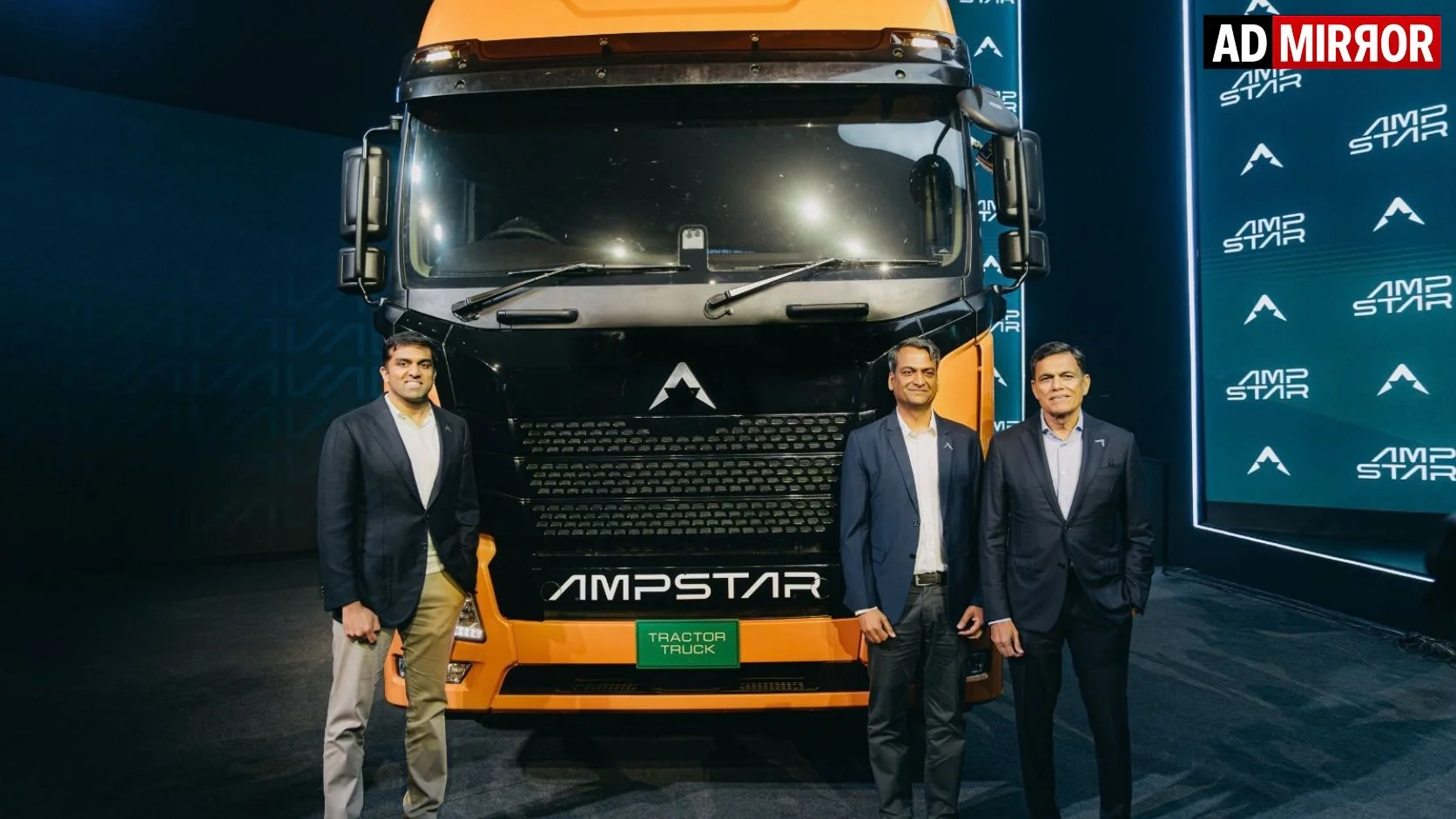
Mumbai: India's electric commercial vehicle market is still at the starting line. JSW, however, is arriving with a scale of ambition that suggests it sees the category not as a niche EV opportunity, but as the next major industrial transition in Indian mobility.
With Rs 2,500 crore invested in the first phase of its electric commercial vehicle programme, JSW Greentech has launched AMPSTAR, its electric buses and trucks brand, from a 90-acre greenfield facility at Chhatrapati Sambhajinagar. The plant is designed for 15,000 vehicles annually — 10,000 electric buses and 5,000 electric trucks.
And this is only the beginning. JSW has articulated a broader Rs 25,000-crore automotive investment ambition over five years, while its commercial-mobility strategy has been reported to target capacity for 100,000 electric trucks by 2030.
That changes the question around AMPSTAR.
It is no longer simple: Can JSW build a good electric truck?
The bigger question is: Can JSW build the economics, infrastructure and ecosystem that make electric commercial mobility scalable?
The Rs 2,500-Crore Statement Matters
Commercial EVs are a very different proposition from passenger EVs. Fleet operators do not buy primarily on design, features or brand appeal. They buy on total cost of ownership, uptime, payload, financing, charging and residual economics.
That is why AMPSTAR's full-stack proposition is strategically important. JSW is offering not just the vehicle, but charging infrastructure, operating solutions, financing, after-sales support and ownership models including leasing and Battery-as-a-Service.
The underlying message is clear: The product is a vehicle. The proposition is operating economics. And JSW is putting substantial capital behind that proposition.
Building Capacity Ahead of the Market
The interesting tension is that the electric truck market remains tiny compared with the conventional commercial vehicle market. JSW's management estimates that around 2.75 lakh heavy commercial vehicles were sold last year, against only about 800 electric trucks. Its expectation is that electric truck sales could reach around 3,000 units this year.
That means the penetration opportunity is enormous but the market still has to be created. JSW says customer conversations indicate strong interest, with operators experimenting with electrification rather than wanting to be left behind in the transition. The company has also indicated that it expects to announce 2,000 to 3,000 units of MoUs, while initial deployments within the JSW ecosystem are being used to generate operating data before wider third-party scaling.
That creates an unusual dynamic: JSW is building capacity ahead of a market that it believes is about to accelerate.
Starting at the Top of the Pyramid
JSW's choice of the 55-tonne tractor-trailer is particularly revealing. The company could have entered through a smaller, easier-to-electrify commercial vehicle. Instead, it chose what management describes as one of the most complex architectures, with high payload, high power requirements and sophisticated high-voltage systems.
The strategic reasoning is straightforward: establish engineering credibility at the top end, build customer acceptance, develop the distribution network and then move down the commercial-vehicle pyramid. Management says lighter commercial vehicles could follow in three to four years. LCVs are a distribution game. Heavy electric vehicles are still an engineering and operating-economics game. JSW appears to want to establish itself in the latter before taking on the former.
Born EV, Built for India
AMPSTAR's differentiation is also built around the idea that India's commercial EVs cannot simply be adapted from global platforms. The company calls its vehicles "born EV" and has developed its own drivetrain logic, software and algorithms.
The battery architecture includes a double-cooling system, with cooling plates above and below the cells, alongside additional structural reinforcement to address India's potholes, road conditions, payloads and temperatures. The facility's PT-ED process is another significant manufacturing investment, designed to improve corrosion protection and structural durability compared with conventional spray-painting processes. These aren't glamorous features. But for a commercial vehicle running hundreds of kilometres a day, durability is a financial feature.
The Operating-Cost Equation
JSW's strongest commercial argument may ultimately be the simplest one: electricity costs less to operate per kilometre than diesel under high-utilisation conditions. Management's illustration suggests a potential operating cost saving of around Rs 30 per kilometre, depending on operating assumptions. At 100,000 kilometres a year, that becomes a substantial annual operating-cost difference.
That is the equation that can potentially overcome the biggest obstacle to commercial EV adoption: higher upfront acquisition cost. And JSW is trying to address that upfront barrier through financing, leasing and BaaS. The company says financial institutions have already approved its vehicles for financing, while the creditworthiness and contractual visibility of the fleet operator remain important factors for lenders. In other words, the EV financing problem is being treated as part of the product, not somebody else's problem.
The Metrics That Now Matter
But Rs 2,500 crore is only the opening bet. JSW has capital, industrial ecosystem and manufacturing ambition. It now has to convert those advantages into vehicle uptime, fleet economics and repeat orders. The company's planned 15,000-unit plant is substantial relative to today's electric commercial vehicle volumes. Its longer-term ambition of 100,000 electric trucks by 2030 is larger still.
That creates a very different test for JSW. It doesn't need to prove that an electric truck can work. It needs to prove that thousands of electric trucks can work profitably, reliably and repeatedly across India's commercial transport ecosystem. That means the metrics to watch are no longer just range and battery capacity. They are cost per kilometre, payload efficiency, battery life, charging uptime, fleet utilisation, financing cost, service turnaround, residual value and, ultimately, customer ROI.
That is where AMPSTAR's Rs 2,500-crore bet will either begin to compound or face its real test.
AMPSTAR is best understood not as JSW's entry into electric vehicles, but as JSW's attempt to industrialise electric commercial mobility. The company is combining manufacturing scale, in-house engineering, financing, charging, BaaS and after-sales into one proposition. India's commercial EV transition will not be won by technology alone. It will be won when the CFO, fleet operator and driver all arrive at the same conclusion: electric makes better business sense. JSW has now put Rs 2,500 crore behind that proposition. The next number that matters is not investment. It is kilometres.
AdMirror Analysis


