











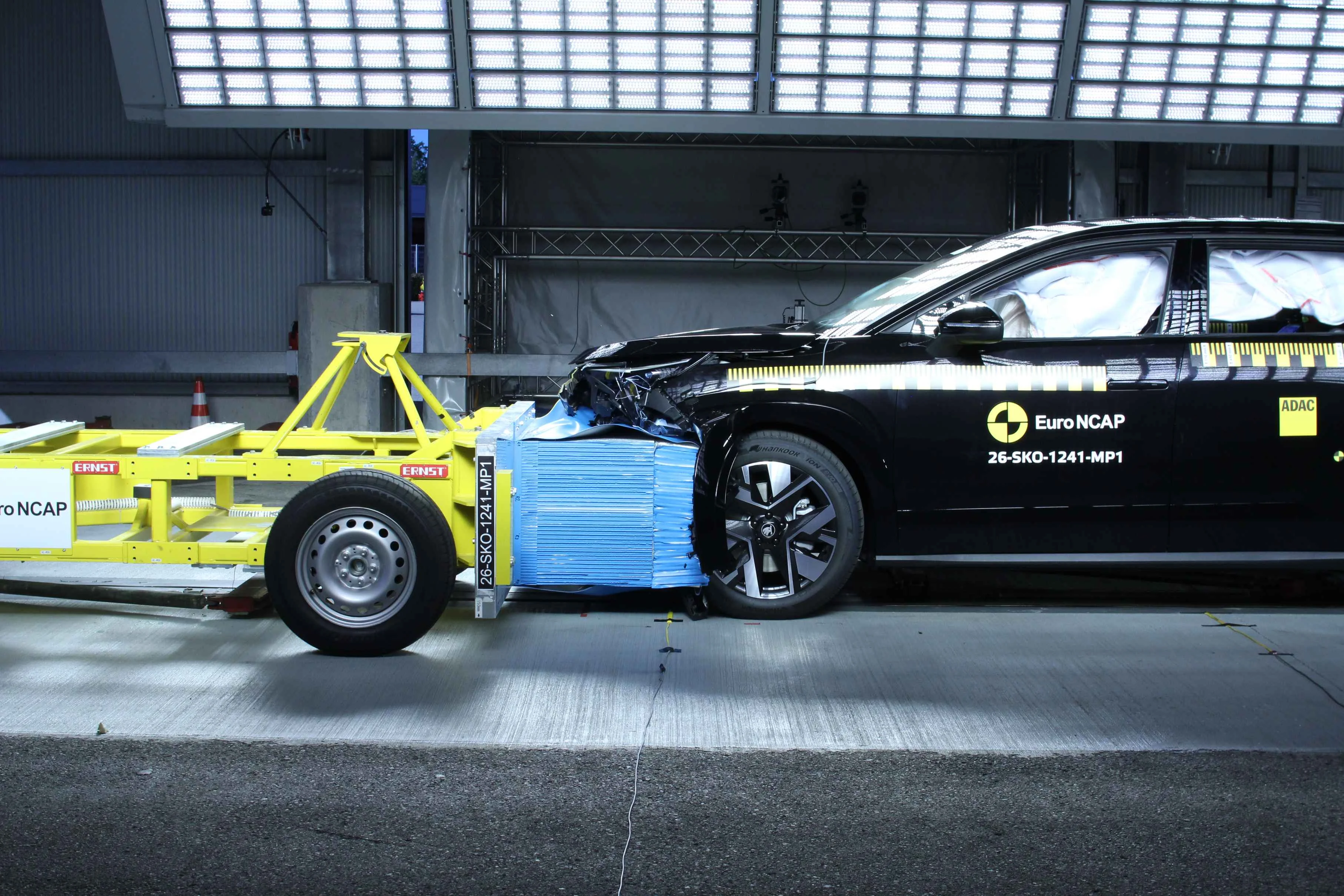
Škoda Auto's upcoming all-electric SUV, the Peaq, has received a five-star safety rating from the European New Car Assessment Programme (Euro NCAP). The vehicle recorded 94 per cent in Crash Protection, the highest score achieved in the category under the 2026 assessment protocol. It is also the first model to secure full points for occupant protection across all assessed crash configurations.
The tested left-hand-drive Peaq Selection 90 scored 92 per cent in Post-Crash Safety, 78 per cent in Crash Avoidance and 65 per cent in Safe Driving. The results cover four key areas of vehicle safety, including occupant protection, emergency response and driver assistance systems.
"With the Peaq's five-star Euro NCAP rating, Škoda continues its strong track record in vehicle safety. This excellent result also demonstrates that our new all-electric SUV fully meets the particularly high standards we set for our flagship across all areas of vehicle development, with safety being integral from the outset. This achievement reflects our team's expertise and great commitment."
Johannes Neft — Chief Development Officer, Škoda Auto
Highest score in crash protection
The Peaq's 94 per cent score in Crash Protection is the highest recorded by Euro NCAP in this category. The SUV achieved full points for occupant protection across all assessed crash configurations, including offset and full-width frontal impacts, side mobile-barrier and side-pole impacts, and rear impacts.
The assessment covered protection for adult occupants and children aged six and 10, as well as passengers in both front and rear seats. The vehicle also recorded strong results in tests involving vulnerable road users, including head, pelvis and leg impact protection.
Both five-seat and seven-seat versions passed Euro NCAP's child-seat installation checks. They support i-Size and ISOFIX child restraints, as well as seat-belt-secured systems in forward- and rear-facing configurations.
Emergency response and crash avoidance
In Post-Crash Safety, the Peaq scored 92 per cent. Its emergency response provisions include four-page rescue sheets available in 23 official EU languages and a 100-page emergency rescue guide in English, German, Spanish and French.
The SUV also features an advanced eCall system that automatically sends information to emergency services when its restraint systems are deployed. This includes the vehicle's location, speed at impact, type of collision and number of occupants wearing seat belts. A multi-collision braking system is designed to reduce the severity of secondary impacts.
The vehicle also met Euro NCAP's thermal propagation requirements for more than 20 minutes and passed its submergence tests, with both front side windows remaining operational for more than two minutes after entering the water.
In Crash Avoidance, the Peaq scored 78 per cent. Its driver assistance systems were evaluated across approximately 1,000 test scenarios involving cars, powered two-wheelers, cyclists and pedestrians. These included frontal collisions, lane departures and low-speed impacts.
Driver monitoring and safety technology
The Peaq scored 65 per cent in Safe Driving. It is the first Škoda model to feature a system that detects the size of the driver and front passenger, allowing the front-airbag deployment and seat-belt load limiter force to be adjusted according to occupant size.
An interior camera integrated into the rear-view mirror monitors seat-belt usage and can identify incorrect positioning, including when the belt is worn behind the back or only the lap section is used. The camera also supports driver-attention and drowsiness monitoring, detecting distraction, mobile-phone use, impairment and an unresponsive driver.
Euro NCAP also assessed the vehicle's controls for driving, comfort and infotainment functions. The Peaq received full points in this area, with haptic buttons and voice controls reducing the need to operate the touchscreen while driving.
Its Traffication app uses cloud-based communication to alert drivers to local road hazards. Euro NCAP's Vehicle Assistance assessment also examines the recognition of supplementary traffic signs across an on-road route of more than 2,000 km covering four European countries.
Euro NCAP, established in 1997 and headquartered in Leuven, Belgium, is an independent vehicle safety assessment organisation comprising transport ministries, motoring organisations, insurance associations and research institutes across Europe. It evaluates new vehicles through a range of crash tests and safety technology assessments.


