











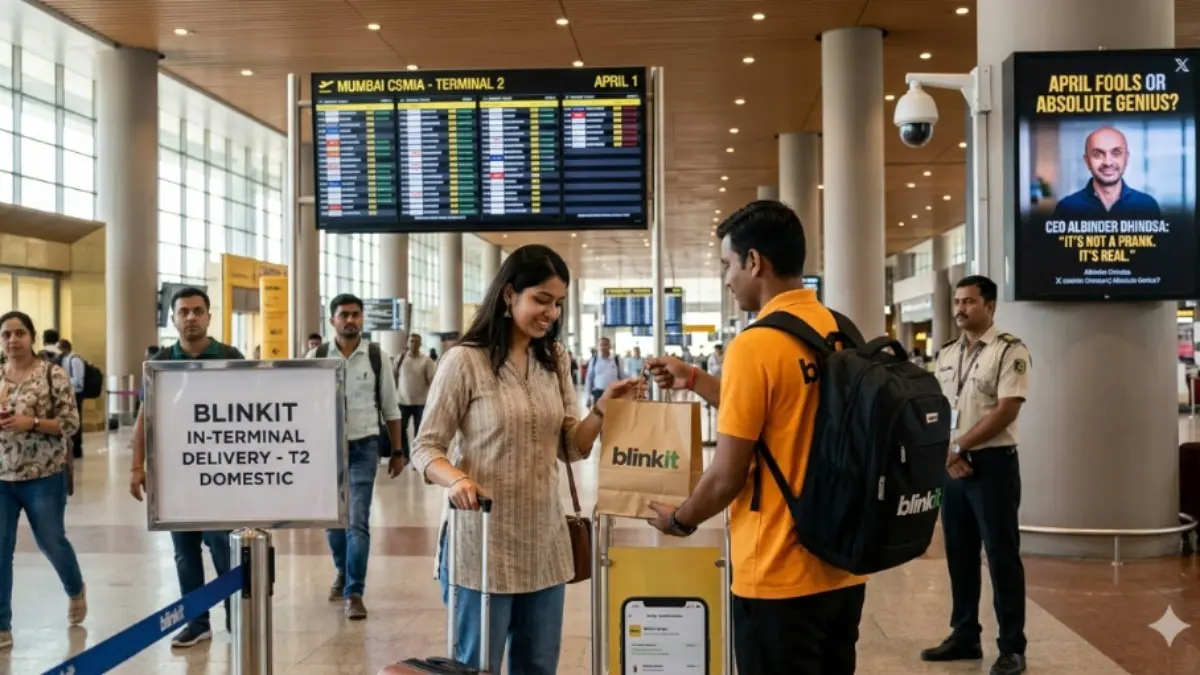
Mumbai: India’s airports have long thrived on a simple advantage: captive demand.
Once inside a terminal, travellers had limited choices. Whether it was a bottle of water, a phone charger or a last-minute snack, passengers were often left navigating expensive retail stores with little time and minimal flexibility.
India’s quick commerce market is built on speed and urgency. Airports compress both further, creating one of the most high-intent consumption environments in retail. With Mumbai Airport handling over 55 million passengers annually, the scale of such demand becomes even more significant.
That model is already starting to shift.
From captive retail to on-demand consumption
The partnership, announced on April 1 between Adani Airport Holdings Limited and Blinkit, introduces in-terminal quick commerce at Chhatrapati Shivaji Maharaj International Airport. The move is more than a convenience play. It signals a structural shift in how airport retail could evolve in the coming years.
Blinkit co-founder Albinder Dhindsa also highlighted the launch in a social media post, announcing that travellers can order essentials and receive them within minutes across the terminal.
At its core, the proposition is simple: order essentials on an app and get them delivered to your boarding gate within minutes. But beneath that simplicity lies a deeper change in consumer behaviour.
The rise of high-intent consumption
Airport retail has traditionally been built around browsing. Quick commerce flips that behaviour into intent-led consumption. Passengers are no longer walking through stores, they are searching, selecting and ordering with purpose.
This is particularly relevant in an airport environment, where time is compressed and decision-making is immediate. A delayed boarding call, a forgotten accessory or even a sudden craving creates a high-intent consumption moment, exactly the kind of behaviour quick commerce platforms are designed to capture.
This aligns with broader airport retail trends, where nearly 70% of purchases are impulse-driven, reinforcing the role of immediacy and convenience in shaping consumer decisions. At the same time, a majority of travellers now expect to order through their own devices, signalling a shift towards mobile-first, on-demand consumption inside terminals.
In that sense, the airport becomes less of a marketplace and more of a fulfilment layer.
A new revenue lever for airports
For Blinkit, this opens up a new category of demand: time-sensitive, high-frequency transactions in a closed ecosystem with guaranteed footfall. For Adani Airports, the implications are equally significant.
Non-aeronautical revenue, which includes retail and F&B, is a critical growth driver for airports globally. At Mumbai Airport, this segment is scaling rapidly, with non-aero revenue reaching ₹2,820 crore in FY25, reflecting strong growth driven by premium retail and high-spend passengers.
This shift is being driven by younger travellers, with Gen Z and Millennials emerging as the highest spenders at airports, significantly outpacing older cohorts.
By integrating digital commerce into the terminal, operators are not just enhancing convenience. They are rethinking how retail value is created and captured.
It also raises questions around control. As digital layers enter the terminal, airports may need to balance traditional retail partnerships with platform-led commerce. The shift is not just about adding convenience, but about who owns the customer interface inside the terminal.
What this means for pricing and control
The move also introduces a subtle but important shift in pricing power. Airport retail has historically operated at a premium due to limited competition. With app-based ordering, that opacity begins to reduce. Consumers now have a more direct, transparent way to access products, potentially reshaping expectations around price and availability.
What comes next
This is unlikely to remain a one-off experiment.
If successful, the model could expand across airports, categories and platforms. Food delivery, pharmacy, last-mile luxury, and even duty-free could see digital overlays in the future. The airport, once defined by physical retail, could evolve into a hybrid commerce environment where digital discovery meets instant fulfilment.
The bigger question is how long this remains exclusive. Quick commerce players are already competing on speed, assortment and geography. Airports introduce a new, high-value layer of competition, where access, partnerships and execution will define early winners. If the model scales, it is unlikely to remain a single-player ecosystem for long.
The larger question is not whether travellers will adopt this behaviour. It is whether airport ecosystems are ready for it.
Because once convenience becomes invisible, it quickly becomes expected. And when that happens, airport retail may no longer be about availability, but how fast it reaches you.


