











Mumbai | India’s ₹50,000+ crore biscuit and bakery market is being reshaped by a convergence of inflation-led down trading, rising health consciousness, and the rapid expansion of quick commerce platforms that are redefining both discovery and shelf dynamics. For legacy FMCG players like Britannia, this is no longer just a portfolio challenge but a format and experience challenge in an increasingly thumbnail-first, algorithm-driven retail environment now populated by platform-owned private labels from players such as Blinkit and Zepto.
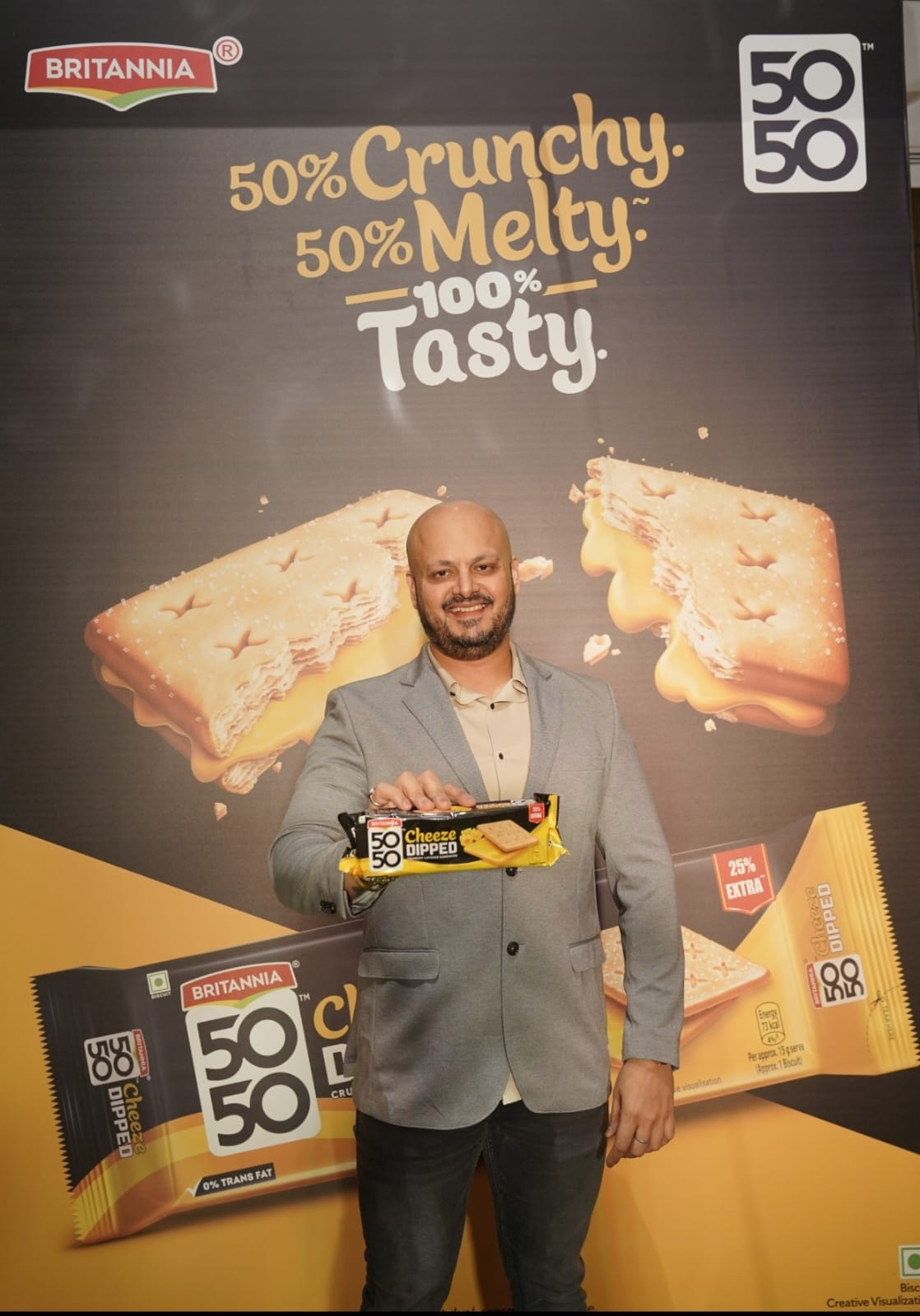
As consumer preferences shift towards texture-led indulgence and experimental snacking particularly among Gen Z cohorts, Britannia is recalibrating its innovation strategy to balance premiumisation with accessibility. The recent launch of Britannia 50-50 Cheeze Dipped Crunchy Layered Sandwich reflects this approach, extending the brand’s long-standing proposition of duality beyond flavour into mouthfeel by combining a 22-layer baked crunch with a melty cheese enrobing in a single, standalone snacking format.
In this conversation, Siddharth Gupta, Vice President – Marketing, Britannia, speaks to AdMirror about navigating premium innovation in a price-sensitive market, responding to the health snacking wave through brands such as NutriChoice and millet-based offerings, strengthening brand salience within quick commerce ecosystems, and deploying influencer-led storytelling while safeguarding core brand equity.
This product brings together three distinct sensory elements into one offering. What was the strategic thinking behind this formulation and from a go-to-market perspective, how do you plan to make it relevant both for Gen Z snackers and Britannia’s deeply loyal, legacy consumer base?
The intent behind bringing these three elements together was not just product innovation, but behavioural relevance. Today’s snacking occasions are increasingly fluid and consumers are looking for experimentation, texture contrast, and multi-sensory experiences within the same consumption moment.
The ‘crunch-meets-melt’ construct allows the product to participate across varied snacking rituals whether it’s impulse solo consumption, social sharing, or family treat occasions. In that sense, the formulation lends itself to versatility without diluting its core sensory promise.
From a go-to-market standpoint, the launch strategy has been designed to work across cohorts rather than for a single demographic. While Gen Z is a critical audience given their preference for novelty, format innovation and social-led discovery, the product remains firmly rooted in the family snacking space, which continues to be Britannia’s stronghold.
We are therefore deploying a full-funnel, 360-degree launch approach spanning mass awareness through television and print, alongside high-intent discovery via digital commerce platforms. Social media activation and influencer partnerships will help drive relevance among younger audiences, while e-commerce storefronts will be optimised with contextual content to enable consideration and conversion.
For our existing Britannia consumers, familiarity and trust remain key drivers. The communication which includes the launch film has been crafted to balance innovation with reassurance, ensuring the product feels both new and recognisably Britannia.
“Today’s snacking occasions are increasingly fluid and consumers are looking for experimentation, texture contrast, and multi-sensory experiences within the same consumption moment.”
Ultimately, the idea is to meet consumers where they already are across platforms, formats and life stages and make the product discoverable in ways that align with their evolving media and consumption behaviours.
Britannia has long dominated the biscuit and bakery aisle, but competitive intensity from players like Parle and ITC is rising across price tiers even as health-first snacking brands challenge the premium end of the market. Where do you see the greatest vulnerability today: at the bottom of the pyramid, or at the top?
For a brand like Britannia, the challenge is not confined to a single end of the consumption pyramid because relevance has to be maintained across value tiers.
At the mass end, affordability and accessibility continue to be critical, particularly in a price-sensitive market like India where downgrading can happen quickly in response to inflationary pressures. That segment remains strategically important and we will continue to serve it through offerings that deliver trusted value at accessible price points.
At the same time, the premium end is undergoing significant disruption driven by younger consumers who are seeking novelty, indulgence and increasingly perceived better-for-you snacking options. The rise of health-forward and functional snack brands is reshaping expectations around ingredients, formats and permissible indulgence.
Our approach has therefore been to innovate across cohorts. Recent launches such as Cheeze Dipped, Pure Magic Stars and Pure Magic Choco Tarts are designed to appeal to consumers looking for more experimental, sensorial snacking experiences particularly Gen Z audiences who are open to format innovation beyond traditional biscuit consumption.
“The challenge is not confined to one end of the pyramid. Relevance has to be maintained across value tiers.”
Ultimately, the objective is to build a portfolio that addresses evolving consumer needs across the value chain from everyday staples to indulgent or differentiated offerings while staying anchored in the trust and familiarity that define the Britannia brand.
As Indian consumers increasingly move towards protein-rich, functional and low-sugar snacking, how is Britannia balancing this health-first shift with the continued dominance of legacy power brands like Good Day, Marie, Bourbon and Jim Jam?
Consumer preferences are clearly evolving towards more health-conscious and functional snacking whether that’s higher protein intake, lower sugar, or cleaner ingredient profiles. As a result, there is growing demand for products that align with specific dietary or lifestyle need states.
Within our portfolio, brands such as NutriChoice are playing a critical role in addressing this shift. NutriChoice today offers a range of 100% atta-based products, and more recently, we have expanded the portfolio with offerings like 100% millet-based variants with no added sugar, catering to consumers seeking everyday, better-for-you alternatives within familiar formats.
At the same time, legacy power brands such as Good Day, Marie, Bourbon and Jim Jam continue to serve distinct consumption occasions rooted in taste, indulgence and habit. These brands have built deep trust and salience over time and remain integral to family snacking moments across the country.
“We do not view health and indulgence as competing segments, but as parallel need states within the same consumer universe.”
Our approach is therefore not to treat health and indulgence as opposing strategies, but to ensure the portfolio remains relevant across different consumer expectations and occasions.
With the rise of quick commerce platforms like Blinkit and Zepto, legacy FMCG brands are increasingly competing not just with traditional rivals, but also with private labels and visually similar SKUs. How is Britannia ensuring distinctiveness in a thumbnail-first shopping environment?
Quick commerce has fundamentally changed how consumers discover and purchase everyday categories like biscuits. In physical retail, packaging and shelf placement influence choice. On digital storefronts, decision-making is often reduced to a thumbnail image and a few seconds of scroll time.
This creates a different competitive dynamic where visually similar packaging, substitute recommendations or platform-led private labels can divert attention at the point of purchase.
Our approach has been to strengthen both brand salience and channel-specific execution. At a product level, the focus remains on delivering differentiated consumption experiences that reinforce trust and familiarity with the Britannia brand.
From a channel standpoint, e-commerce and quick commerce are among the fastest-growing avenues for us today. We are therefore investing in platform-specific content, search optimisation and digital shelf visibility to ensure that our portfolio remains easily identifiable and discoverable within these ecosystems.
“In quick commerce, the decision moment is often reduced to a thumbnail and a few seconds of scroll time.”
At the same time, our general trade distribution remains a core strength across Tier 2, 3 and 4 markets, allowing us to maintain strong physical availability even as digital penetration expands.
With platform private labels rising, do you see retailer-owned brands becoming a structural threat to legacy FMCG players?
The emergence of platform-led private labels is clearly gaining momentum, particularly within quick commerce ecosystems where control over assortment, visibility and pricing rests with the retailer.
In categories such as breads, rusks or cream biscuits which are relatively high-frequency and habit-driven there is potential for retailer-owned brands to build consistent off-take over time, especially if they meet expectations around price and availability.
Our approach is to closely track evolving consumer preferences and ensure that we remain present with the right propositions across relevant need states.
“Channel presence today is not optional. It is strategic hygiene.”
Ultimately, the focus is on responding to consumer demand with the right value proposition so that Britannia continues to remain relevant as the retail landscape evolves.
Inflation cycles typically hit discretionary categories first. How do you balance premiumisation while protecting core market share?
In a market like India, premiumisation cannot be viewed in isolation from accessibility.
Our core biscuit portfolio with brands such as Good Day, Marie and Milk Bikis continues to drive everyday consumption. The priority is to ensure that these staples remain salient and relevant, particularly during inflation when value-led decision-making becomes more pronounced.
At the same time, there is a growing segment of consumers seeking differentiated snacking experiences. Innovation-led launches address this demand, but we ensure that these products are introduced at accessible entry price points.
For instance, even within newer offerings, we are introducing ₹10 trial packs to enable consumers to
experience the product without a significant increase in spend.
“Premiumisation is not just about higher-value innovation. It is about democratising access to those experiences.”
This calibrated pack-price architecture allows trial today and trade-up tomorrow.
With influencer marketing scaling rapidly, how do you ensure creator-driven storytelling stays aligned with brand equity?
Brand ownership continues to rest firmly with us. Influencers are collaborators in the storytelling process, but the responsibility for how the brand is represented remains with Britannia.
Creator partnerships are evaluated across multiple parameters starting with the product and the cohort it is intended for. We then identify influencers whose content genres and audiences align with that need state.
The objective is not to have creators sell the product conventionally, but to integrate it organically within content their audiences already engage with.
“Effective influencer marketing lies in balancing creative freedom with clear brand guardrails.”
Authenticity is critical because audiences can distinguish between forced endorsements and contextual storytelling. Our focus is to ensure communication remains both credible and consistent.


