











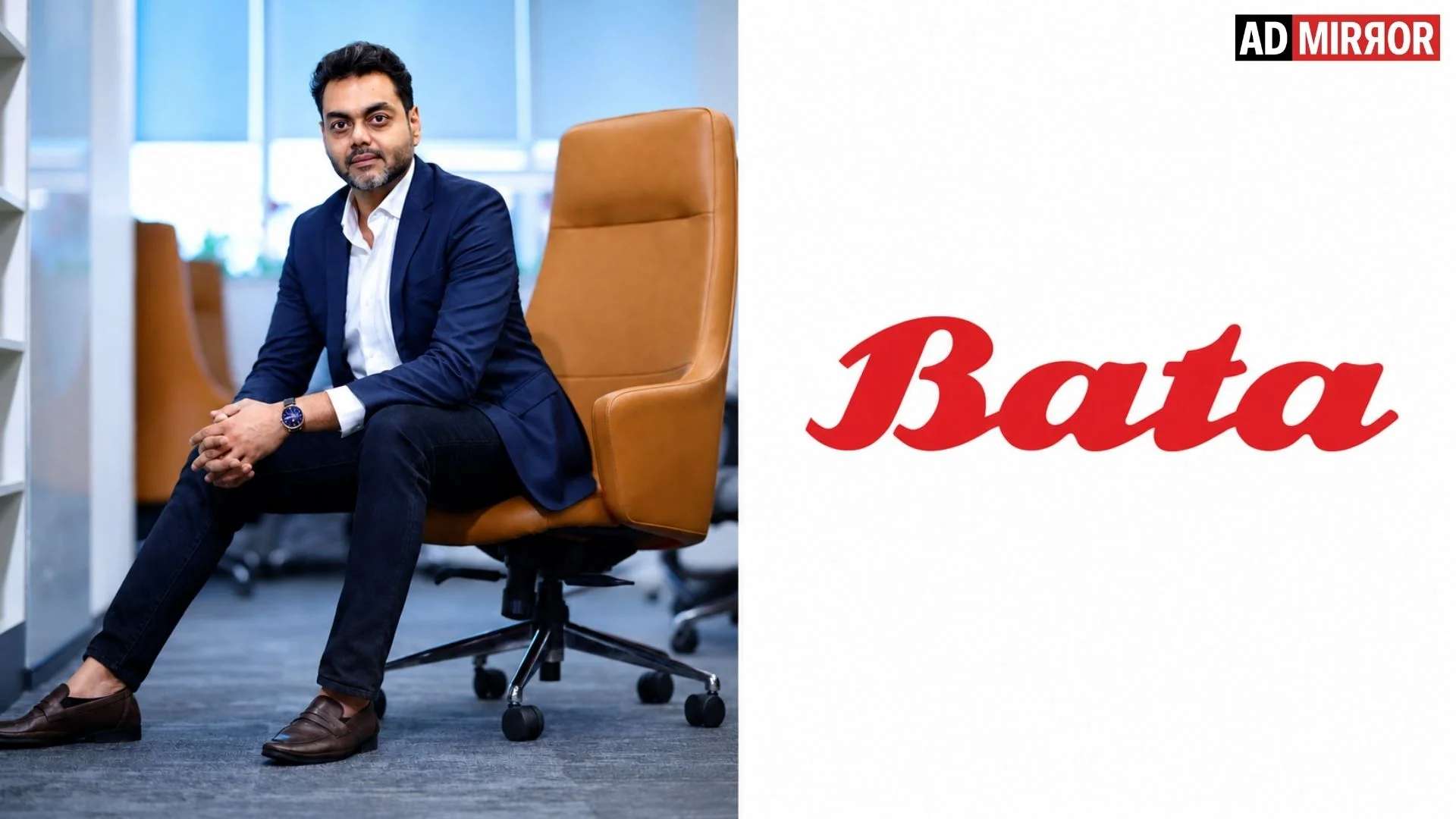
Mumbai: India's footwear consumer is no longer asking simply, "Kitna chalega?" The question is increasingly about comfort, design, versatility and identity a shift that is reshaping how footwear brands innovate, build categories and compete for the consumer.
For Bata India, this transformation is creating an opportunity to turn decades of consumer trust into contemporary relevance. Few leaders have been closer to that product and category evolution than Ankur Rastogi, Sr Vice President and Head, Regional Design and Development Hub, Bata India. His track record includes helping scale Hush Puppies from 0.5 million pairs in 2015 to 1.7 million in 2017, and incubating Floatz, which reached around 1.5 million pairs by 2025 and has since expanded into Latin America and Asia-Pacific.
In this conversation with Kalpana Ravi, Rastogi decodes the changing Indian footwear consumer, explains how Bata identifies consumer gaps that can become scalable categories, and makes the case for India as a potential global source of footwear design, innovation and brands.
You have spent more than two decades inside the footwear ecosystem. What has fundamentally changed about the Indian consumer, are we still buying footwear for utility, or has it become an expression of lifestyle and identity?
The biggest change is that footwear has moved from being an occasional utility purchase to becoming a much more active part of how people live and express themselves. Twenty years ago, the conversation was largely around durability and functionality, 'kitna chalega?' Today, the consumer is equally interested in how it looks, where they can wear it and whether it fits into their lifestyle.
We are also seeing people own pairs that are hybrid and can be worn to several different occasions. The rise of sneakers, athleisure and social media has accelerated this shift, particularly among younger consumers.
But I don't think utility has disappeared. Comfort, durability and quality remain the foundation; design and self-expression are increasingly becoming the differentiators. That is also why premiumisation is becoming more meaningful in footwear. Consumers are willing to pay more when they see a clear difference in the product.
For a brand like Bata, which is India's most trusted footwear brand, the opportunity is to take that trust and make it relevant to how the next generation wants to live.
Bata carries enormous legacy and familiarity in India. From a design perspective, does that heritage become an advantage or can it sometimes make experimentation harder? How do you make a legacy footwear company feel contemporary to younger consumers?
I see heritage as an advantage, provided you don't confuse heritage with doing things the way you have always done them.
Bata has something that very few brands can build today, generations of consumer trust. We are India's most trusted footwear brand and that trust gives us a strong foundation. But trust alone doesn't make a brand relevant to a 20-year-old consumer.
The way we approach it is quite simple: keep the trust, rethink the expression. The fundamentals that consumers have trusted us for — comfort, quality and durability remain important. But the way we bring those fundamentals to life has to evolve through design, silhouettes, colours, collaborations, new categories and the retail experience.
"Younger consumers don't necessarily reject legacy brands. They reject brands that feel disconnected from their lives."
That is why our transformation is not about walking away from what Bata has built over the years. It is about taking that equity and making it meaningful for a new generation.
You often speak about converting "production ideation and execution into repeatable consumer appreciation." But how do you identify an idea that has the potential to become a category rather than simply another successful product?
A good product and a category are two very different things. A product can sell because it is new or because the marketing is strong. A category gets created when you identify a consumer need that is likely to stay.
We therefore don't start by asking, "What shoe should we make?" We start by understanding what is changing in the consumer's life. We look at trends beyond footwear — how people work, travel, spend their leisure time and what they value. Then we look for the friction that nobody has really solved.
Floatz is a good example. We saw that consumers wanted something that gave them the comfort of home footwear but was stylish enough to step out in. That was not simply a new design; it was a new usage occasion.
The other important test is what happens after launch. We look very closely at the first few weeks of consumer response. If the product starts getting repeat demand, wider acceptance and a clear use case, that's when we know we may have something bigger than a successful SKU.
Hush Puppies grew from around 0.5 million pairs in 2015 to 1.7 million by 2017 under your leadership. What unlocked that 3X growth?
It was a combination, but consumer understanding came first. At the time, we saw a very clear change in the working consumer. People were spending long hours commuting and at work, and the traditional choice was often between looking formal and being comfortable. We saw an opportunity to remove that compromise footwear that could look appropriate in a professional setting but feel closer to a sneaker in terms of comfort.
We then had to make the entire proposition work together. The product had to deliver on comfort and materials, the pricing had to make the value obvious, and the distribution had to make the product accessible. I wouldn't attribute the 3X growth to one lever. The real unlock was getting product, price, distribution and consumer insight to work as one proposition. Once the consumer understood the value, the scale followed.
Floatz was incubated within Bata and scaled to 1.5 million pairs by 2025. When you started building it in 2022, what consumer gap did you see?
Floatz came from a very specific change in how people were living after the pandemic. We saw a gap between the traditional home slipper and the more premium clog or casual comfort products in the market. Consumers wanted something they could wear comfortably at home, but also step out for a coffee, a quick errand or a casual day without having to change their footwear.
"We used to call this the 'two-mile' need — comfort at home but enough design and attitude to go beyond it."
There was also a clear price gap. At one end, you had basic slippers at very low-price points; at the other, premium international offerings were often above ₹2,999. There was an opportunity in between for a product that was comfortable, well-designed and aspirational but still accessible. That became the starting point for Floatz. We developed Flofoam to deliver the cushioning we wanted and built the brand across age groups rather than treating it as a niche product. By 2025, Floatz had reached around 1.5 million pairs, which tells us that the consumer need we identified was much broader than the original pandemic context.
Floatz has travelled into Latin America and Asia-Pacific. Is the reverse beginning to happen — can products and design thinking originating in India travel to global markets?
Absolutely. I think the direction of influence is changing. India has traditionally been seen as a market that adopts global trends. But the Indian consumer today is sophisticated, demanding and very value conscious. We want comfort, design, durability and the right price all at the same time. That makes India a very good testing ground for products that have to solve real consumer problems at scale.
Floatz travelling to Latin America and Asia-Pacific is a good example of that. The product was conceived around an Indian consumer need, but the underlying need for comfort, versatility and design is not uniquely Indian. I think this is where India has an opportunity. We should not only ask what the world is bringing to India; we should also ask what India can take to the world. With our consumer scale, manufacturing capabilities and growing design talent, we have the ingredients to create products that can travel globally.
As sneakers, athleisure and D2C brands disrupt traditional footwear categories, is Bata fast enough to keep pace?
The answer is yes, but the way we think about speed has changed. New-age brands have accelerated the category by creating very specific products around trends, occasions and impulse purchases. That has pushed established players like Bata to become much more responsive. We are experimenting with more focused collections, drops and products that can respond to emerging consumer needs faster.
The question is not whether we can move exactly at the pace of a D2C brand. It is whether we can read consumer signals quickly and convert those signals into relevant products faster. Ultimately, speed is not about chasing every trend; it is about knowing which consumer signals are worth acting on and acting on them before the opportunity passes.
Collaborations with Disney, Marvel and DC bring entertainment IP into footwear. How do you ensure an iconic character doesn't become merely a graphic on a shoe?
For us, the character must be part of the product, not just a graphic placed on it. If we are creating a Spider-Man shoe, for example, the design language runs through the entire product the upper, outsole, colours, graphics and detailing are all developed around the character. The objective is that when you look at the shoe, it feels like a Spider-Man product rather than simply a Bata shoe with a Spider-Man graphic on it.
At the same time, the character cannot come at the expense of what the consumer expects from Bata. Comfort, functionality and quality still must remain intact. There is also a very rigorous process because the products are vetted by the IP owners and must follow their brand guidelines.
You have advocated bringing a global design language into Bata's Indian collections. Where does global design stop and Indianisation begin?
For Bata, bringing global design to India doesn't mean simply importing a global product and putting it on an Indian shelf. We look at global trends for the design language the silhouettes, colours, materials and overall aesthetic — but then we adapt the product to how an Indian consumer lives. The way we see it is a global trend, Indian execution. We bring the global flavour into the product, but build the collection around Indian consumers, their climate, usage and preferences.
Footwear design ambition must eventually confront manufacturing realities and price points. How much of great footwear design is about knowing what not to design?
A lot. As designers, there is always a temptation to push the boundaries and add something that makes the product look different. But ultimately, the consumer has to understand why the product exists and what problem it is solving. We start with the consumer and the message we want the product to communicate. Once that is clear, we challenge every element of the design. Does it add value, does it improve the product, or is it simply there because it looks interesting? A lot gets removed at that stage.
Can sustainable footwear genuinely become mass-market without asking consumers to pay a significant premium?
I believe sustainability must become part of how you make a product, rather than something that gets added to the product and passed on as a premium. At Bata, we have been recycling and reusing materials from our manufacturing processes for decades. Floatz is one example, where around 20% of the wasted compound is recycled back into the product. The consumer doesn't pay extra for that; we are simply making better use of the material that would otherwise become waste. Sustainability becomes meaningful at scale when it improves the way you manufacture, rather than becoming a feature that the consumer must pay extra for.
Where do you see AI making the biggest difference in footwear development, and what part of the creative process should remain distinctly human?
AI can significantly shorten the distance between a consumer insight and a product idea. Today, we can analyse what consumers are buying, identify emerging trends and use those insights to build visual and theme boards much faster. We can then create design options, test concepts and get consumer feedback much earlier, sometimes even before we invest in physical sampling and development.
But I don't see AI replacing the creative process. The idea, the intuition and the understanding of what will resonate with a consumer still comes from people. AI gives us more options and helps us get there faster. The real advantage is that designers can spend less time on repetitive work and more time on the decisions that actually require creativity and judgement.
Is the Indian consumer now moving faster than traditional product-development cycles can accommodate?
Yes, and that has fundamentally changed how we think about product planning. A trend that looks relevant today can become irrelevant by the time the season arrives. We have to be much closer to the market and much more responsive to what is gaining momentum. Core, evergreen products continue to remain on the shelf, while trend-led products need to be much more flexible and closer to the launch window. You can't predict every trend six months in advance anymore; you must build the organisation to respond when the signal becomes clear.
At what point do you know a product has crossed over from being commercially successful to becoming a genuine consumer franchise?
When a new product reaches the market, the first four weeks are really important to us. We closely track how consumers are responding, how quickly it is moving, whether the acceptance is broad-based and whether the demand is repeating. If the response is strong, we start expanding the product much more aggressively.
Reaching a scale of a million pairs is not simply a result of getting the launch right. It requires sustained alignment across consumer response, marketing, retail execution and supply chain, along with continued investment in the product to build and sustain momentum.
If we were having this conversation five years from now, what would you like India to be known for in the global footwear industry?
I would say all of these, but particularly manufacturing and design coming together. India already has the consumer scale and market understanding. We are one of the youngest and largest consumer markets globally, and that gives Indian brands an incredible testing ground. The next step is to stop thinking of India only as a manufacturing destination or a China-plus-one opportunity. We should be thinking about products conceived, designed and manufactured in India that can compete globally.
We are already seeing home-grown products travel to international markets. Over the next five years, I believe India can establish itself not just as a manufacturing powerhouse, but as a source of footwear design, innovation and brands for the world. For Bata, that is particularly exciting because India is already our largest market globally and contributes nearly a third of Bata's global business.


