











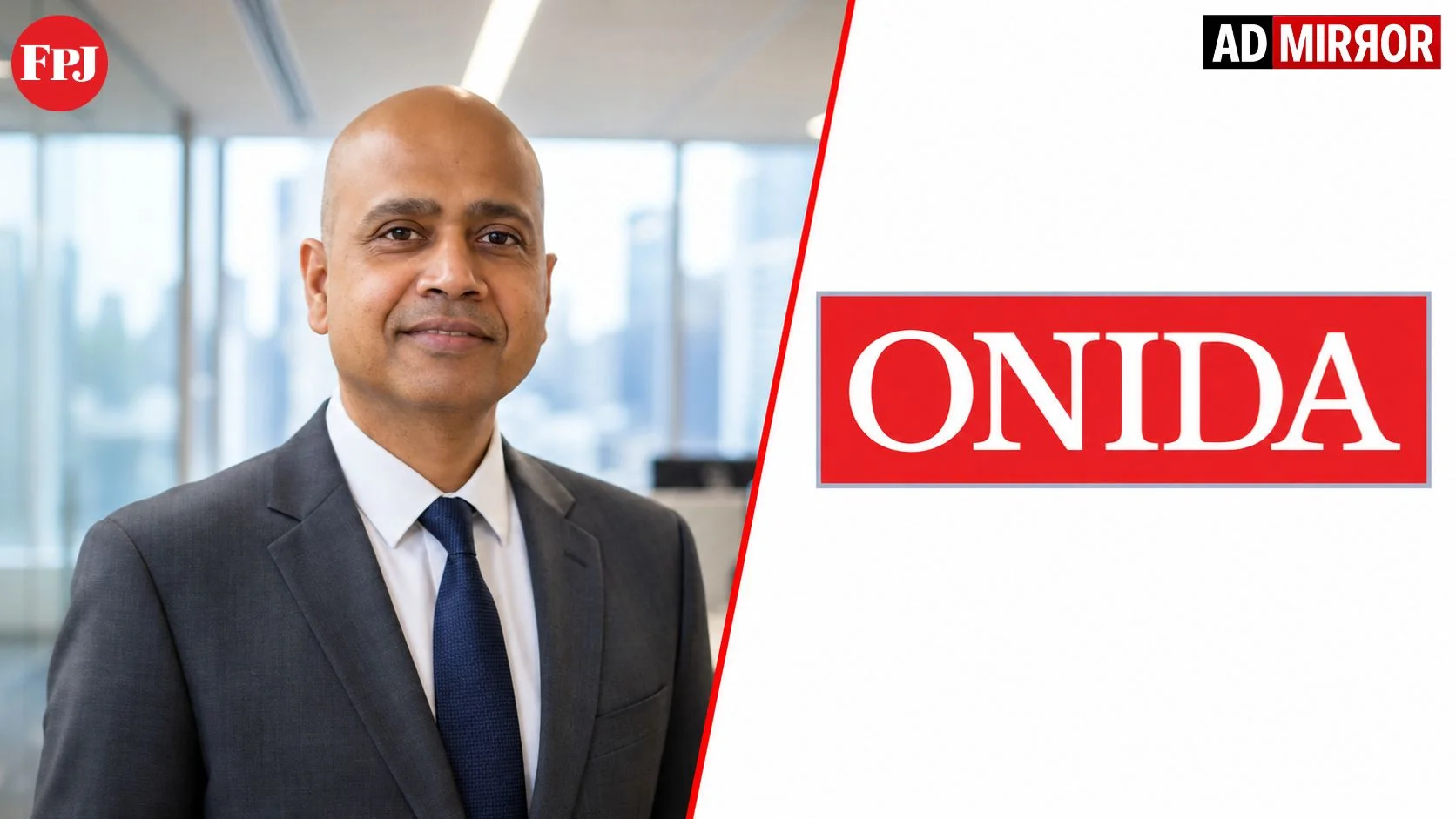
Forty-five years after becoming a household name with its iconic Devil campaign, Onida is no longer looking at the past for its next growth story. It is rebuilding the business from the ground up.
In an exclusive conversation with Admirror, Gunjan Srivastava, Chief Executive Officer and Managing Director, Onida Electronics Limited, lays out an ambitious transformation agenda for the brand, one that aims to scale the business 5 to 6X over the next five to six years, outpace the consumer durables market and rebuild the market share Onida has lost across televisions, air conditioners and washing machines.
The reset is being driven by a sharper go-to-market strategy, with Onida targeting 8,000 to 10,000 stores, up from around 4,000, while aiming to take weighted distribution from the current low double digits to around 50% over the next two to three years. Alongside distribution, the company is putting renewed emphasis on retail execution, customer service, product innovation and a clearer affordable premium positioning.
But the bigger challenge is relevance. Onida still carries strong recall among consumers who grew up with the brand, while its connect with younger consumers has weakened after years of lower visibility. Srivastava says the next phase will have to bridge those two audiences, retaining the equity of the Devil while building a new digital-first connection with consumers aged 20 to 25.
The strategy also places Bharat at the centre of Onida's growth ambition, with Tier II and III cities and semi-urban markets emerging as critical engines for aspiration-led consumption. From longer warranties and financing options to category expansion and a planned network of around 100 brand stores, Onida is attempting to make affordability, quality and peace of mind part of a single consumer proposition.
This is not simply an Onida comeback story. It is a test of whether a legacy Indian consumer brand can convert 45 years of equity into scale, relevance and competitive muscle for the next decade.
Onida was once one of India's most recognisable consumer electronics brands. Today, as the market has become crowded with global and aggressive Indian players, what is the new Onida you are building and what do you want the brand to be known for over the next five years?
Onida has 45 years of heritage, a strong legacy in consumer electronics and appliances, and tremendous brand familiarity. But we also must be candid about the fact that, over the last few years, the business lost some of its momentum. We lost market share, retail presence and distribution; customer service also needed significant improvement, and the financial performance was not where it needed to be. So, what we have embarked on since April is not an incremental recovery plan. It is a fundamental transformation of the business.
We have gone back to the fundamentals and asked ourselves a simple question: what will it take to make Onida a scaled, relevant and profitable consumer durables business again?
The first answer is scale. We have set ourselves an ambitious target of growing the business five to six times over the next five to six years. In consumer electronics and appliances, scale is not optional; it is fundamental to competitiveness. But we are equally clear that we don't want to chase topline growth without quality. The objective is to build scale with sustainable and consistent margins.
Distribution is therefore one of our biggest priorities. We began this financial year with a presence in around 4,000 stores. We are targeting 8,000 to 10,000 stores by the end of this year. But reach alone doesn't create a strong business. Within that network, we have identified approximately 800 to 1,000 priority stores where we want to create what we call retail excellence. Over the next two to three years, our ambition is to take our weighted distribution from the current low double-digit level to around 50%.
The transformation also extends to customer experience. We know that improving installation timelines, reducing repair turnaround time and ensuring the availability of spare parts are essential to rebuilding consumer trust. The third pillar is product and innovation. We have a clear two to three year product roadmap that will allow us to compete more meaningfully on performance, features and quality. And finally, we are sharpening the brand itself. We want Onida to occupy a clear space as an affordable premium brand, one that understands uniquely Indian consumer needs and delivers premium performance, features and quality without making the consumer pay a premium price.
"This is not about bringing back the Onida of the past. It is about building an Onida that can compete for the future."
Gunjan Srivastava, CEO and MD, Onida Electronics
Where does Onida stand today in its key categories, particularly televisions, air conditioners and washing machines, in terms of market share and growth? Which categories do you see as the biggest opportunities for gaining share?
We are currently focused on three core categories, televisions, air conditioners and washing machines, and we see significant headroom across all three. Onida was historically a double-digit market-share player on both televisions and air conditioners. That share has declined over the years, and today we are in the lowest single digits. So, clearly, there is a significant gap to close.
At the same time, the brand has retained pockets of strong equity. In markets such as Punjab, Gujarat, West Bengal and Tamil Nadu, among others, we continue to see market shares of around 4 to 5%. That tells us that the consumer connection has not disappeared; the challenge has been converting that equity into consistent national scale. Our strategy is therefore very clear: we want to rebuild shares, not simply defend what remains. The levers are differentiated products, stronger distribution and go-to-market execution, and a substantial improvement in customer service.
Onida has strong recall among consumers who grew up with the brand, but the younger consumer has grown up in a very different media and shopping environment. How are you making Onida relevant to the next generation without losing the equity built over 45 years?
Yes, that's a very important question. As a brand, we obviously have a very strong presence in the minds of consumers who are 40-plus and 50-plus. But if you look at the 20 to 25-year-old consumer, our connect is not as strong. And that's understandable because, frankly, we haven't been active enough as a brand over the last 10 years or so.
So, our intention is very clear. We don't want to lose the equity we already have, but at the same time, we need to build a strong connection with the younger consumer. The 20 to 25-year-old is important because even if they may not always be the final purchase decision maker today, they are strong influencers within the family. Digital and e-commerce will obviously play a big role here. Our plan is to have around 100 Onida brand stores over the next two to three years. We've just started, we opened our first two stores about two weeks ago, one in Meerut in Uttar Pradesh and the other in Tirupur in Tamil Nadu.
As TVs and home appliances become increasingly feature-rich, consumers are often left wondering what makes one product meaningfully better than another. What consumer problems is Onida looking to solve through innovation, and where do you believe the brand can genuinely differentiate?
The starting point for us is to stay very close to the consumer and understand what pain points still exist with the products they are using today. Take televisions, for example. Today, everybody is talking about large screens, picture quality and different display technologies. Those are important, but we also believe there is a gap when it comes to sound. One of the areas we are focusing on is making Onida the king of cinematic sound. If you bring a large Onida television home, the experience should feel like bringing the cinema home.
But there is another aspect of the consumer experience that we believe is equally important, peace of mind. That's why we are strengthening our warranty proposition. Our semi-automatic washing machines come with a seven-year comprehensive warranty. In televisions, we offer a 1+3-year comprehensive warranty, and our air conditioners come with a five-year warranty. For us, this is not just about putting a longer warranty on the box. It is about telling the consumer: buy an Onida, take it home, install it and don't worry about it.
The consumer durables market is highly competitive, with brands constantly battling prices, promotions, distribution and margins. As Onida targets five to six times the growth, what are the milestones you are working towards, and how are you ensuring that this scale-up remains sustainable and profitable?
Our ambition is to scale the business five to six times over the next five to six years, which means consistently growing ahead of the market. We have detailed year-on-year plans, with clear expectations from each category. Washing machines, for instance, is a significant opportunity. Our market share is currently low, so we are focused on strengthening the product portfolio, expanding distribution and building share. The other growth lever will be new categories. We are already working on refrigeration, along with several other categories that we expect to introduce over the next one to two years. But we will not enter a category simply to expand the portfolio. We will do so only when we are confident about the product, quality, execution and our ability to win.
Onida once showed how powerful advertising could be in turning a consumer electronics brand into part of popular culture. How are you thinking about creating a new emotional connection with consumers while retaining what is still distinctive about Onida?
We must transform the brand because we cannot build the future of Onida by relying on what we did 30 years ago. Our core positioning is clearly affordable premium. One thing has come through very clearly in our consumer listening: for many consumers, Onida and the Devil are inseparable. So, the Devil stays. We don't see a reason to walk away from an asset that is still so strongly associated with the brand.
Digital and social will give us scale across the country, while traditional media will be used selectively based on the market and the consumer. The larger objective is quite simple: retain the emotional equity that makes Onida recognisable but build a new reason for consumers to engage with the brand today. We want to reconnect with our older audience, while creating a new connection with the younger consumer, and do that without turning Onida into a nostalgia brand.
If we look five years ahead, what would you want Onida to stand for, not just in terms of scale and market share, but in the minds of Indian consumers? And how important will Tier II, Tier III and semi-urban India be to that ambition?
For me, what is important is that five years from now, Onida should be seen as an aspirational, proudly Indian consumer brand that understands Indian needs and delivers genuinely premium quality at an affordable price. Strong financial performance follows a strong consumer proposition. What matters first is how strong Onida is in the consumer's mind.
And this is where Bharat becomes extremely important for us. There is an India and there is a Bharat, and some of the most aspirational consumers are coming from Bharat. Our brand is already stronger across Tier II and Tier III cities and semi-urban markets, and that is where our primary focus will remain. When we offer long warranty periods, we are essentially telling the consumer that we believe in the quality of what we are selling. That reassurance is an important part of our proposition, particularly in Bharat.
Onida has spent 45 years building an Indian consumer franchise. Is taking that proposition beyond India part of the longer-term ambition, or is the immediate priority to win back and deepen the Indian market?
Not in the immediate future. Our priority right now is very clearly India. We have a significant opportunity to rebuild the business, strengthen our categories, expand our reach and deepen our relationship with Indian consumers. Having said that, if you look at it from a five to six-year perspective, going global is certainly not ruled out. Once we have built the scale, proposition and capabilities we want in India, we can look at where else the Onida proposition could travel.
"We want to offer an aspirational Indian brand without compromising on quality, technology or features, but at a price that the consumer can realistically afford."
Gunjan Srivastava, CEO and MD, Onida Electronics


