











Founded in 1962, Vinod Cookware has built its reputation on understanding the Indian kitchen. But as consumer preferences evolve, cookware is no longer simply about functionality and durability. Material safety, healthier cooking, convenience, design and technology are increasingly influencing purchase decisions.
For the next generation of leadership at Vinod Cookware India Pvt. Ltd., the challenge is to build on a six-decade legacy while preparing the business for a very different consumer and competitive landscape.
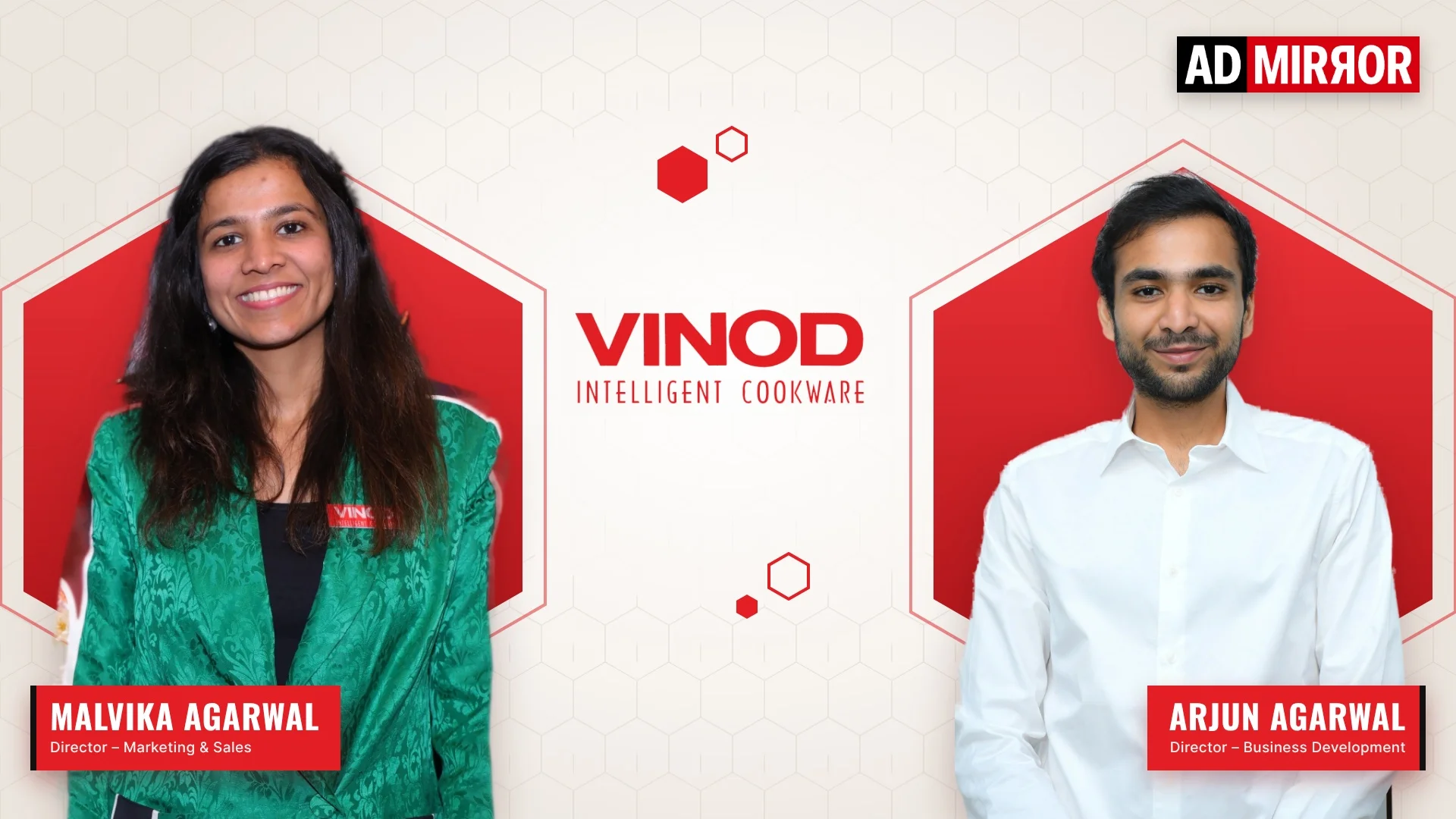
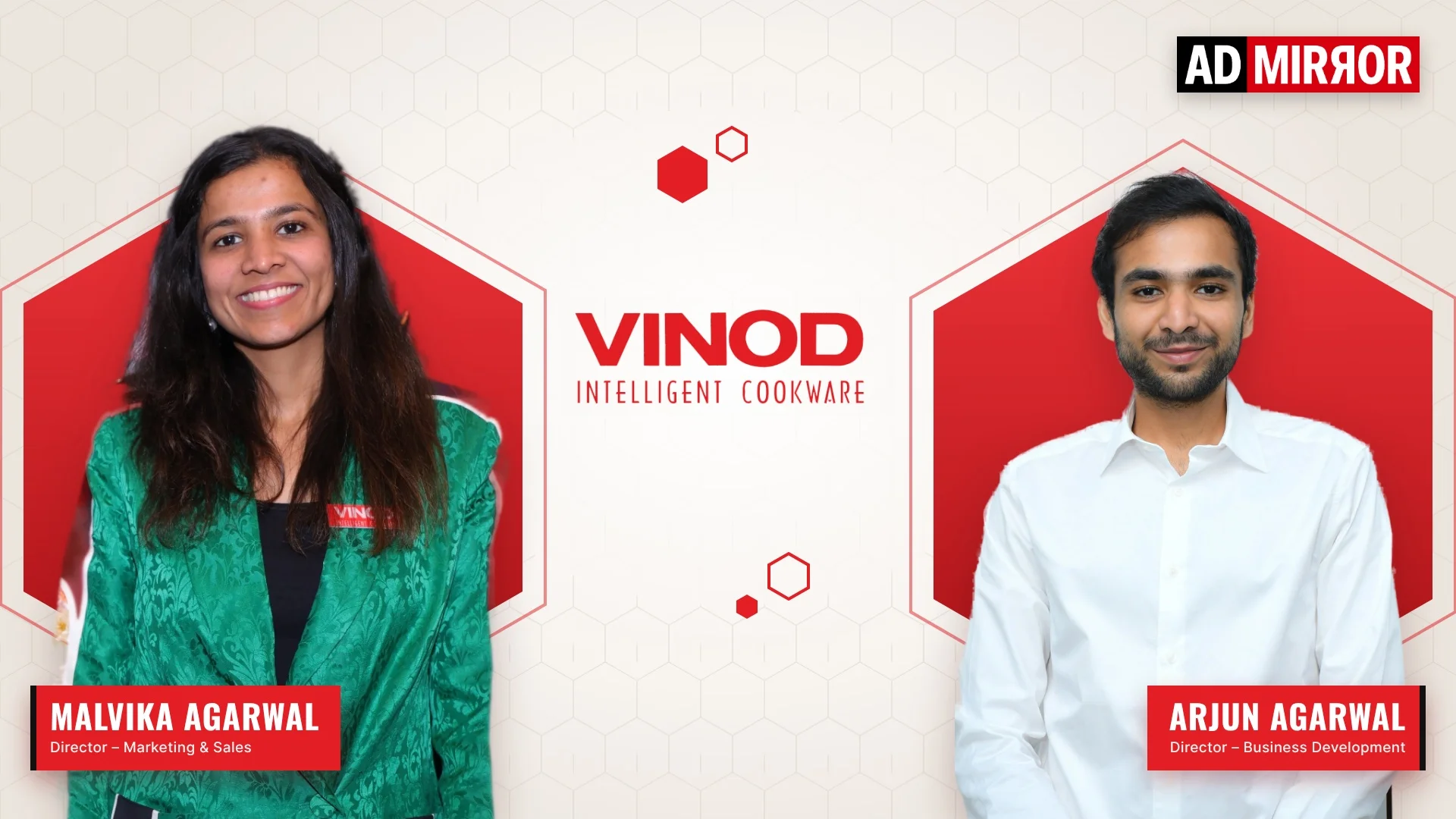
In a conversation with AdMirror, Malvika Agarwal, Director – Marketing & Sales, and Arjun Agarwal, Director – Business Development, discuss the company's evolving product portfolio, the growing importance of consumer education, its television and digital marketing strategy, regional expansion and the opportunities emerging in international markets.
While Malvika's focus is on brand building, consumer engagement and market development, Arjun brings a perspective shaped by manufacturing, operational capabilities and strategic growth. Together, they offer a glimpse into how the next generation is approaching the transformation of a traditional Indian cookware business.
Vinod has spent over six decades building its presence in Indian kitchens. How is the company rethinking its brand proposition to remain relevant to a new generation of consumers who are increasingly conscious about cookware materials, health and convenience?
Malvika: Product innovation is a key focus, but we remain rooted in our strengths as a stainless-steel cookware brand. We have expanded into newer categories that address changing consumer expectations around healthier cooking. Triply was introduced over a decade ago, and we have since strengthened our cast-iron portfolio with three distinct ranges: traditional cast iron, lightweight cast iron and titanium-enameled cast iron.
An important part of our brand-building approach is educating consumers. Our advertising is designed to communicate product benefits and technology in an engaging, often humorous manner rather than following conventional kitchen advertising formats. Whether through our campaigns, packaging or digital content, we want consumers to understand what they are buying, including material specifications and product features.
Arjun: The conversation around cookware materials has also evolved. Different products serve different cooking requirements. Non-stick, for instance, has its place, provided consumers understand its product life and use it correctly. The material alone does not determine performance; how a product is maintained and used matters equally.
With launches such as Freya, Ceravit and Ferona, Vinod is entering newer materials and premium cookware segments. What consumer insights and market trends are influencing this innovation strategy?
Malvika: We draw insights from our teams on the ground, our dealer network and our understanding of global developments. We also visit international trade fairs to see where the category is heading. At recent international exhibitions, we have seen ceramic cookware, coated triply and newer cast-iron formats gaining attention.
Our manufacturing capabilities give us an advantage because we can experiment, conduct trials and develop products in-house. Equally important is the trust we have built with our dealers. Introducing a new category is not easy when most consumers walk into a store looking for a stainless steel kadhai or pressure cooker. Dealers need to understand the product before they can sell it.
We therefore invest in educating our internal teams and sales personnel so that they can communicate the technology and benefits effectively. Product innovation must be supported by product knowledge at the point of sale.
"Introducing a new category is not easy when most consumers walk into a store looking for a stainless steel kadhai or pressure cooker. Dealers need to understand the product before they can sell it."
Malvika Agarwal, Director – Marketing & Sales, Vinod Cookware
Vinod has associated with television properties such as MasterChef, Kaun Banega Crorepati and Laughter Chefs. In an increasingly fragmented media environment, how do you evaluate these associations beyond visibility?
Malvika: Television continues to have significant relevance in India, particularly when you want to reach mass audiences across Tier II, III and IV markets. Each property has played a different role for us.
MasterChef helped us connect with consumers who are genuinely interested in cooking. We even incorporated the association into our packaging. With KBC, having Amitabh Bachchan on the packaging created a strong recall opportunity. Laughter Chefs gave us access to a much wider entertainment audience.
We have also ensured that these associations extend beyond television through our own digital platforms, retail displays and on-ground visibility. For Laughter Chefs, for instance, our product integrations were planned around specific launches, including Ceravit and Freya.
We cannot always directly attribute sales to a television association, but we have received considerable feedback from dealers and consumers who recognise the brand through these properties. The important thing is to use the association effectively rather than simply buy visibility.
Vinod has traditionally been stronger in northern and western India. What are the challenges and opportunities in expanding into southern and eastern markets, particularly with e-commerce and quick commerce changing consumer access?
Malvika: We are growing in the southern market, but it is a complex region because consumer preferences and brand loyalties vary significantly across states. Communication strategies also need to be localised. Influencer marketing, for example, cannot be approached uniformly across the four southern markets. Each requires different regional voices and investments.
In the East, price points and purchasing power influence the categories that perform better. Our Kraft brand, which offers a different price proposition, has a stronger presence there.
Interestingly, we are seeing considerable online traction in markets such as Karnataka. Maharashtra remains one of our strongest markets, followed by Karnataka in our online business. Consumers in these markets are comfortable discovering and purchasing products through digital platforms.
Arjun: The opportunity is to understand where each channel makes sense. We are present across Amazon and Flipkart, as well as quick-commerce platforms such as Blinkit, Swiggy Instamart and Zepto. Consumers are increasingly purchasing even products such as pressure cookers through these platforms.
However, building a market requires more than distribution. Strong regional teams and partnerships are equally important. We are seeing encouraging progress in the South, and it is a market we are prepared to build over time.
In a price-sensitive market, how do you persuade consumers to invest in premium, innovation-led cookware when they may not immediately understand the difference between materials and technologies?
Malvika :It is a challenge because consumers can find products at significantly lower price points, particularly online. But we believe brand loyalty and product quality continue to matter. When we introduce a product, we study the market and understand what consumers can absorb before deciding on its pricing.
Education is central to this process. Our packaging and content explain the technology and specifications behind the product. We are also seeing a shift in consumer awareness. People are beginning to ask for specific grades of stainless steel and are becoming more conscious of the materials they use in their kitchens.
Premium cookware is an investment. A product that lasts for several years can offer better value than repeatedly replacing a cheaper alternative. Consumers are already spending more on organic food and nutrition. We believe greater awareness of the cookware used to prepare food is the next step.
Arjun: The larger point is that consumers need to understand the value proposition. Price will always be a consideration, but quality, durability and the intended use of a product should also influence the purchase decision.
As a legacy business, what needs to change operationally to build the next phase of growth without compromising the strengths that have sustained Vinod for six decades?
Arjun: Our manufacturing strength is one of our biggest advantages, and that is something we do not want to lose. We also have a strong family-oriented culture. However, we are open to exploring new avenues of growth, whether through external investments, joint ventures, mergers and acquisitions or strategic collaborations.
These are conversations we have regularly. We are at a stage where several of these possibilities are available to us, and we are keen to evaluate opportunities that can strengthen the business.
The important thing is to remain connected to both ends of the market. We need to understand global trends and developments while staying close to our dealers and the realities of Indian consumers. Maintaining that balance is critical.
Malvika: From the business and market-facing side, one of our priorities is to build the brand among younger consumers. Vinod has strong recall among older consumers and millennials. The next challenge is to reach Gen Z and understand how their relationship with cooking and the kitchen is evolving.
We are also looking at new marketing channels and consumer touchpoints. We have recently experimented with influencer events, something we had not actively pursued in the past. These initiatives help us generate content, obtain product reviews and reach consumers through people they trust.
We have also found that our product portfolio is not always fully understood. Some consumers associate Vinod primarily with pressure cookers, without realising the breadth of our cookware offerings. Creating greater awareness is therefore an important part of our strategy.
You represent two complementary sides of the business. When you look at Vinod's next decade, where do you see the biggest growth opportunities, and how do your perspectives complement each other?
Arjun: Our roles are quite different. A lot of my work is internally focused on manufacturing capabilities, understanding factory operations and identifying ways to improve them. Malvika's role is more externally focused, looking at how the brand is presented and perceived in the market.
There can be different perspectives. For instance, if sales are affected, I may look at product availability and manufacturing constraints, while she may look at the market and sales performance. Ultimately, both perspectives are necessary, and we understand each other's challenges.
Malvika: For me, the opportunity lies in capitalising on what we already do well while identifying new consumer segments and channels. We are looking at how to make the brand more relevant to younger households and how to strengthen our presence across digital, quick-commerce and traditional retail.
There is also a need to align demand with supply. Marketing can generate interest and demand, but the products need to be available. That coordination between manufacturing and sales is an ongoing priority.
Looking five to six years ahead, what would you like Vinod to be known for beyond cookware, and what would success look like for the next generation of leadership?
Malvika: We see Vinod becoming a larger brand, potentially with other complementary brands within the same broader ecosystem. The kitchen is increasingly becoming the heart of the home, and consumers are more willing to showcase their kitchens and invest in the kitchen space.
Rather than trying to innovate in every category, we are open to collaborations with like-minded brands operating in adjacent kitchen categories. Cookware remains our core strength, but partnerships could help us explore other opportunities without moving away from our value system.
Arjun: The larger ambition is to build on our existing capabilities while remaining open to new opportunities. Whether through collaborations, investments or strategic partnerships, we want to strengthen the business and prepare it for the future without losing sight of the manufacturing expertise and quality that define Vinod.
For us, the next phase is about combining the company's legacy with a more contemporary approach to business, innovation and growth.


