











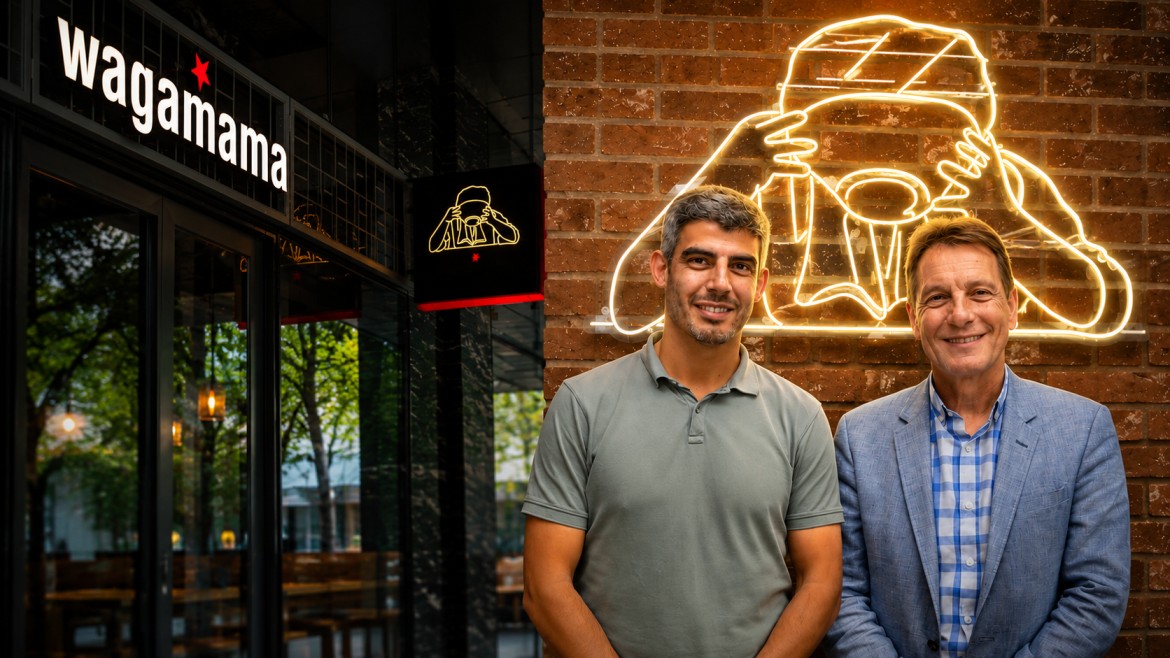
Mumbai: India is the world's fastest growing major economy, home to one of its youngest and most food-obsessed populations, and increasingly the market every global restaurant brand wants a piece of. Wagamama, the 30-year-old British pan-Asian brand with 180 restaurants in the UK, has made its choice. Through a multi-million-pound joint venture with K Hospitality's Charcoal Concepts, it is accelerating its expansion across the wider Indian market with a clear ambition: 50 to 100 restaurants over the next decade and a brand that becomes as much a part of Indian dining as it has become part of British life.
From Test to Scale
When Wagamama opened its first restaurant at Churchgate, Mumbai a year ago, it was a test. The question was whether a 30-year-old British pan-Asian brand could find its footing in one of the world's most competitive and culturally specific food markets. The spicy chicken ramen, a dish developed specifically for the Indian market, became the most popular item on the menu. Guests were sharing their experiences on social media. The brand was landing. Delivery has been very successful from the first site.
Now Wagamama is scaling. A second restaurant has opened in Worli, Mumbai. A third location in New Delhi is scheduled to open within a month or two, with Bengaluru and other key cities to follow. And the joint venture between The Restaurant Group and Charcoal Concepts, K Hospitality Corp, is being built for what Andy Hornby, Chief Executive Officer of The
Restaurant Group, describes as a 10 to 20 year development of the brand across Indian cities.
"India is for us the most important priority international market," Hornby said. "There's a huge interest in pan-Asian cuisine, whether it's Indian, Japanese, Korean or Vietnamese, and we are a pan-Asian brand. So it made huge sense to really come here."
The Joint Venture
The 50:50 equity structure of the JV is significant. Wagamama supplies the brand concept, the pan-Asian food philosophy, the open kitchen model and the communal dining experience. K Hospitality's Charcoal Concepts brings deep local market understanding, site selection expertise and operational track record.
"The overarching goal was, over the next 10 to 20 years, to build a really scaled operation here in India, deliberately structured through a joint venture, so we are working with a trusted local partner who truly understands the local market, whilst we supply top-quality food and everything that comes with the wider Wagamama concept."
Andy Hornby, Chief Executive Officer, The Restaurant Group
Beyond the JV, Wagamama operates an airport franchise arrangement with TFS Travel Food Services. Two airport locations are already open, one at Mumbai T2 domestic terminal and one at the new Navi Mumbai airport, with further airport openings planned across India.
The First Year
"This first year was extremely positive for us in terms of overall performance and successfully landing our standard operational model here in India, which involved further adjusting our menu offerings to suit local palates, but also landing upon what we believed would be the right experience and the overall brand proposition for the future in India," Neves said.
Global Menu, Local Palate
Wagamama's classics, the chicken katsu curry, the bang bang cauliflower, the bao buns, have arrived largely unchanged. But the spicy chicken ramen was developed specifically for India, calibrated to what the Indian palate wants. It is now the highest-selling dish on the Mumbai menu. Korean food is also growing rapidly, with Wagamama carrying a strong Korean-inspired section on its menu. "That proves the point," Hornby said. "You never quite know until you develop dishes for the local market exactly what will land. We are learning all the time."
Building the Brand
Building brand awareness in a market where Wagamama had no existing consumer memory has required a different approach from the brand's traditional playbook. Wagamama has never been a heavy advertising brand. It built its global identity through experience, word of mouth, and a very specific in-restaurant energy. In India the approach has been more layered. Influencer marketing and content creators have been part of the strategy from day one.
Location has been equally deliberate, a mix of office districts for weekday demand and shopping malls for families and younger groups. "When you enter a development like this, you want to make sure the people in the local offices and surrounding residential areas get to know the brand," Hornby said. "Shopping malls attract families, younger groups and people from different neighbourhoods. A restaurant brand has to think carefully about where they place their footprint to maximise exposure."
On marketing spend his philosophy is direct. "You spend more on driving transactions because brand spend is always best done once you are delivering a quality service. You see some restaurant brands throw a lot of marketing budget at a concept before it's really got going and you can waste a lot of money. Ultimately, word of mouth is the best marketing. You can't put the cart before the horse. Get the basics right first, then put your marketing on it."
Neves points to the organic social media response in India as evidence that the approach is working. Guests sharing their experiences on social media, whether food pictures or memories the brand evokes, has been a strong early signal that Wagamama is resonating.
Pricing and the Long Game
On pricing, Hornby was direct. "You price for what is right for the Indian market, from what the competition are charging, what is right for the local clientele, local earnings, local catchments. One thing I will say is it is not as different as you might think. I have been surprised. There are some things in India that are actually more expensive than in the UK."
Hornby's five year target is 30 to 50 successful, profitable restaurants operating in India with the brand loved and respected. Over the next decade the broader ambition is 50 to 100. But he is clear about what determines readiness to scale. "Profitability," he said. "We probably need three or four successful sites operating in both cities before we know we have truly found a winning formula."
"If you grow too quickly, you don't get really good sites, you probably overpay rents, and you probably make your food too expensive to justify those rents. You get on a negative spiral. If you go gradually, make sure each site is good and each opening is done really well, that is how you build something that lasts."
Andy Hornby, Chief Executive Officer, The Restaurant Group
"We are fundamentally betting on that continued growth," Neves said.
The India Moment
"The hospitality ethos that you find in India resonates exceptionally well with the brand. It is fundamentally about cooking good food, but also about providing a genuinely great hospitable experience," Neves said.
"Wagamama is a British brand that has been built on pan-Asian principles from day one, from 30 years ago. To come to the most exciting Asian market and try to make Wagamama really succeed here is just so exciting. And in my view, the only real way to do that successfully is by a proper joint venture with a local operator who properly understands the market," Hornby said.
Wagamama spent its first year in India proving the concept. The second year, with Worli open and Delhi imminent, is about proving the model. The third, fourth and fifth will determine whether a British brand built on pan-Asian principles can become a staple of Indian dining for decades to come.
This interview appears in print in partnership with Free Press Journal. To read the print copy, Click here


