











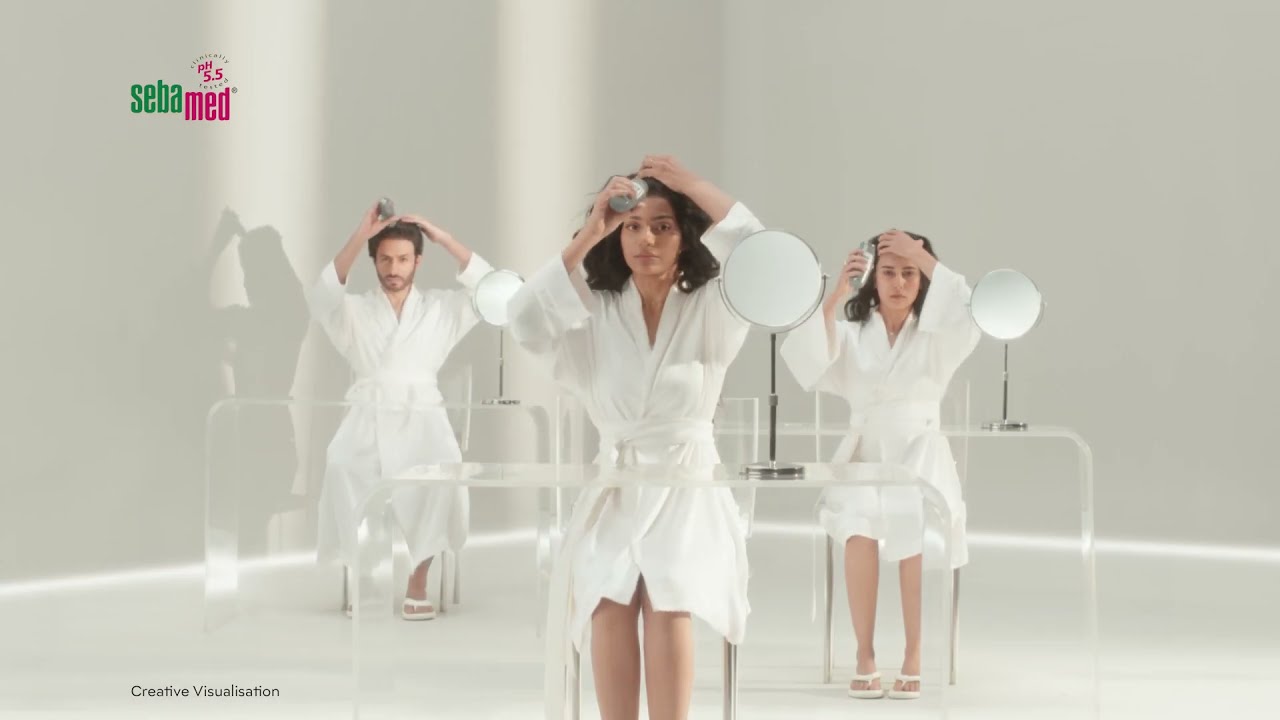
Mumbai: Sebamed has launched a digital campaign for its Anti-Hairloss Shampoo built around the insight that hair fall and hair loss are not the same condition, yet most consumers treat them as if they are. Conceptualised by Famous Innovations and directed by Mahesh Gharat at Hungry Films, the campaign uses two films to challenge this misconception before introducing the science behind the product.
The first film visualises the misconception through an unsettling metaphor: individuals are seen running a generic hair fall product across their scalp like an electric trimmer, causing their hair to disappear with each stroke. The film closes on the message that using a hair fall product for hair loss is effectively damaging your own hair.
The second film takes a more surreal approach. A man attempts to fix hair loss from the top of a giant hair strand, only to be reminded that the problem lies at the root, not on the strand itself. Both films then pivot to a science-led demonstration of how Sebamed Anti-Hairloss Shampoo works beneath the scalp with its NHE Formula containing Caffeine and Ginkgo Biloba Extract, designed to improve scalp nourishment and reduce hair loss from the roots.
"For years, hair fall and hair loss have been used as interchangeable terms, leading many consumers to unknowingly address the wrong concern. Through this campaign, we wanted to challenge the misconception in a way that is impossible to ignore. By combining bold storytelling with scientific education, our objective is to encourage consumers to understand what hair loss really is and why identifying the problem correctly is the first step towards finding the right solution."
Pranay Rao, VP Marketing, Sebamed
Mansi Shah, Business Head, Mumbai, Famous Innovations, said the campaign made a conscious choice to break the assumption before introducing the solution. "Hair fall and hair loss are often seen as the same problem, so unless we broke that belief first, the science behind the solution wouldn't have landed the way it needed to," she said, adding that the visual metaphors were designed to make people pause and question what they know before becoming more receptive to the science that follows.
The campaign will be amplified across digital video, social media, contextual platforms and creator-led content.


