











Mumbai: McCann has released The Truth About Global Brands, a study of 20,713 people across 20 markets, revealing a fundamental reset in how brands achieve growth and relevance globally. This year's edition draws on independent insights from an analysis of B2B decision-makers conducted by Economist Enterprise, the B2B arm of The Economist Group.
The research finds that brands must help consumers navigate an increasingly complex Truth Maze, a web of conflicting information, AI-generated content, and competing claims that has made it harder than ever to determine what is real. In India, 73% of people say it is more important than ever to prioritise truth, while 46% believe brands are less truthful than they were 20 years ago.
Concern around AI is also high. 71% of people in India worry they will soon be unable to distinguish between real people and artificial ones online. At the same time, accountability around AI use is emerging as a trust signal: 57% of people in India say being transparent about AI use is the most effective way for brands to build trust, and 49% say brands should help them understand what is real and what isn't in AI-generated content.
"Global brands are experiencing a growth crisis as we've shifted from a trust economy to a doubt economy, putting CMOs under more pressure than ever. The new playbook for the future of brand building will be grounded in a brand's ability to show up with clarity, credibility and cultural fluency at every decision point."
Tyler Turnbull, Global CEO, McCann
The commercial stakes are significant. 88% of people in India say they will actively choose brands they trust even if they cost more, signalling a growing premium on credibility. At the same time, 71% of consumers in India and 79% of global B2B decision-makers have stopped using a brand because they no longer trusted it.
"In a world where truth matters more than ever, certainty is the new value exchange," said Harjot Singh, Global Chief Strategy Officer at McCann. Tamara McMillen, Chief Revenue Officer at Economist Enterprise, added that the commercial cost of doubt is real and measurable, and that brands investing in being trustworthy guides to B2B decision-makers are best positioned to grow.
The research also points to a shift in how culture and influence flow globally, described as multi-modal globality. Influence is increasingly multi-directional rather than moving from West to rest, with markets including China, India, and Saudi Arabia shaping global norms. 79% of people in India say you can be a global citizen without travelling.
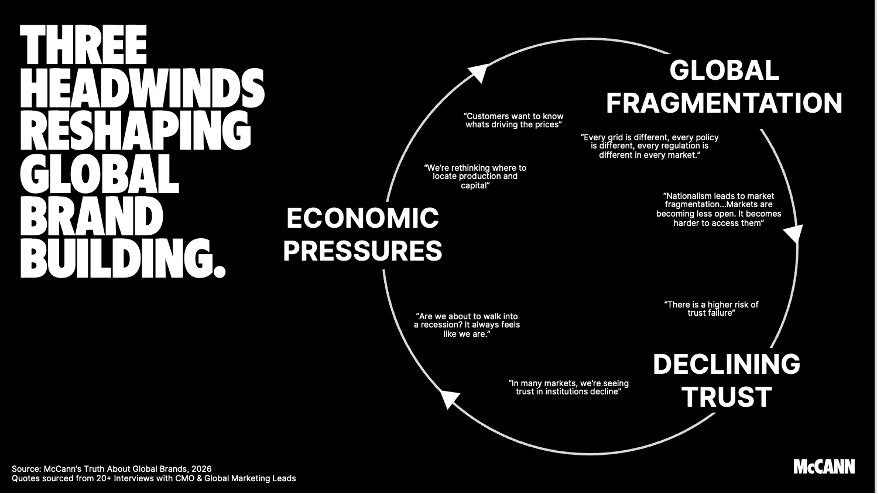
Three headwinds reshaping global brand building: economic pressures, global fragmentation, and declining trust | Source: McCann's Truth About Global Brands, 2026
The study identifies a new growth engine in what it calls the Upward Class: 1.02 billion people globally with $29.5 trillion in annual spending power, motivated by progress, self-improvement, and upward mobility. Unlike previous generations, this segment uses brands not just to consume but to signal progress, identity, and belonging, reshaping the meaning of status itself.
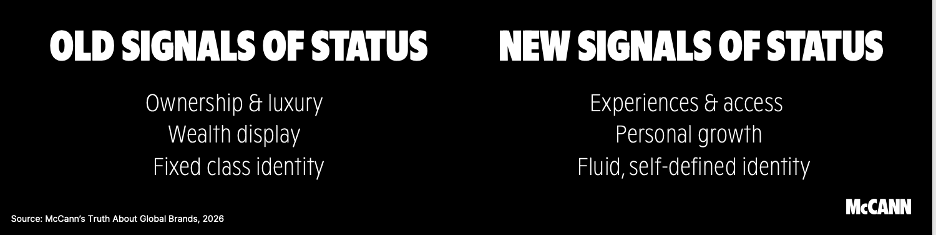
Old signals of status versus new signals of status, as identified in McCann's Truth About Global Brands, 2026 | Source: McCann
"Future growth won't come from leaning on existing audiences or legacy markers of scale," Turnbull said. "It will come from brands that turn truth into a genuine growth engine, building connected systems of meaning, culture and commerce. That's what McCann's Truth Well Told framework is designed to do."


