











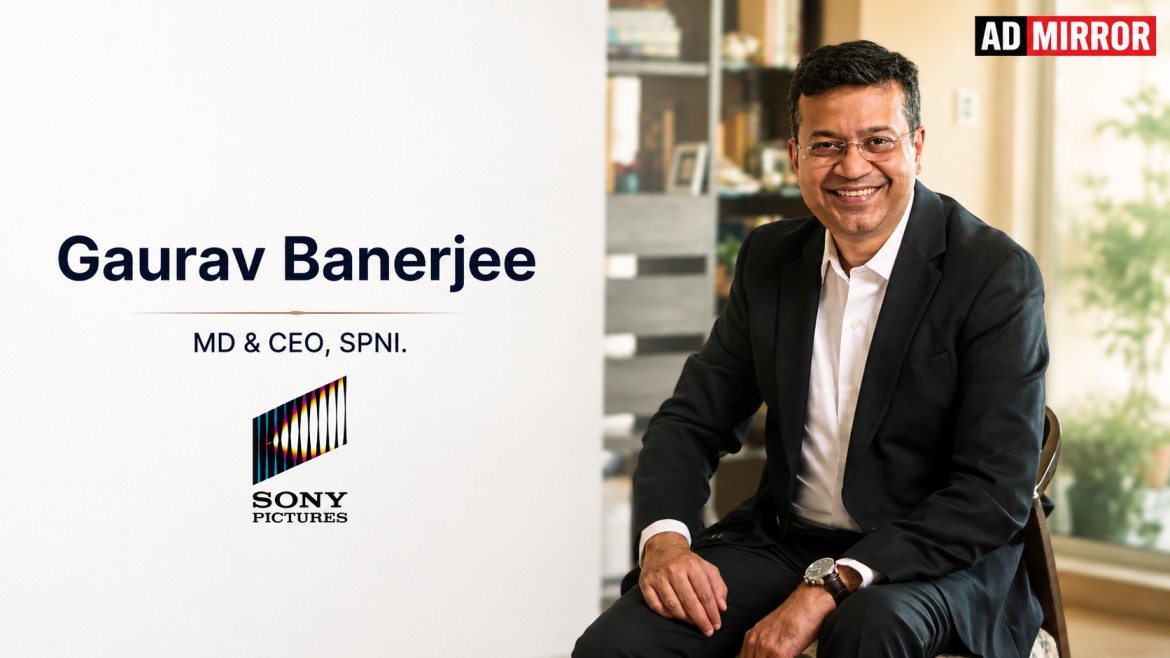
Mumbai: There is a temptation to read Sony Pictures Networks India's latest content slate as another festive-season programming push. That would be missing the larger story.
What Gaurav Banerjee is outlining is a fundamental reset in how Sony wants to think about the entertainment business: not as television versus digital, not as fiction versus non-fiction, and not even as entertainment versus sports, but as a single content ecosystem competing for one increasingly scarce commodity: attention.
And that changes the strategy.
Because Sony is not trying to win the screen wars. It is trying to make the screen irrelevant. The IP has to travel.
The core idea behind SPNI's organisational restructuring is straightforward. Content creation and monetisation have been brought closer together because the company wants to think about its consumer and its IP more holistically. A good story is a good story, irrespective of where it plays. That means KBC does not need to be defined by television. A movie does not need to be confined to streaming. Sports does not exist merely as a rights business. Every piece of content has to be capable of travelling across the ecosystem, be it television, streaming, connected TV, free TV and, increasingly, languages.
This is a crucial distinction. The old media question was: Where should the content live? The new question is: How much attention can the content generate, and how many ways can that attention be monetised?
KBC is the clearest signal
The new season of Kaun Banega Crorepati is perhaps the strongest expression of this philosophy. After 25 years, the challenge isn't awareness. It is relevance. In the age of Google, search and generative AI, knowledge itself has become almost frictionless. Answers are sitting inside every consumer's smartphone. So Sony is attempting to reposition KBC around something more valuable: reasoning under pressure. That is a smart evolution of a legacy IP. Instead of asking whether the audience knows the answer, the show increasingly asks what happens when people have to think, decide and reason under pressure. In other words, AI may know the answer. KBC wants to understand the human behind the answer.
When advertising markets become uncertain, advertisers often gravitate towards proven environments. Familiar IP provides reassurance, particularly when it comes with a powerful host, predictable audience behaviour and decades of consumer equity. The Google Gemini partnership around KBC illustrates the opportunity: technology brands can plug into legacy entertainment IP without the relationship being reduced to conventional spot advertising. That is where Sony sees the future of monetisation, integration rather than interruption.
The real regional play is bigger than Tamil
The launch of Tamil programming and the decision to establish a Tamil channel is another important piece of the strategy. Sony is entering one of India's most competitive entertainment markets as an underdog. It does not have the cultural history or market dominance of the established South Indian networks. So it cannot win by simply copying their programming playbook. Its proposition has to be recognisably Sony. That means game shows, crime franchises, differentiated formats, premium talent and strong IP but adapted for local audiences. Tamil is the entry point.
Marathi gets greater investment. Bangla and Telugu are next. The ambition is much bigger than launching another regional channel. It is about transforming SPNI into a multilingual Indian content company, and this could ultimately be one of Sony's most important growth levers.
India's media market is not one market. It is a collection of linguistic and cultural markets, each with its own consumption behaviour, stars, formats and economics. The opportunity is to take Sony's existing IP expertise and make it culturally native across these markets.
Sports isn't being abandoned. It is becoming more strategic.
There was a natural assumption that a bigger entertainment slate could signal a reduced dependence on sports. Banerjee's response is unequivocal: sports remains central. Cricket remains a major attention engine, while the Asian Games and international cricket properties provide a significant live-sports pipeline. That matters because live sport does something scripted entertainment increasingly struggles to do: it creates appointment viewing. But there is a second part to Sony's sports strategy that is arguably more important. Attention cannot be bought at any price.
A sports property can deliver millions of viewers and still destroy value if the rights economics don't work. Sony's approach appears increasingly disciplined: buy sports where the audience engagement, strategic value and economics make sense. That is a very different proposition from simply chasing the biggest available rights.
Attention is the metric. Retention is the outcome.
This may be the most interesting part of Banerjee's thinking. While much of the streaming industry has shifted the conversation towards retention, discovery, commerce and AI-led recommendations, Sony continues to put attention at the centre. At first glance, that may sound old-school. It isn't, because retention without attention is impossible. If audiences don't care enough to watch a story, they won't return to it. If they don't return, subscriptions become difficult to sustain. Attention is therefore the first link in the chain.
Attention - engagement - retention - monetisation.
For a company whose primary business is creating and curating stories, it is a remarkably clean strategic framework.
Sony's answer to YouTube isn't to become YouTube
The creator economy presents another interesting test. Game shows, reality formats and entertainment properties are increasingly being created directly for YouTube and social platforms, often at significantly lower production costs. Sony's response isn't necessarily to fight this phenomenon. It is to use it as a discovery mechanism. The India Game Show is an example of how creators can build IP independently, generate attention and then enter the traditional media ecosystem.
That reverses the old model. Earlier, television executives discovered talent and ideas and gave them distribution. Now creators can prove the idea first and negotiate distribution later. For broadcasters, that could become an increasingly important source of IP.
Less can be more
There is also a deliberate restraint in Sony's strategy. Banerjee points out that Sony produces less content than many competitors. That is not necessarily a weakness. In an environment where every platform is producing more shows, more movies and more formats, the real problem is not content scarcity. It is content discoverability and content differentiation. Sony's bet appears to be that fewer, stronger IPs can create greater economic value than an endless volume of programming.
That explains the continued investment behind KBC, Crime Patrol, premium originals and marquee sports properties. It also explains the selective approach to movie acquisitions and sports rights. Sony is willing to spend when it owns or can meaningfully build the IP. It is more cautious when simply renting somebody else's attention.
The competitive advantage may be focus
In a market increasingly defined by consolidation, Banerjee identifies Sony's independence and focus as advantages. There is something important in that. Larger media groups can bring scale, distribution and financial muscle. But scale can also create complexity. Sony's proposition is different: stay focused, make fewer bets, understand the IP deeply and invest behind the ones that work. The company believes its long-standing franchises give it another advantage and accumulated knowledge. It knows what makes KBC work, knows what makes Crime Patrol work and it knows its audiences.
The challenge now is to keep these franchises relevant without destroying the equity that made them valuable in the first place.
The Sony bet is ultimately an IP bet. Strip away the channel launches, the festive slate, the sports properties, the streaming strategy and the regional expansion, and the strategy becomes remarkably simple.
Sony wants to own attention by owning or building IP that people care about.
KBC gives it legacy. Crime Patrol gives it scale. Sports gives it appointment viewing. SonyLIV gives it digital depth. Tamil and other regional markets give it new audiences. Creators give it a new talent and IP pipeline and finally multi-screen distribution gives every successful property more opportunities to monetise.
The bigger challenge will be execution. India's attention economy is becoming brutally competitive. Every platform, broadcaster, creator and social network is fighting for the same few hours of consumer time. The answer cannot simply be more content. It has to be better content, sharper IP and smarter monetisation.
That is ultimately what Banerjee's strategy points towards. Sony isn't choosing between television and digital. It is choosing to compete above the screen and in the next phase of Indian media, that may be the more important battle.


