











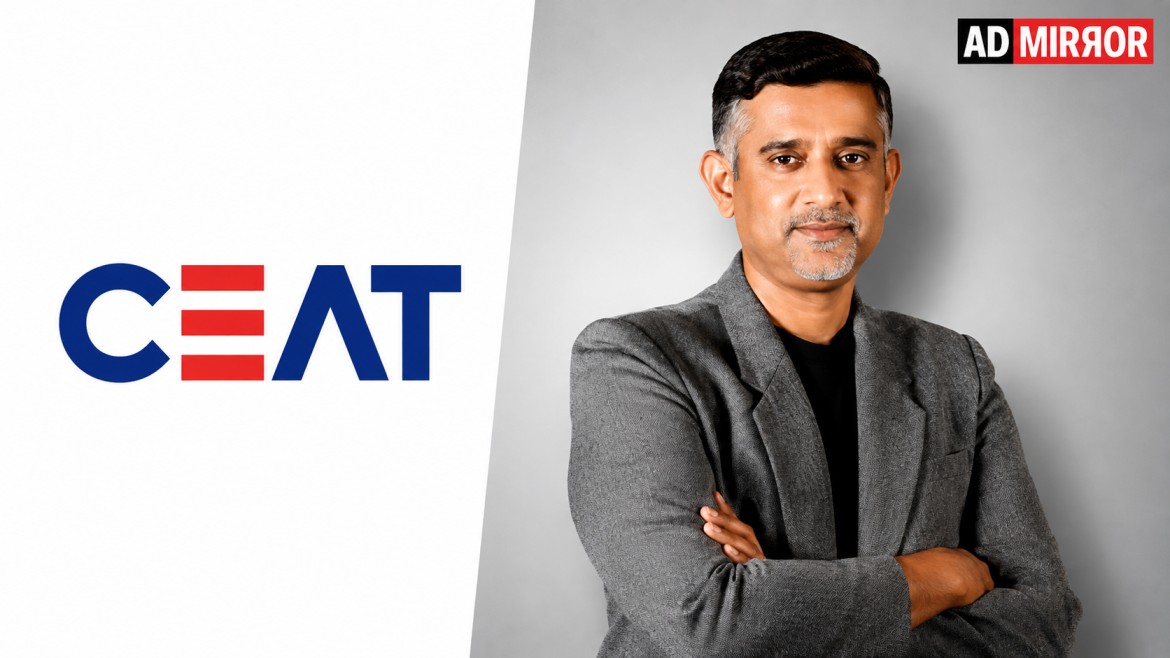
Mumbai: The conversation around the future of mobility is often dominated by electric vehicles, software-defined cars, connected technologies and artificial intelligence. Yet, according to CEAT Limited's Chief Marketing Officer Lakshmi Narayanan B, the biggest disruption isn't technological, it's behavioural. Consumers are redefining what mobility means, forcing brands, products and marketers to evolve faster than ever before.
In an exclusive conversation with AdMirror, Lakshmi Narayanan B explains why CEAT is transforming from a traditional tyre manufacturer into a consumer-centric mobility brand, how premiumisation is creating new opportunities in a historically functional category, why AI will improve efficiency but not replace human insight, and why long-term brand building still depends on consistency, trust and meaningful consumer experiences. He also shares how CEAT is balancing product innovation with experiential marketing as India's automotive landscape enters its next phase of growth.
The automotive industry is going through one of its biggest transformations — EVs, connected mobility, premiumisation and changing consumer expectations. From a marketer's perspective, what is changing faster today: the consumer, the product or the brand itself?
Without a doubt, it is the consumer. Products and brands simply respond to that evolution. Marketing has always been about identifying behavioural shifts before they become obvious and translating those insights into products, experiences and communication. Everything begins with understanding how consumers are changing.
Take the automotive industry. It is no longer just about moving from point A to point B. Consumers today expect very different things from their vehicles depending on the occasion. A weekday commute, a weekend getaway, long-distance touring, off-roading or adventure riding all demand different experiences. As mobility itself gets redefined, products and brands are forced to evolve alongside it.
It is similar to what happened in the mobile phone industry. We began with feature phones, but as consumer expectations expanded, smartphones transformed the category. Mobility is now experiencing a similar shift, where changing consumer aspirations are driving the next phase of innovation.
"The consumer changes first. Products and brands simply follow. A marketer's job is to recognise that shift before everyone else."
Lakshmi Narayanan B, CMO, CEAT Limited
CEAT has steadily evolved from being seen as a tyre manufacturer to becoming a consumer-facing mobility brand. What has been the biggest shift in your brand strategy over the last few years?
For decades, tyres were viewed purely as components. Around fifteen years ago, CEAT Limited consciously decided to move beyond functional communication and build an emotional connection with consumers.
At that point, the dominant emotion was fear. Indian roads were unpredictable, and consumers worried about the safety of themselves and their families. Our communication reflected that reality. Over the past decade, however, India has changed dramatically. Better infrastructure, rising incomes and growing confidence have fundamentally altered consumer sentiment. Today, the dominant emotion is confidence rather than fear.
For us, marketing is about recognising that emotional shift and ensuring the brand evolves with it. While the emotional narrative has changed, our core promise around safety, grip and reliability remains constant.
Tyres have traditionally been considered a functional purchase. How do you build emotional affinity in a category where consumers often prioritise price over safety and durability?
The opportunity still lies in educating consumers about functionality. Most people believe the tyre carries the weight of the vehicle. In reality, it is the air inside the tyre that supports the load. Maintaining the correct air pressure has a huge impact on performance, safety and durability. Even simple consumer education can significantly improve the ownership experience. At the same time, the category itself is evolving.
As consumers increasingly use their vehicles for multiple purposes, daily commuting, road trips, performance driving and adventure travel, they begin to appreciate that not all tyres are created equal.
In mature markets like Europe, consumers routinely compare wet braking, dry braking and grip ratings before making a purchase. India is approaching a similar stage where buyers are becoming more discerning and willing to invest in performance rather than simply replacing tyres based on price. Consistency also plays an important role in brand building.
Although our communication has evolved from fear to confidence, the central idea remains unchanged. Every CEAT campaign reinforces the importance of grip because the true value of a tyre becomes most evident during braking. That has become a consistent signature across our communication.
Premiumisation is reshaping almost every category in India. How is this influencing consumer expectations in the tyre business?
I see premiumisation as one of the biggest opportunities for our category. When consumers upgrade to premium vehicles, whether EVs, SUVs or performance motorcycles, their relationship with the vehicle changes completely. They become more involved in understanding every aspect of ownership.
Electric vehicles are a good example. Many modern EVs offer multiple driving modes. Consumers now need to understand how these modes affect efficiency, performance and even tyre wear. Someone constantly driving in Sport mode will naturally experience faster tyre wear.
That learning process creates opportunities for brands like CEAT to educate, engage and build stronger relationships with consumers. The more informed consumers become, the greater the opportunity to move the conversation beyond price and towards performance.
Having led marketing at CEAT, Asian Paints and Samsung, what principles of brand building have remained constant across industries? What has fundamentally changed?
The biggest constant is the consumer. Across every industry I have worked in, the consumer has remained at the centre of every important marketing decision. Understanding consumer behaviour and the consumer journey continues to be the foundation of brand building.
What has changed dramatically is speed. Consumers today have access to information instantly. They can compare products, read reviews, use AI tools, seek recommendations and complete a decision-making journey within hours, something that previously took days or even weeks. Information has become democratised, and the speed of evaluation has increased exponentially. That demands much greater agility from brands.
Digital has dramatically altered how consumers research and purchase automotive products. How is CEAT balancing investments across digital commerce, dealer networks and traditional brand building?
Tyres remain an online-to-offline category. Consumers increasingly research online, but the purchase journey still concludes offline because fitment, balancing and wheel alignment require physical intervention. Our investment strategy therefore operates across three layers.
The first is the trust layer, built through dealers and retailers who complete the consumer journey. The second is the communication layer, where digital platforms, social media and traditional media help consumers discover and evaluate products.
The third is the relevance layer, where long-term brand associations keep CEAT culturally visible. Our decades-long association with cricket illustrates this philosophy. Whether through the CEAT Cricket Ratings or the IPL Strategic Time-Out, consistency has ensured the brand remains top of mind across generations.
With AI transforming marketing, where do you see the biggest opportunity for brands like CEAT?
AI has enormous potential, particularly in improving operational efficiency. Whether it is supply chain optimisation, dealer servicing, inventory planning or consumer reminders for tyre rotation and maintenance, AI can make processes significantly more efficient. It can also improve customer engagement through greater personalisation. However, we should avoid assuming AI can replace human understanding. Consumer behaviour remains fundamentally a human insight. Technology can improve efficiency, but empathy, observation and interpretation continue to be the marketer's responsibility.
"AI can dramatically improve efficiency, but consumer behaviour remains a deeply human insight. Technology can support marketers, it cannot replace human understanding."
Lakshmi Narayanan B, CMO, CEAT Limited
The mobility ecosystem is becoming increasingly fragmented. How does CEAT remain relevant across such diverse consumer segments?
The answer lies in balancing one consistent promise with highly specialised products. Across every segment, EVs, premium motorcycles, SUVs, commercial fleets or off-road vehicles, our central promise remains grip and safety. Around that promise, we build segment-specific innovations.
For off-road enthusiasts, we have specialised rugged terrain tyres. For premium and electric vehicles, we offer technologies such as Calm tyres that reduce cabin noise. Beyond products, we are also investing in experiences. Our Enduro Park in Leh allows motorcycle enthusiasts to experience adventure riding in a safe environment while building deeper engagement with the brand. The future of mobility marketing will be driven not only by products but also by communities and experiences.
Marketing today is under constant pressure to demonstrate business impact. Beyond awareness and reach, what metrics matter most to you?
Performance marketing has made marketers increasingly accountable, and rightly so. For me, two metrics remain critical. The first is consumer consideration. Is the brand consistently entering the consumer's shortlist when purchase decisions are made? The second is commercial performance. Brand building must ultimately translate into sustainable business growth. Long-term marketing success comes from balancing both, building stronger brand equity while delivering measurable business outcomes.
Looking ahead five years, what will define the next generation of successful mobility brands in India?
Three trends will shape the future. First, global technologies will increasingly be adapted for Indian driving conditions. There is enormous scope to Indianise international innovations. Second, connected technologies will transform tyres into intelligent products capable of providing real-time feedback on performance, maintenance and vehicle health. Third, consumers themselves will become significantly more engaged. As mobility becomes more experiential, enthusiasts will increasingly choose specialised products for different driving conditions, whether touring, adventure riding or off-roading.
Ultimately, however, one principle will remain unchanged. Technology will continue to evolve rapidly, but the consumer will always remain the starting point. Brands that understand consumers earliest and innovate accordingly will define the future of mobility.


