











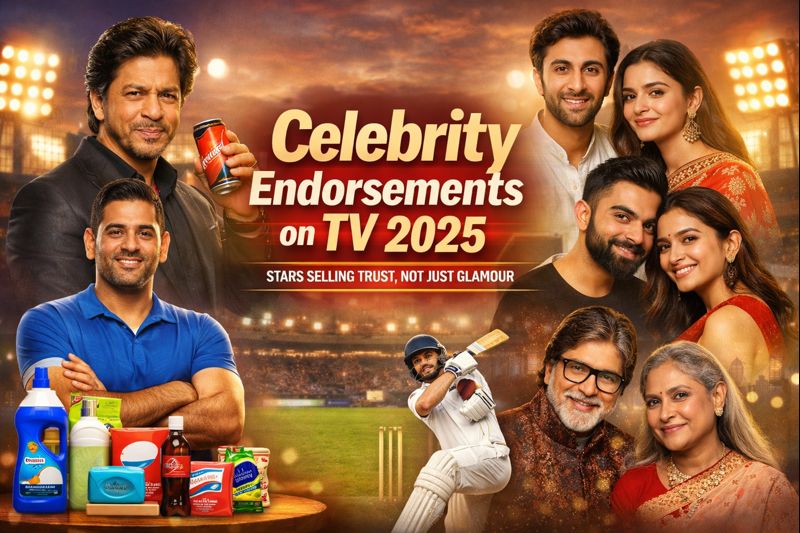
MUMBAI: “Celebrity presence on TV is no longer about frequency, it is about impact.”
In India’s highly cluttered television environment, where audience attention is fragmented across multiple screens and platforms, celebrity endorsements continue to serve as a powerful recall device for brands. However, the 2025 trends show a clear shift in how celebrities are being used on television. While the overall volume of celebrity-endorsed advertisements has reduced compared to previous years, their deployment has become more strategic, more sector-focused, and more concentrated around a few high-impact personalities.
This report examines how celebrity endorsements are shaping television advertising across sectors, categories, and brand strategies.
Celebrity Presence in Television Advertising
“Brands use celebrities less often, but with far greater intent.”
Film actors remain the most preferred endorsers on television, followed by sports personalities and television actors. Male film stars continue to command the largest share of endorsement visibility.
This indicates that brands are not using celebrities frequently, but when they do, they rely on personalities with strong recall and mass familiarity.
Shift in Advertising Patterns: Event-Led Deployment
“Celebrity advertising is now aligned to high-attention windows, not always-on visibility.”
2025 saw a decline in the volume of celebrity-endorsed commercials compared to previous years. However, this reduction signals a shift toward more tactical usage.
Advertising activity featuring celebrities was stronger in the first half of the year, particularly during major sporting periods, suggesting that brands deploy celebrities during peak attention phases.
Sectors Driving Celebrity Endorsements
“Trust-driven categories rely the most on celebrity assurance.”
Food and beverages, personal care and hygiene, household products, healthcare, and building materials emerged as the leading categories using celebrities.
These are everyday-use categories, where consumer confidence plays a critical role in purchase decisions. Celebrity endorsements in these sectors function as reassurance rather than aspiration.
Gender Patterns in Endorsements
“Category stereotypes continue to influence who endorses what.”
Food and beverage advertisements featured more male celebrities, while personal care and hygiene categories leaned more toward female endorsers. Certain sectors showed a dominant male celebrity presence. This suggests that traditional category stereotypes continue to influence endorsement choices.
Categories with Highest Celebrity Dependence
“Hygiene and household trust categories are the biggest celebrity magnets.”
Hygiene-related categories such as cleaners, soaps, and washing products were among the largest users of celebrity endorsements. These categories rely heavily on consumer trust and familiarity.
In contrast, emerging categories attracted a wide range of celebrities, indicating experimentation and differentiation rather than volume-driven endorsement.
Most Visible Celebrities on Television
“A handful of celebrities command disproportionate share of screen presence.”
A small group of celebrities accounted for a large share of television visibility through endorsements, highlighting the concentration of advertiser confidence in familiar, credible faces.
The dominance of male celebrities in top visibility rankings highlights the skew in endorsement representation.
Celebrities with the Highest Number of Brand Associations
“Endorsement breadth reflects advertiser trust and credibility.”
Some celebrities significantly increased their brand associations, reflecting strong advertiser confidence in their credibility, reach, and consistency across categories.
Celebrity Couples as Trust Multipliers
“Couples amplify familiarity, relatability, and trust for brands.”
Celebrity couples emerged as significant endorsement assets. A handful of high-profile pairs accounted for a large share of couple-led advertisements, amplifying trust for brands across categories.
Key Takeaways for Marketers
“Celebrity endorsement on TV has shifted from glamour to assurance.”
Brands are using fewer celebrity ads but ensuring that the personalities chosen carry maximum recall and credibility.
Hygiene, household, and food categories depend heavily on celebrity assurance. Major sporting periods act as peak windows for celebrity deployment, and celebrity couples are increasingly leveraged as trust ecosystems.
Conclusion: The New Role of Celebrities on Television
“Celebrities today sell assurance more than aspiration.”
The 2025 landscape demonstrates that celebrity endorsement on television remains highly relevant, but its purpose has evolved. In categories where consumer trust matters most, brands rely on familiar, credible faces to strengthen messaging and drive recall.
2025 tells us that celebrity endorsement on TV is no longer about glamour.
It is about trust transfer in high-frequency, low-involvement categories.
Celebrities are no longer selling aspiration, they are selling assurance, that your floor cleaner works, your soap is safe, your paint lasts, your drink refreshes.
And when that assurance is needed at scale, brands still turn to SRK and Dhoni.


