











Mumbai: With platforms like Blinkit, Zepto, Instamart and Amazon blurring the lines between media, marketplace and last-mile fulfilment, performance marketing is no longer confined to search and social. Retail media networks, first-party data, and hyper local delivery signals are becoming central to brand growth strategies.
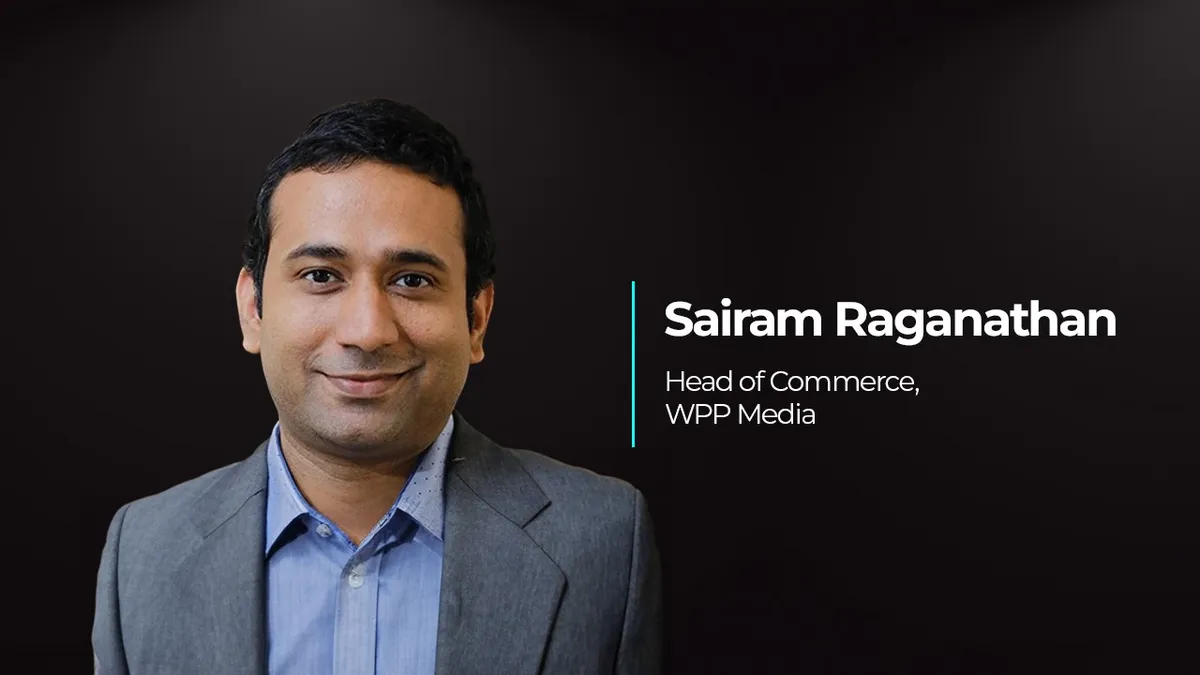
At WPP Media, this shift is driving deeper integration between media planning, commerce strategy and data intelligence. In this conversation, Sairam Ranganathan shares how WPP Media is building commerce-first frameworks, aligning performance with profitability, and helping brands navigate the explosive rise of quick commerce in India.
Is WPP Media now treating e-commerce and quick commerce platforms as full-fledged media ecosystems rather than just sales channels? How does that change planning architecture?
At WPP Media, the distinction is sharp.
Quick Commerce is not treated as just another awareness-led media vehicle. It is, first and foremost, a sales channel. And that difference changes everything from mind-set to measurement.
Traditional media planning is designed to generate awareness, consideration and brand equity. Commerce planning, especially in Quick Commerce, is engineered to deliver consistent, month-on-month sales. That requires a completely different orientation.
“Quick Commerce is not treated as just another awareness-led media vehicle. It is, first and foremost, a sales channel. And that difference changes everything from mind-set to measurement.”
While some media principles still apply, Quick Commerce cannot be approached like a campaign. It has to be treated like building and running a business channel much like how brands historically approached General Trade or Modern Trade.
Success in commerce is not driven by media alone. It is the outcome of an integrated system where media investments, creative optimisation, assortment strategy, pricing architecture, platform visibility and operational efficiency work together.
It’s a channel that must be built, optimised and sustained not just activated.
Recognising this shift, WPP Media has expanded its talent mix. Beyond traditional agency planners, the team includes professionals from diverse, non-agency backgrounds people who understand that the difference between a media plan and a business plan is critical.
Commerce planning demands breaking down every lever that influences sales and integrating them into one cohesive framework. The objective is not impressions it is conversion velocity, repeat purchase, and sustainable revenue growth.
In essence, WPP Media treats Quick Commerce not merely as commerce media, but as a business architecture that requires end-to-end orchestration.
With high discounting and razor-thin margins in Q-commerce, how should brands balance growth versus profitability?
In a high-discount, low-margin Quick Commerce ecosystem, the growth-versus-profitability question cannot be answered with a single formula. The right approach depends entirely on the brand’s life stage, distribution strength and strategic intent.
There are broadly three types of brands entering Quick Commerce.
Legacy brands entrenched in General Trade and Modern Trade but new to Quick Commerce focus first on learning economics rather than scaling rapidly. Omni-channel brands treat Quick Commerce as an integrated growth lever from day one. Disruptor brands use it as a breakthrough channel with sharper pricing, differentiated packs, exclusive SKUs or premium propositions.
SKU strategy plays a decisive role. The packs that work in traditional retail often don’t translate directly into Quick Commerce. Smaller packs, impulse formats and premium variants behave differently in a 10–15 minute delivery ecosystem. Many brands now use the channel to trade consumers up by offering upgraded variants alongside core portfolios.
At present, a significant share of Quick Commerce revenues is concentrated in 8–10 cities. As platforms expand into 30–40 additional cities, differentiated regional strategies are expected to emerge.
“In Quick Commerce, growth without a path to profitability is fragile. Profitability without growth limits scale.”
How is retail media data enabling closed-loop measurement?
The real opportunity lies in leveraging platform data in a compliant, privacy-centric manner to enable closed-loop maximization.
Consumers who frequently buy indulgence categories such as sweets or ice creams on platforms like Zepto or Blinkit create purchase signals that can inform off-platform targeting. If that same consumer sees a contextual nudge on Instagram or YouTube during payday week, the message can act as a trigger leading directly to conversion on the commerce platform.
Algorithms update dynamically even based on small signals such as clicking a single SKU. Media is no longer about broad targeting. It is about identifying triggers, category entry points and high-intent windows.
“Media is no longer about broad targeting. It is about identifying triggers, category entry points, and high-intent windows.”
The opportunity often lies before the consumer lands on a commerce platform. Once inside, intent is usually clear. The real value comes from identifying moments before intent crystallizes.
Are budgets shifting from Google and Meta to commerce platforms?
At its core, every media budget today is performance-driven. The KPI may differ, but accountability does not.
Amazon is now the third-largest digital advertising player globally after Google and Meta and also the fastest growing. That signals a structural shift in advertiser priorities.
Budgets are not expanding dramatically. Which means retail media platforms must acquire share from existing allocations. Typically that share comes from Google and Meta budgets, traditional media allocations, or a small incremental layer of digital-first spend.
Search itself is fragmenting. Ten years ago search meant Google. Today search could mean Google, Amazon or Zepto depending on user intent.
“Search is fragmenting and commercial intent is migrating downstream.”
If consumers want research they may go to Google. If they want to transact they move closer to commerce platforms. Discovery and conversion are increasingly collapsing into the same journey.
What will define leadership in commerce media over the next few years?
If there is one factor that will accelerate brand growth across commerce platforms, it is understanding the consumer journey and intervening at the right moment with the right message.
Operational fundamentals remain non-negotiable. Supply chain efficiency, accurate assortment mapping and zero out-of-stock scenarios are baseline requirements. If a consumer clicks and the product is unavailable, the negative experience outweighs any performance gain.
Real differentiation will come from contextual relevance. The brands that win will be those that orchestrate cross-platform messaging, align creative to need states and trigger communication at high-probability moments.
How important is CX in Quick Commerce?
Customer Experience plays a decisive role.
On most platforms, users spend roughly 60–70 seconds from entry to exit. Within that compressed timeframe brands must achieve discovery, consideration and conversion.
“In a 60-second commerce cycle, CX is not a support function it is the brand’s growth engine.”
Post-purchase experience is equally critical. Delivery timing, product condition, packaging integrity and substitution logic all influence retention. In a high-frequency environment, a single poor experience can lead to churn.
Are legacy brands embracing Quick Commerce?
Absolutely.
Quick Commerce is no longer experimental. It is a growth lever. Brands that stay away risk losing a new sales channel, real-time consumer insights and incremental demand pools.
If consumers are present on these platforms and a brand is not, the loss is measurable. Visibility, relevance and share shift to competitors who are present.
Channel presence today is not optional. It is strategic hygiene.


