











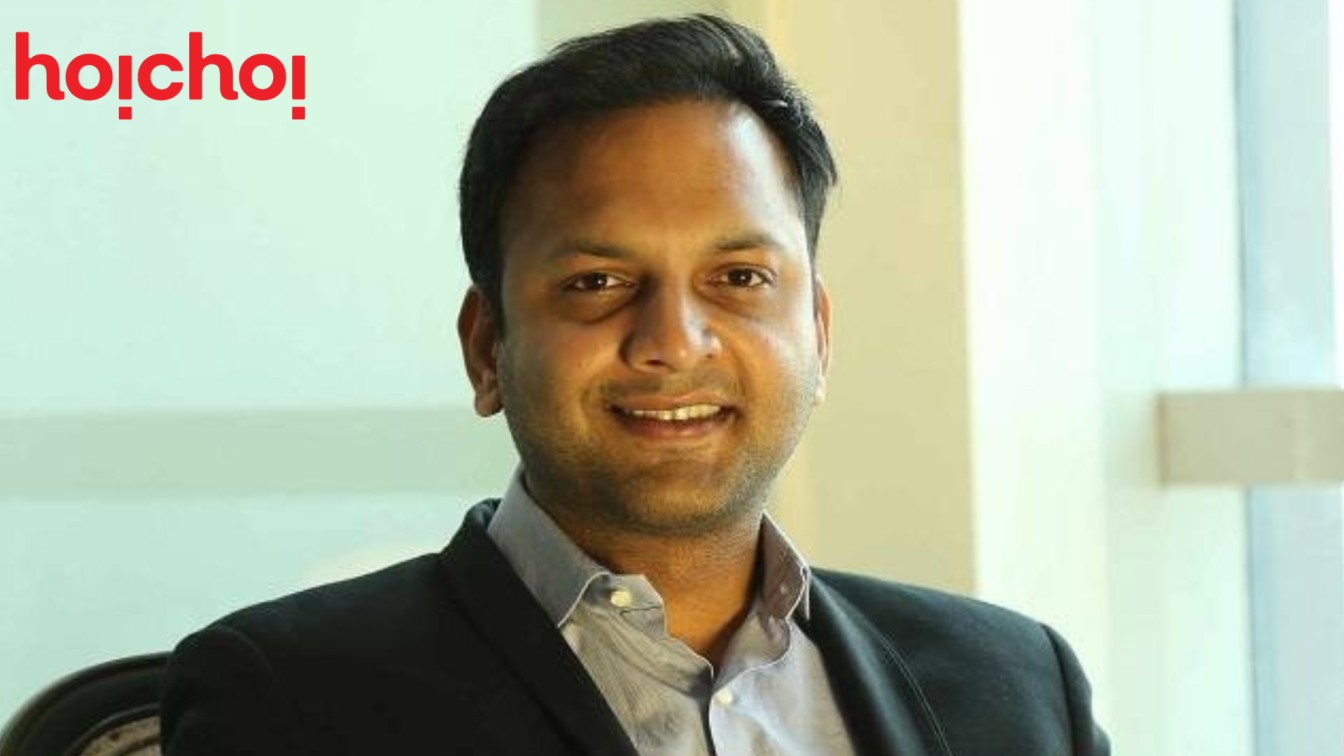
Mumbai: At a time when global streaming giants are doubling down on scale, spend, and pan-India storytelling, Vishnu Mohta is building in the opposite direction, depth over breadth, habit over hype, and culture over category labels.
For Mohta, Bengali content isn’t “regional”; it’s a 250 million–strong audience hiding in plain sight. And Hoichoi isn’t just an OTT platform, it’s an evolving content ecosystem experimenting across formats, monetisation models, and now, artificial intelligence.
In this wide-ranging conversation, Mohta challenges some of the biggest assumptions shaping the streaming industry, from the myth of subscription fatigue and the limits of AVOD in India, to the need for weekly engagement over blockbuster drops. He also offers a candid look at how AI could fundamentally alter not just distribution, but the very act of storytelling itself.
The underlying theme: in a world heading towards infinite content, the real battle won’t be for scale but for attention, habit, and survival.
AdMirror caught up with Vishnu Mohta, Co-Founder, Hoichoi & Logline, and Executive Director, SVF, for an exclusive one-on-one conversation on the evolving dynamics of regional OTT, shifting monetisation models, and the disruptive impact of AI on storytelling.
Edited excerpts:
Regional OTT platforms were once seen as a niche, but today they're shaping India's streaming landscape. How has HoiChoi managed to turn Bengali storytelling into a global digital proposition?
Regional is a label the industry uses. For us, Bengali is a 250 million–strong audience. That’s not niche, that’s scale hiding in plain sight.
We’ve spent over two decades obsessing over one language, one community. Hoichoi wasn’t a pivot it was simply taking that legacy direct-to-consumer. The format evolved from cinema and television into web series, but the focus never changed.
The real difference is mind-set. Most platforms are chasing scale; we’re chasing depth. We don’t want to be the biggest player in the room, we want to be the one with the most fight.
That shows up in where we put our money. Nearly 60–70% of our investment goes into content, not marketing. Because marketing is short-lived stories are not. We produce about 30 shows a year and continuously expand their reach through dubbing and partnerships.
Also, this is a survival game. If you don’t have the runway, your vision doesn’t matter. Being around after 10 years is a bigger achievement than any spike in viewership. And despite that, we still think we’re at day one. We’re experimenting constantly on formats, technology, even AI. Because the mission is far bigger than what we’ve achieved.
If our goal is to entertain audiences in their native language, we’ve probably done 1% of that. The ambition is to build something that outlives us and that’s the real scale.”
With global platforms today investing heavily in regional content, how does Hoichoi differentiate itself while competing with giants that have larger budgets?
“We don’t think of this as a budget battle. In our category, for our audience, Hoichoi is synonymous with Bengali content and that’s not built overnight.
We’ve spent decades understanding one community. Today, that translates into a 200+ strong series library, built over 10 years, backed by 30 years of content intuition and just as importantly, the mistakes we’ve learned from. That depth is hard to replicate.
But the real game isn’t just content and it’s a habit.
Streaming is a subscription business, and subscription is driven by consistency. If television builds habit daily, OTT platforms need to create excitement at least once a week. That means 50+ strong content drops a year for a single language to remain relevant. That’s a massive creative and operational challenge and also where most platforms underestimate the effort required.
For us, scale comes from serving a deeply engaged cohort. We’re probably among the largest single-language catalogues in India, and we continue to add 30 shows every year. The goal is simple: give the consumer enough variety, frequency, and freshness so they keep coming back.
Speed becomes critical in that equation. We green light shows and aim to release them within three to six months. Because in today’s world, content relevance has a short shelf life. What works today may not work two years later and frankly, even predicting three years out is impossible.
So while others may compete on size or spend, we’re focused on three things: depth of understanding, consistency of engagement, and speed of execution.
Because in the end, this isn’t just a content business it’s a behaviour business.
Bengali content has a strong, literary and cinematic legacy. How do you balance staying rooted in that cultural authenticity while making stories that appeal to younger and global audiences?
“Language is often mistaken for culture”, but it’s really just a medium of communication.
Take Bengali. We operate across India and Bangladesh, two markets connected by language, but fundamentally different in culture, religion, socio-economics, and worldview. Assuming one audience will seamlessly consume the other’s stories is a flawed approach.
That’s why we don’t ‘export’ content, we rebuild it locally.
When we entered Bangladesh, the ambition was clear: not to be an Indian platform operating there, but to become a local storytelling ecosystem. That means backing local creators, building local narratives, and ensuring the content feels native and not imported. The moment it feels like an external voice, the audience rejects it.
This is where our role evolves. We’re less a traditional studio and more like a venture capital firm for storytelling—deploying capital, insight, and experience to back creators, and then stepping aside. Because the most authentic stories can only come from those who live that reality.
Of course, not everything works. We produce around 30 shows a year, some succeed, and some don’t. But like any portfolio model, the strength lies in the overall blend.
As for global or younger audiences, the assumption is often that you need to dilute authenticity to scale. We believe the opposite. The more rooted a story is, the more universal it can become.
But that authenticity must be preserved. A story designed for Bangla doesn’t always translate the same way in Hindi or other languages and it can lose nuance, tonality, even meaning.
Which is why, even as distribution expands through platforms like Prime Channels, the core experience still belongs in its native form.
Because in storytelling, authenticity isn’t a layer you add and it’s the foundation you can’t afford to lose.
Subscription fatigue is becoming real as consumers juggle multiple authentic services. Hoichoi adopting to ensure sustained subscription growth and retention?
“Subscription fatigue is real, but it’s also misunderstood”.
People don’t churn because they have too many subscriptions. They churn because they don’t have a reason to come back.
For us, retention is built on one simple principle: give the consumer something to look forward to every week. Streaming isn’t about one big show, it’s about building a habit. The moment you stop showing up consistently, you disappear from the consumer’s mind. And in the internet era, brand loyalty is limited. Even after 10 years, we don’t take that for granted. At best, you earn a little patience but not indefinite attention.
That’s why we backed annual subscriptions from day one, at a time when neither regional content nor subscription models were mainstream. The belief was simple: if consumers see enough value, they will commit upfront.
Because ultimately, people don’t evaluate what they pay and they evaluate what they get.
If your platform becomes part of their daily life, through emotional connection, cultural nostalgia, or just the comfort of familiar storytelling, you become sticky. You move from being a service to becoming a habit. And once that happens, subscription is no longer the challenge. It’s just the mechanism.”
Beyond India, Bengali diaspora audiences across the US, UK and Bangladesh form a significant, how important is the digital market in my choice, long term growth strategy?
Global audiences and diaspora are important, but the bigger shift today is not geographic, it’s technological.
I spend nearly 50% of my time on AI now. Because this is not just another wave of innovation and it’s a fundamental shift in how content itself gets created.
For the last 100 years, technology has largely enhanced storytelling, better cameras, better editing, and better distribution through television or OTT. But this is the first time technology is not just enabling content, but it’s starting to create it.
That’s a big difference.
Earlier, innovation solved for distribution. AI is solving for creation. It can potentially substitute parts of the filmmaking process itself and that’s both powerful and, frankly, a little scary.
But resisting it is not an option. No technology wave in media has ever been stopped. The only choice is whether you adapt early or get disrupted later.
What’s important, though, is context. AI doesn’t automatically make someone a great storyteller. Tools don’t replace taste, intuition, or cultural understanding. The real opportunity lies in the combination of great creators empowered by powerful tools.
That’s where the multiplier effect is. A strong creator can now do 10x more. And this shift is not limited by language or geography. Which means the next phase of content creation will be far more democratised and far more competitive.
Our role, as a company, is to enable that transition. To ensure we’re not disrupted by it, but actually shaping how it evolves within our ecosystem. Because whether we participate or not, it will happen.
Beyond content, AI will transform every part of the business, be it customer experience, marketing, operations, tech. A company that embraces it holistically will simply be more efficient, more responsive, and more future-ready.
At its core, this is not just about technology. It’s about mind-set.The way we’ve done things so far will not define how we succeed in the future.
Do you see Hoichoi increasingly collaborating with theatrical filmmakers or even experimenting with hybrid releases?
Collaboration with filmmakers isn’t new for us, it’s our default.
We come from a film production background, so working with top creative talent across cinema and streaming has always been part of our DNA. The real shift isn’t in collaboration, it’s in how we think about audiences and monetisation.
Because the bigger reality is this: subscription alone won’t solve India. At best, maybe 3–5% of the market is ready to pay consistently. The real opportunity lies in the remaining 95% and that requires completely different models. So we’ve started building beyond a pure subscription mind-set.
For instance, we launched a format called TV Plus, longer, more habitual storytelling with 30–50 episode arcs, dropping multiple episodes weekly. The first few episodes are free, so users can build familiarity before deciding to pay. It’s designed to convert a more TV-like audience into digital consumers.
We’re also experimenting with Hoichoi FM, an audio storytelling layer because storytelling doesn’t always have to be visual. And interestingly, we’ve kept it free for now. The idea is to first win consumer time; monetisation can follow.
Then there’s microdrama and short-form vertical content, a space exploding globally. It’s fast, cost-efficient, and potentially scalable with AI. We’ve launched a beta platform, Super, to explore this. And perhaps the biggest learning and we can’t expect younger audiences to come to us. We have to go to them.
Take anime. I saw 20,000 people at a Kolkata anime event, deep fandom, merchandise, community. That’s a signal. Whether or not we fully understand it, it’s a space worth building for. All of this points to one thing: this is no longer a single-format business. It’s a portfolio of bets.
Finally, on pricing India doesn’t have an affordability problem as much as a willingness-to-pay challenge. Which is why partnerships and bundling become critical. Telco’s, ISPs, aggregators, they help solve distribution and scale far better than going purely direct-to-consumer.
So the future isn’t about choosing between theatrical, OTT, and any one model. It’s about building a content ecosystem that meets audiences wherever they are and evolves faster than they do.
AVOD-supported streaming tires are gaining traction globally. Is AVOD or hybrid monetization something you're looking at because you've never looked at it?
AVOD isn’t new to us and we’ve evaluated it since day one. In fact, when OTT started, AVOD was the default model. But the decision isn’t philosophical, it’s economic.
At our current scale, traditional ad-supported streaming doesn’t make enough sense. Even if we opened up the platform fully to advertising, the revenue wouldn’t be meaningful. The reality is simple: digital ad spends are heavily concentrated among a few global platforms, and CPMs in India remain too low to sustain a premium content ecosystem.
So the question becomes, why interrupt the consumer experience for marginal returns?
In many cases, we’d rather make content completely free than dilute it with ads. That’s why formats like TV Plus or even our audio initiatives are free-first. The focus is on building engagement and habit, monetisation can follow in smarter ways.
Which brings us to our alternative approach: brand-integrated storytelling.
Instead of running ads around content, we build content with brands. It’s subtle, contextual, and value-driven where the audience gets something meaningful to watch, and the brand becomes part of the narrative rather than a disruption. We call this Hoichoi Brands.
It’s a more sustainable middle path between pure subscription and interruptive advertising.
Stepping back, the bigger shift isn’t AVOD vs SVOD. It’s how content itself will evolve. And here, AI will be the defining force not just for entertainment, but for how people consume information, learn, and engage with media.
So the next phase of growth won’t just be about monetisation models. It will be about who adapts fastest to a world where technology is reshaping both creation and consumption.
Looking ahead three to five years, what will define the next phase of growth for regional OTT platforms in India?
First, we need to rethink the term ‘regional.’
Just like Bollywood prefers to be called Indian cinema, what we call ‘regional’ is simply large, language-led audiences at scale. Bengali alone represents over 250 million people globally. The opportunity is not niche and it’s massively under-recognised.
But the bigger shift over the next 3–5 years won’t just be about language or market expansion, it will be about AI.
And not in an incremental way. We’re entering a phase where technology is no longer just assisting creation it’s compounding on itself. Software is building software, agents are building agents, and systems are improving recursively. The pace of change is already beyond human intuition and accelerating.
In that context, five years is not a short horizon and it could represent decades of progress compressed. What that means for content is profound.
We are moving from a world of scarcity, where content creation was limited by cost, time, and human bandwidth and to a world of abundance, even infinity. The barriers to creating high-quality content will drop dramatically.
Which raises a bigger question: what happens when content is no longer scarce?
We could be looking at an era of hyper-personalised, made-to-order storytelling, where content is generated for individuals, not just audiences.
That’s both exciting and unsettling. Because while access and scale will explode, discoverability, authenticity, and human connection will become even more critical.
So the next phase of OTT growth won’t just be defined by platforms or pricing models. It will be defined by how well we navigate a world where content is everywhere and attention is the only real currency.


